Prior Auth Initiation Timelines for Recurring Biologic Infusions
Practices must start authorization weeks before infusion, not days.

Recurring biologic infusions run on a calendar of cycles. Every cycle needs its own prior authorization, and the clock on that authorization starts weeks before the infusion date, not the day before. Practices that tie auth initiation to the appointment, instead of to the treatment cycle, are the ones eating most of the preventable denials in specialty infusion. Here's what that timeline actually looks like, stage by stage, across a patient's full course of treatment.
How long prior authorization takes for biologic infusions, and why the clock starts earlier than most practices think
Two different clocks run here, and mixing them up is where most of the trouble starts.
One clock belongs to the payer. Call it the decision clock. It starts only once the plan has a complete, clean request sitting in front of it. The other clock belongs to the practice, and it starts the moment someone on staff figures out a patient needs this treatment. Every day between that moment and submission is a day the practice controls, and a day it's handing back for free.
Starting January 1, 2026, CMS-0057-F sets a regulatory floor: standard requests get a decision within 7 calendar days, expedited requests within 72 hours. That covers Medicare Advantage, Medicaid managed care, and ACA marketplace plans, including biologic infusion therapies covered under medical benefits. Denials under this rule have to come with a specific reason and instructions for appeal.
Those numbers are floors, the best case, not the norm. Electronic PA submissions with complete documentation often clear in a few days. Submissions with incomplete documentation can stretch timelines to weeks, while clean submissions may clear in a matter of days. Specialty drugs and biologics, as a category, commonly run 5 to 14 business days. Adding a peer-to-peer review or an appeal stretches the timeline well past that.
A cross-sectional study using 2024 IQVIA retail pharmacy claims looked at prescriptions that got an initial PA rejection. Only 35% got processed in a single day. The other 65% took a median of 6 days, with a middle range of 3 to 12 days, and cases needing multiple rounds of review ran longer still. For a patient on a fixed infusion schedule, every 4, 6, or 8 weeks, that means the authorization window has to open long before the appointment, not once the patient is already sitting in the chair.
One more wrinkle: documentation expires too. Some payer policies only accept clinical notes from the last 30 to 90 days. The age of the paperwork sitting in the chart is a timeline variable, not something settled and done the day it's filed.
Problems from tying auth initiation to the treatment date rather than the treatment cycle
The most common failure is easy to name: authorization kicks off when the appointment gets booked, or when the last auth expires, instead of at the point in the cycle where there's still room to catch problems. Tying the trigger to the calendar date, instead of the biology of the cycle, is the single decision that manufactures most of these denials. It happens the same way every time.
Documentation gets thrown together under time pressure: missing clinical notes, unclear diagnosis codes, no step-therapy evidence attached. Clinical notes go stale because nobody had time to get a fresh visit note on file before submission. The site of care turns out wrong, treatment fully covered, just not at a hospital outpatient department, when an ambulatory infusion center or home setting was what the payer actually preferred. This one gets missed constantly. Step therapy goes unsatisfied because the payer swapped its preferred drug since the last cycle and nobody on staff caught the change. The file omits prior treatment history and objective severity metrics.
Denials that do land often route to peer-to-peer review, and that path isn't the safety net it sounds like. A 2024 AMA survey found only 15% of physicians believe the reviewer on the other end is actually qualified to make the clinical call. So an hour of a prescriber's day gets spent on a conversation with long odds of changing anything.
The clinical cost is real and it's documented. Research in Arthritis Care & Research found that patients waiting on insurance approval were more likely to end up on glucocorticoids in the three months following a biologic request, a sign that disease flares fill the gap authorization delay opens up. Separately, the AMA survey found close to a quarter of physicians reported that prior authorization led to a serious adverse event, including hospitalization, permanent impairment, or death.
That same Arthritis Care & Research study found 96% of prior authorization requests get approved eventually, and that number should sting. Almost every one of these requests was headed for approval from the start. What delayed it, and put the patient at risk in the meantime, was when and how the paperwork went in. With physicians averaging 39 PA requests a week per the AMA survey, there's no slack left to start each one from zero at the last minute.
The initiation timeline for a first biologic infusion authorization
First-time authorization has no existing approval to renew or lean on. The whole window has to be built backward from the treatment calendar, starting the moment a prescriber decides on the biologic.
A workable sequence looks like this:
Day 0 is the prescriber's decision, and benefits verification should start that same day. Confirm whether the drug falls under the medical benefit or the pharmacy benefit. That single fact decides which PA pathway applies, what documentation gets required, and how long the whole process takes.
Days 1 through 3 cover building the full clinical package: ICD-10 diagnosis codes, an objective disease severity score, prior treatment history with dates and outcomes (the step therapy evidence), relevant labs and imaging, and a clear reason for choosing this biologic over the alternatives.
Days 3 through 5 are for submitting electronically wherever the payer supports it. Confirm receipt, and log the reference number along with the expected decision date somewhere the whole team can see it.
Days 5 through 14 make up the active follow-up window. Respond to any payer request for more information the same day it arrives. Don't wait for a denial letter to find out the documentation was incomplete. That's the most expensive way to learn it.
If a denial does come through, appeal or request a peer-to-peer right away, and hold off scheduling the infusion until the authorization is actually in hand.
Site-of-care verification belongs inside this window too, not after submission. Confirm the ordered site matches the payer's coverage policy before the request goes out, because a site-of-care mismatch can't be fixed with more clinical evidence after the fact. Step therapy needs the same upfront treatment: check the payer's current preferred drug list for the diagnosis, and if the prescribed biologic isn't the preferred agent, document the contraindication or prior failure before submitting, not after a denial forces the issue.
None of this is free labor. An MGMA report found 60% of practices need at least three employees to complete a single PA request, and many practices report spending significant staff time on each request. That workload has to sit in the schedule at initiation, not appear after the appointment's already booked.
The reauthorization timeline for ongoing infusion cycles
Reauthorization is a different animal from initiation, and treating it like a rerun of the same process misses what actually changed. The clinical record already exists. What's shifted is the payer's requirements, and those can move without warning between cycles.
The reauthorization clock runs on payer policy, not clinical judgment. Some payers require renewal every 12 months except for documented short-term medical reasons. Others renew every 6 months, or tie renewal to proof of clinical response. Step therapy preferences can shift between cycles, so a drug that sailed through last cycle might need fresh justification this cycle if its formulary position moved underneath it.
Set the reauthorization initiation date at least 30 days ahead of the current auth's expiration. Never on the expiration date itself, that's the trigger that actually works.
For a 12-month authorization, mark month 10 or 11 to start the documentation refresh. For a 6-month authorization, mark month 4 or 5.
That 30-day buffer has to cover the real-world decision window (5 to 14 business days), plus the time it takes to gather clinical notes fresh enough to satisfy the payer's recency rule, which varies by plan.
Reauthorization documentation isn't the same file as initiation. It needs updated proof the treatment is working, current disease activity scores and labs, and notes that fall inside the payer's recency window.
A commitment from AHIP, covering roughly 50 health plans, requires honoring existing authorizations for 90 days when a patient switches plans mid-treatment. Practices need to know that right exists and actually use it, instead of defaulting to a brand-new authorization from scratch every time a patient's coverage changes mid-cycle.
Step therapy rules are shifting state by state too, changing what has to get re-documented depending on where the patient lives. Connecticut, starting January 1, 2026, bars insurers from requiring step therapy longer than 30 days for drugs treating MS or rheumatoid arthritis. Other states have enacted similar protections limiting step therapy requirements for certain conditions. These state rules set the floor under whatever the payer tries to require, so they need tracking right alongside payer-specific policy.
Missing a reauthorization deadline leaves no clean recovery. If the auth lapses before renewal comes through, the infusion can't go forward without real financial exposure, and the only paths left are delaying treatment, filing an appeal, or scrambling for a bridge authorization, which isn't always available.
Building the operational infrastructure that makes these timelines executable
None of this timeline holds up unless someone owns it full-time. A dedicated prior authorization team needs to hold the calendar for every active biologic patient in the practice. Splitting that job across whoever's free that day is how deadlines slip through the cracks.
A centralized tracking system logs, for every active auth: start and expiration date, the payer's specific reauthorization cadence, submission date and reference number, expected decision date, and how recent the documentation needs to be.
A payer requirement library, refreshed at minimum every quarter, covers step therapy thresholds and preferred drug lists, biosimilar substitution rules, site-of-care restrictions, and documentation recency windows.
Therapy-specific documentation templates, built into the EHR itself, capture diagnosis, severity scores, dated medication history, and biologic rationale at every visit, so nobody's scrambling to reconstruct a clinical story the week submission is due.
Electronic PA meaningfully shrinks the payer's decision clock. By 2027, six major payers, including United Healthcare, Aetna, Cigna, Humana, Blue Cross Blue Shield, and Kaiser Permanente, have committed to approving at least 80% of electronic PA requests in real time. For any infusion practice running real volume, ePA adoption stopped being optional a while ago.
A related standardization push, a voluntary FHIR API initiative backed by AHIP, targets January 1, 2027 as the operational date for electronic PA submission across participating plans. Practices have a real window right now to get their systems ready before that date lands.
The financial case is stark enough that it shouldn't need repeating, but it does. The CAQH 2024 Index put the cost of a manual prior authorization at roughly $93,000 per physician per year. MGMA analysis found practice spending on PA staffing jumped 43% between 2019 and 2024. Reactive PA handling doesn't just cost time, it compounds, turning into a line item too big to explain away as overhead.
Denial tracking closes the loop on all of it. Logging denial reasons by payer, by drug, and by denial type turns scattered problems into visible patterns. A payer that consistently rejects a certain site-of-care designation needs a fix aimed at that payer specifically.
Infusion-focused revenue cycle platforms, Ruby among them, are built around exactly this lifecycle: tracking auth expiration, encoding payer-specific workflow rules, and running denial root-cause analysis in ways general billing software was never designed to do.
The authorization timeline across the full recurring treatment lifecycle
A patient on recurring biologic infusions should never sit in a state where the next authorization's status is a mystery. The whole lifecycle needs to live on a rolling calendar, visible at a glance, not something staff reconstructs from memory every time a renewal comes due.
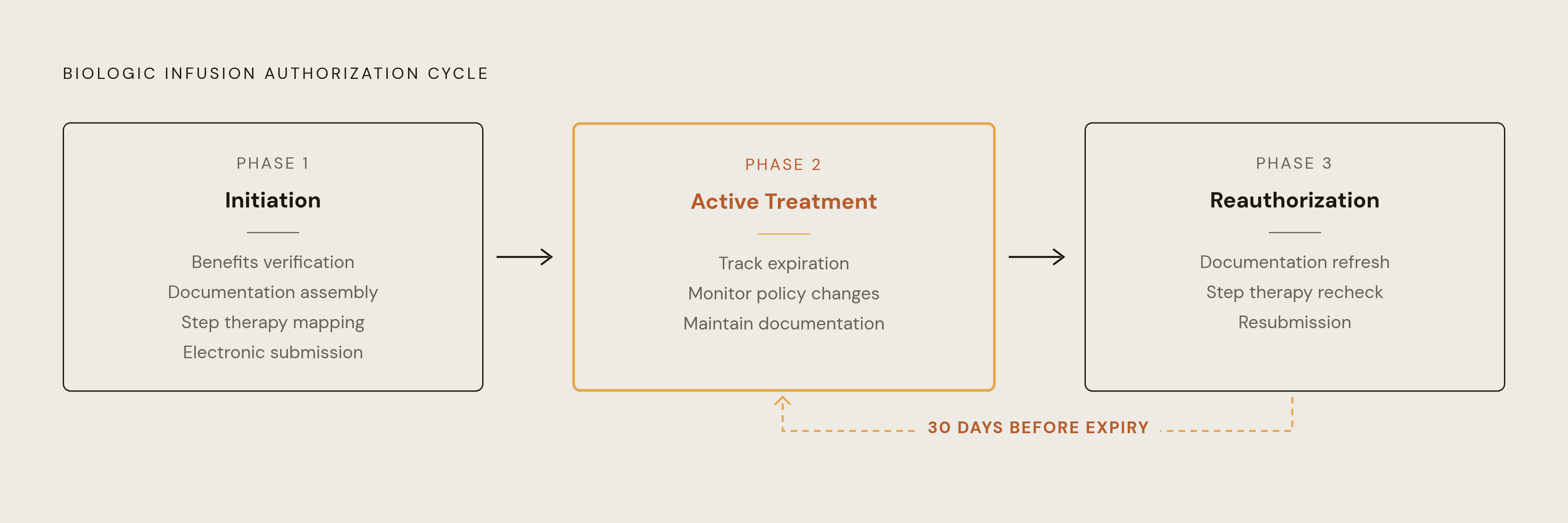
Three phases repeat, over and over, for as long as treatment continues.
Phase 1, initiation, gets set in motion by the prescriber's decision. It covers benefits verification, confirming medical versus pharmacy benefit, assembling documentation, confirming site of care, mapping step therapy requirements, and submitting electronically. Target: submission well ahead of the prescriber's decision date, with a decision in hand before any infusion appointment gets confirmed on the schedule.
Phase 2, active treatment, runs while the authorization is in force. The job shifts to tracking the expiration date against the treatment calendar, watching for any payer policy change that could hit the next cycle, and keeping documentation fresh enough to meet the recency window whenever renewal comes due. Most practices lose their grip here, because nothing urgent is happening, right up until it suddenly is.
Phase 3, reauthorization, kicks off at least 30 days ahead of expiration, never on the expiration date. The documentation refresh, the step therapy recheck, and the submission all happen inside that buffer, and then the cycle rolls straight back into Phase 2 once approval comes through.
Run on a calendar like that, the recurring infusion patient never actually leaves an authorized state. That's the whole point of tying initiation to the treatment cycle instead of the treatment date. There's no gap left for a denial to sneak into.