Why Payer-Specific Denial Patterns Repeat and How to Break the Cycle for Infusion Claims
Identifying payer-specific denial patterns stops infusion claims from failing repeatedly.
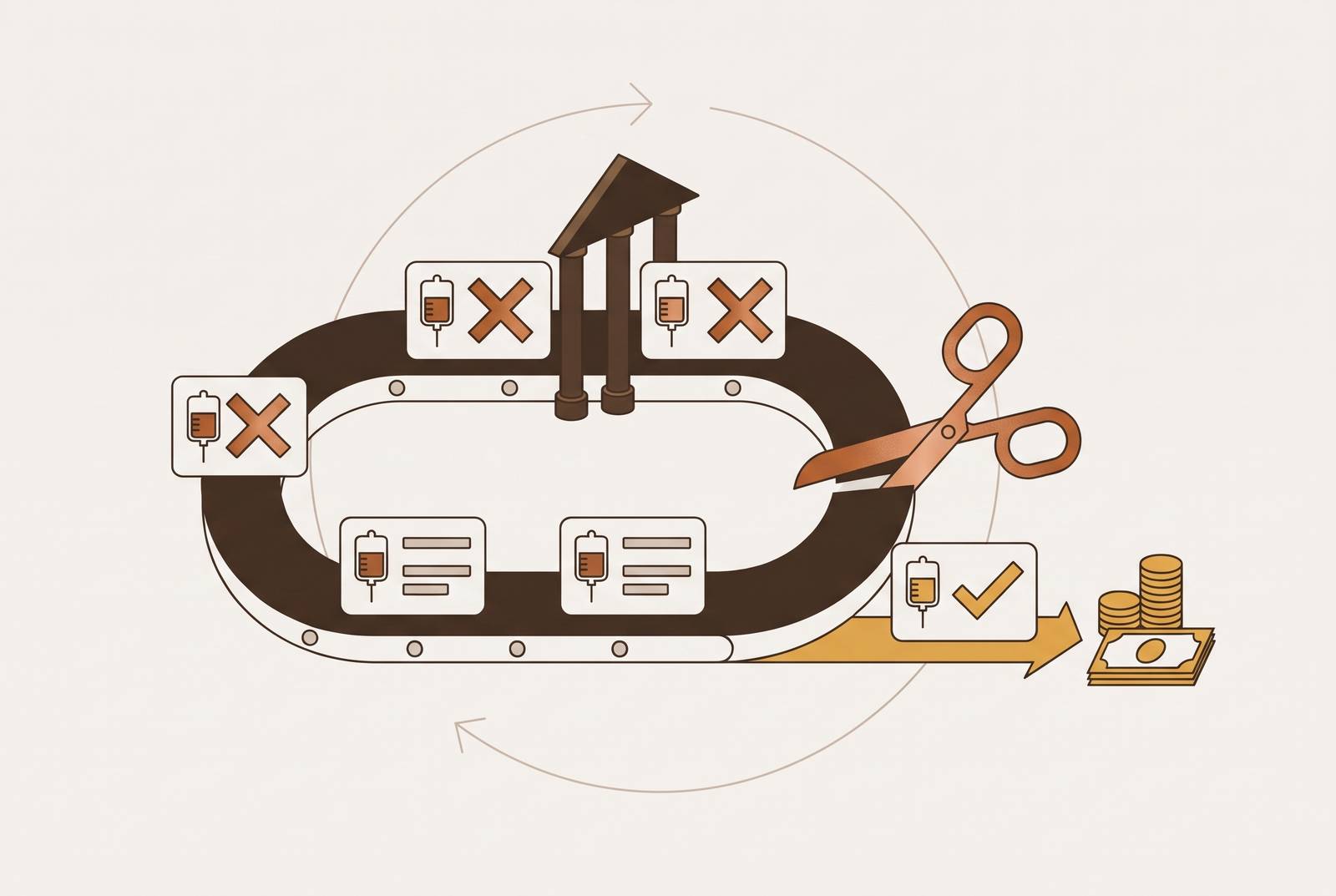
Payer-specific root-cause denial management for infusion claims means tracing each payer’s recurring denials to the authorization, documentation, or coding process that produced them. The way to stop the cycle is to correct that process before the next treatment or claim, along with appealing the last denial. Paid claims need the same close look because payer-specific underpayments can hide in what looks like a successful payment.
Why infusion denial patterns repeat instead of resolving
An infusion denial becomes visible days or weeks after the decision that caused it. By then, treatment may have proceeded under an authorization that no longer matched the plan, or the record may lack the clinical support the payer required. The billing team receives the downstream result of the original problem. That delay separates the people handling the denial from the workflow that created it. When each claim is treated as an isolated billing failure, the same gap stays open for the next visit.
Infusion makes that gap harder to spot. A single visit can involve four or five CPT codes, and a sequencing error, bundling conflict, or drug-unit mismatch can derail an otherwise complete claim. Clinical completeness does not guarantee payment. A payer may also reject a claim even when its coding follows industry guidance. A team judged only on how much denied revenue it recovers can get better at fixing claims while the practice keeps making the same mistakes.
The distinction is between a correction and a cure. Correcting one claim may recover its payment, but it does not update an authorization workflow or change how units are calculated. Those decisions sit earlier in the process.
How each payer's adjudication logic creates its own predictable failure points
Each payer applies its own combination of coverage policies, coding edits, bundling rules, and documentation thresholds. Those combinations produce recognizable failure points. Many non-governmental payers have payment policies that differ from AMA and CMS interpretations, so a claim can follow established coding guidance and still fail a payer’s review. The team therefore needs to identify which requirement this payer applied and where the claim failed to meet it.
At the claim-line level, missing or mismatched NDC numbers, the wrong unit of measure, and incorrect modifiers can trigger different payer edits or recoupments. JW, JZ, Modifier 59, and X-modifiers are not interchangeable details. Their application belongs to the specific billing situation and the payer’s requirements. A recurring modifier edit is a different operational problem from a denial for missing treatment history, even if both appear in the same monthly denial total.
The overall denial rate cannot show whether a payer is rejecting claims over step therapy, clinical documentation, or drug coding. Payer identity alone is not enough either. The signal comes from pairing the payer with the actual failure type, so that repeated outcomes point back to a specific requirement rather than a vague conclusion that an insurer is difficult.
Why prior authorization is the highest-leverage failure point for recurring cycles
Authorization failures drive the majority of repeating infusion denials because approval is often treated as a completed intake task. Treatment does not stay frozen at intake. A course can span weeks or months, while the medication, dosage, frequency, or duration changes. If the authorization does not reflect those changes, a previously approved course can produce a claim that falls outside the approval. The failure is in maintaining coverage through the treatment cycle after the first authorization.
Payer requirements can also change during that interval. Payers update prior authorization lists throughout the year, sometimes without proactively notifying infusion centers. A drug or code that needed no authorization last month may require it now. An outdated checklist can therefore produce denials even when staff follow the checklist exactly.
An approved authorization also has to match the claim. Approval for one CPT code or J-code does not cover a slightly different billed code simply because the clinical intent is the same. Missing treatment history, lab values, or medical necessity support can create another technical failure at submission. Appropriate treatment is not the same as sufficient documentation.
Centers that do this well close that timing gap by making authorization part of clinical work. They check the requirements before scheduling and start re-authorization well before the approval runs out. That approach connects the approval to the treatment being planned, rather than leaving it as a record of what was approved at intake.
How J-code complexity and buy-and-bill structure amplify denial exposure for high-cost biologics
A claim can have a valid authorization and still have drug-billing errors. Buy-and-bill makes those errors especially costly because the practice purchases the drug before the payer has approved or paid for it. A denial can freeze tens of thousands of dollars in drug cost. That is a cash-flow event. The gap between the purchase and reimbursement puts claim-line accuracy directly in the path of recovering the practice’s outlay.
Drug units are a common point of failure. Billing units come from the dose actually administered and the code’s unit definition. Iron sucrose bills per 1 mg, sodium ferric gluconate per 12.5 mg, and iron dextran per 50 mg. Applying the wrong conversion can create overbilling risk or underpayment. Missing or mismatched NDC numbers, or an incorrect NDC unit of measure, can separately cause the billed quantity to fail payer validation.
New biologics add a timing problem to that calculation. A new drug may have no permanent J-code at launch, so it must be billed under NOC or temporary Q-codes. Even after a code is assigned, reimbursement is based on WAC until ASP data catches up, typically two quarters later. Waste reporting adds another requirement. JW and JZ must reflect whether waste exists and whether the payer requires reporting, while missing JW when waste exists can cause underbilling or audit disputes.
These failures sit apart from authorization maintenance. A practice can handle approvals well and still lose payment because its drug-billing process misses code, quantity, or waste requirements.
Why underpayments hide inside remittances that look like paid claims
The same payer-specific pattern can appear as a short payment. A denied claim demands attention, but a paid remittance can be posted and closed even when the amount is wrong. Payment status alone conceals the loss. Without comparison against contracted rates and HCPCS descriptor definitions, repeated underpayments can pass through the revenue cycle as completed work.
The 835 remittance shows what the payer did with each claim line. Its CARC and RARC codes explain adjustment and remark reasons, giving the team a basis for distinguishing a coding problem from another payment issue. The line is the useful unit of analysis. Looking only at the claim total can lead the team to follow up on the wrong cause or hide an adjustment that keeps affecting one drug.
If billing units are derived from vial packaging rather than the HCPCS descriptor, the same faulty conversion can understate payment on every claim for that drug. Each claim still pays something. A denial report will not expose the pattern, and delayed review can allow the audit window to close before the loss is addressed.
Some missing revenue never reaches a remittance at all. Drugs administered but not entered into billing, and add-on infusion time omitted from extended visits, create charge-capture losses. Those omissions explain why neither paid-claim counts nor denial totals provide a complete view of revenue performance.
What AR aging patterns reveal about which denial cycles are still unresolved
AR aging shows where unresolved failures are accumulating. It is more than a collections queue. When older balances are separated by payer, drug class, and denial root cause, they can reveal which authorization, documentation, or coding problems remain active. A single total shows the size of the backlog, leaving the process that keeps replenishing it unidentified.
Drug class adds context that payer totals alone lack. High-cost biologics create a different financial exposure from claims without the same drug outlay, while payer-level detail identifies whose requirements are involved. Details on the root cause then show which failure left the balance unpaid.
Timing changes what that diagnosis can accomplish. Once a claim passes a critical aging threshold, collectibility drops sharply, and some outstanding AR is effectively uncollectible even before it is written off. Exception analytics that flag at-risk claims before they are submitted, along with checks of payer payments against contracted rates, help catch the problem sooner than a general aging review. Aging then provides evidence of which failures have escaped those controls and still need attention.
How operational inconsistency — not payer behavior — sustains the cycle
Payers set complex rules, but how consistently the practice works shapes its response. A new requirement for a high-cost biologic may reach the organization through an email or meeting. That communication is not a workflow change. Unless the requirement reaches intake, benefit verification, authorization, clinical documentation, billing, and follow-up, different staff can keep working from different rules. One coordinator follows the old process, another interprets the update differently, and another never receives it.
Dozens of claims can move through the revenue cycle with small inconsistencies that delay payment. By the time leadership sees the slowdown, the originating gap is weeks old. More work on follow-up alone will not fix that gap.
The effects can also begin before treatment. Inefficient eligibility checks, benefit investigations, clinical reviews, and authorization workflows can hurt referral conversion before any claim exists. Infusion revenue cycle management must protect referrals during intake as well as function as a back-office billing operation.
The practice needs dedicated authorization and revenue cycle teams trained in payer-specific rules, while practice operators need to see where claims stand and how they turn out without managing each one themselves. Automation helps those teams, but experienced operators must make the judgment calls that a rules engine cannot. The change is one of responsibility and coordination.
How do practices stop recurring infusion denials from the same payers?
Before scheduling, benefit verification should cover more than eligibility. It should address site-of-care restrictions, formulary status, and current authorization requirements for the specific drug and diagnosis. This gives the pre-visit workflow the payer-specific detail that a general coverage check misses.
Authorization then needs an owner throughout the treatment cycle. Requirements should be verified before scheduling, re-authorization should start before the current approval expires, and changes in medication, dosage, frequency, or duration should be checked against the active authorization before the next cycle.
Before submission, drug billing needs its own control. The review should check code selection, units based on the administered dose and HCPCS definition, NDC accuracy, and waste reporting against the rules for each drug, beyond the checks used for generic claim fields. This addresses the independent failure layer that remains even when authorization is sound.
After adjudication, the remittance should feed the earlier workflows. CARC and RARC codes, separated by payer and failure type, provide the evidence for deciding which process needs correction. Regular checks of each line against contracted rates and HCPCS definitions should catch underpayments during the remittance cycle, before they are left to an occasional audit. Aging segmented by payer, drug class, and cause then shows where unresolved balances remain.
Software supports the payer-specific and drug-specific workflow, while people handle exceptions and judgment across verification, authorization, submission, payment posting, denials, and AR. Root-cause management succeeds when resolving a denial changes the process before the next affected claim is submitted.