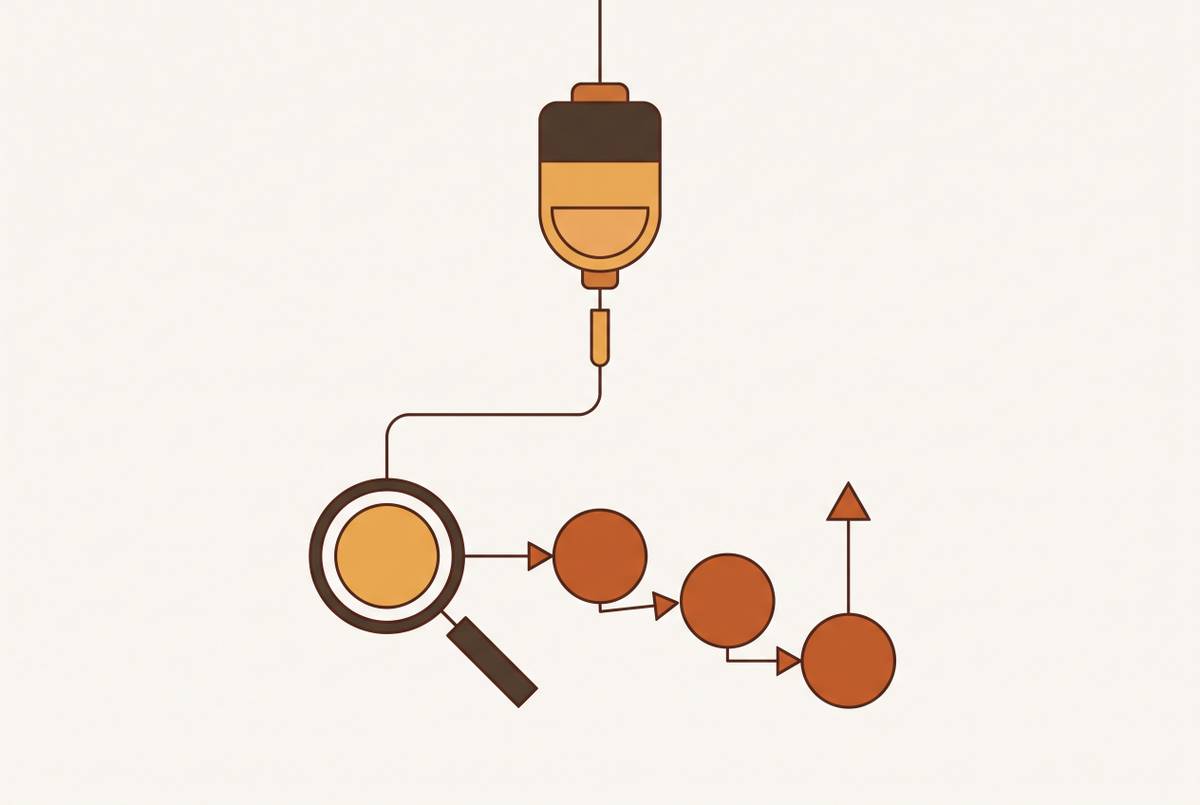
Root-Cause Denial Stratification Beyond CARC and RARC Groupings for Infusion Claims
Infusion denials need root-cause analysis beyond payer codes to fix workflow failures.

Infusion denial management and underpayment recovery require two views of each claim. CARC and RARC codes explain the payer’s decision, while root-cause stratification identifies the workflow failure, its owner, and the change that prevents recurrence. Teams recover more on denied claims when they focus on the payer rule and operational cause, while line-level remittance reconciliation finds losses that denial codes never flag.
Why CARC and RARC codes cannot locate the operational failure in an infusion claim
A payer’s adjustment code records an outcome. CO-16 can surface after a charge entry problem, a clearinghouse problem, or an eligibility failure. The paired RARC narrows the interpretation. It still does not establish which process failed, where the defect should have been caught, or who owns the correction.
X12 defines MA130 as an incomplete or invalid claim that is unprocessable and requires a new claim with corrected information. X12 defines M76 as a missing, incomplete, or invalid diagnosis or condition. Those distinctions guide the claim response, but they do not identify the workflow origin. Classification can also fail before investigation begins. CO-45 represents a contractual adjustment, so counting it as a denial distorts the distribution of fixable failures.
Why infusion claims make this classification gap acutely dangerous
Buy-and-bill practices pay for drugs before they get reimbursement. A denied biologic claim therefore leaves the practice holding an acquisition cost while waiting for service revenue. The exposure is concentrated in each treatment. Because therapies recur over extended cycles, a failure left in place can affect subsequent encounters before the first denial reaches an aging report. Authorization expiration mid-cycle makes that risk especially clear.
Drug configuration errors compound in the same way. If a J-code is defined per 10 mg but the system bills per 1 mg, the error can trigger payer validation failures or recoupment across encounters for that drug. A denial code does not call this a charge master problem. Meanwhile, a paid-but-wrong claim may never enter denial reporting at all. Repeated treatment turns both rejected claims and unnoticed payment shortfalls into a cash-flow problem that individual appeals cannot contain.
What a root-cause stratification layer actually does that CARC grouping cannot
Root-cause stratification adds an operational classification beside the payer’s adjudication classification. The first layer preserves the CARC, RARC, and payer message. The second identifies the event that created the defect, the point where it should have been detected, and the intervention that prevents recurrence. These layers answer different questions about the same claim. Neither replaces the other.
In practice, the workflow begins by translating payer messages into a controlled taxonomy, then examining claim history, documentation, eligibility, authorization, coding, and submission evidence. That evidence identifies the earliest controllable failure point. Responsibility follows that point. Causes are then prioritized by preventable dollars, volume, effort, and recurrence, with a named owner, due date, and post-change measurement. “Payer denied” is an outcome.
The five standard stratification dimensions and why infusion requires a sixth
Standard stratification uses reason code, payer, service line, rendering provider, and coder. The reason code supplies the starting signal, while payer segmentation exposes differences in authorization requirements, modifier preferences, and bundling logic. Service line shows whether workflow failures are local or affect the whole practice. Provider segmentation reveals documentation or prescribing patterns, and coder segmentation helps isolate training gaps or outdated knowledge. Together, these views show concentrations that an organization-wide average conceals.
Infusion requires drug classification as a sixth dimension because billed services can fail to match what the payer authorized by drug. That distinction is not optional detail. A pattern tied to one drug can be lost when every infusion claim is in the same category. Drug classification also exposes configuration-driven failures that follow a product. Without that view, improvement in one payer segment can mask a growing loss in another drug category.
Scheduling and authorization as the upstream origin of most infusion denial clusters
Most infusion denial clusters start at scheduling or authorization intake, before there is a claim. Recurring therapy makes authorization a lifecycle task. Coverage must match the treatment that will actually occur. The CPT code, provider, facility, and service date must align with the authorization, while expiration must be tracked across treatment cycles. By the time CO-197 appears, billing may be handling the consequence of an access-team failure.
Payer policy changes create another upstream source. When a payer adds a drug to its authorization requirements, an authorization matrix that stays unchanged can keep treatments moving ahead under the old rules. The resulting cluster looks like missing authorization, but its source is the payer-monitoring workflow. The preventive response belongs before treatment. Authorization must begin before the cycle, with reauthorization initiated before an expiring approval interrupts it.
The CMS rule changes the operational context without removing that responsibility. The rule addresses authorization speed and transparency. CMS set March 31, 2026, as the deadline for impacted payers’ initial public authorization metrics. Those metrics provide approval rates, denial rates, and turnaround times for benchmarking payer behavior. They do not replace drug-specific requirement tracking.
Infusion-specific coding failures that generic CARC groupings fold into one category
A generic coding category collapses failures with different origins. Selecting the wrong initial service creates hierarchy sequencing problems, while mislabeling sequential infusion as concurrent can collapse billable units. When start or stop times are missing, time-based billing suffers. These defects may originate in charge capture, clinical documentation, or order entry. Grouping them together removes the signal needed to choose the right correction.
Modifier-related losses require the same distinction. Documentation may lack the support for a separately identifiable E&M service on the infusion date, even when the infusion itself pays. Failure to apply JW when reportable waste exists can cause underbilling or audit disputes. Neither pattern is explained well by “coding error.” A template that prompts for times, sequence, and support for a separate service addresses future claims, while an individual appeal addresses only the account already affected. The owner of template governance therefore belongs in the corrective process.
J-code and drug-unit failures as a charge master and pharmacy-reconciliation problem, not a billing error
J-code failures often originate in system configuration or the hand-off from pharmacy to billing. The code’s unit definition sets how much gets billed, so a wrong charge master setting repeats the same error across encounters. Retraining a coder cannot repair that setting. Likewise, when a reference product’s J-code is billed after a biosimilar was given, the team needs to reconcile the product that was used, a task another broad coding reminder cannot do.
Before a claim is sent, the reconciliation process must link the product name, NDC, and J-code. An NDC-to-J-code mismatch can prevent pricing validation, while a discontinued HCPCS code can produce a rejection. These are maintenance and hand-off failures. They require charge master governance and a pharmacy-to-billing checklist, with experienced operators who recognize when a claim-level error points to a system-level defect. Reviewing only the rejected claim leaves the shared source untouched.
Drug reimbursement can also lead to losses when a claim is paid. A new biologic may initially require an NOC code or temporary Q-code, while ASP data typically catches up two to three quarters after launch. That lag creates a margin-compression window. It reinforces why drug classification belongs in the analysis, but it should not be confused with a recoverable billing mistake. Operators need to tell reimbursement conditions apart from configuration errors before they decide what can be fixed.
Underpayments as a denial-equivalent that standard root-cause programs miss entirely
A program built only around denial codes excludes paid-but-wrong claims by design. A remittance can pay less than the contracted amount without generating a denial that opens a recovery workflow. Payment is not proof of billing accuracy. In infusion, drug-unit errors, hierarchy miscalculations, and modifier omissions can produce partial payment. A low denial rate can therefore coexist with systematic revenue loss.
Line-level remittance reconciliation finds these shortfalls by comparing what was paid with the contracted amounts. Its findings belong in the same operational taxonomy as denied claims. The recovery queue is different, but the source may be identical. A short payment tied to one drug’s unit setup needs the same configuration correction as a denial caused by that setup. Without this parallel data source, the practice can close accounts while leaving both recoverable dollars and recurring defects untouched.
Building the stratification taxonomy — mapping denial codes to their operational workflow origin
Scheduling and access is the first operational source category. CO-197, CO-27, CO-22, and CO-109 can prompt investigation of authorization intake, coverage, coordination of benefits, or payer selection. Patient access and scheduling own failures created by missing eligibility checks or intake information, with detection at scheduling before the drug is ordered.
Authorization lifecycle is the second category, with CO-197, CO-50, and CO-15 among its signals. The review checks whether approval covered the right service, facility, and dates, and whether expiration was tracked as treatment repeated. The prior authorization team owns this process. A scheduling hand-off when a cycle approaches expiration supports prevention, while the overlap in codes shows why a lookup table alone cannot assign the cause.
Clinical documentation is the third category. CO-16, CO-50, or CO-167 may lead investigators to missing times, absent sequence information, or insufficient support for the service. The paired RARC helps guide the investigation. Clinical documentation and template governance own defects created in the note, rather than billing inheriting responsibility simply because the remittance exposed them.
Charge capture and coding is the fourth category. CO-4, CO-11, and CO-97 can signal procedure-modifier mismatches, diagnosis-procedure inconsistencies, or bundling issues that require review of hierarchy, charge entry, and coding. The coding team owns defects created there. When evidence instead points to a documentation template, ownership returns to that process.
Pharmacy-to-billing reconciliation is the fifth category. CO-16 and underpayment findings can expose incorrect units, NDC-to-J-code mismatches, product substitutions, outdated codes, or omitted waste reporting. Charge master governance and pharmacy reconciliation own those defects. The same category accepts signals from both remittances and denied claims, allowing the system to surface patterns and operators to determine their actual source.
How do you reduce infusion claim denials through measurement, ownership, and prevention?
The operating model must measure preventable denial dollars by operational cause, recurrence before and after intervention, and the point where each defect is detected. Underpayment recovery dollars need a separate track fed by remittance reconciliation. These measures test different parts of performance. Recovery shows whether the team is dealing with past losses, while recurrence shows whether the workflow fix worked. Earlier detection shows whether control is moving upstream from submission.
Ownership must follow the source of the defect. A unit error in the charge master needs configuration work, a missing prompt in the documentation needs template governance, and authorization requirements that are out of date need payer-policy monitoring. More appeals staff cannot substitute for those changes. Prioritizing operational causes by payer and preventable dollars directs effort toward concentrated losses instead of treating every denial category as equally urgent. Each intervention needs an owner, a due date, and a measured result.
For a practice choosing an operating model, the relevant criteria are infusion-specific pattern detection, line-level remittance reconciliation, and experienced operators who can investigate beyond the code. A general-purpose grouping tool does not supply that judgment. Software can surface a payer-and-drug cluster, but someone must trace it to the failed process and own the correction. The test is whether the denied account gets resolved and the workflow stops producing the same preventable loss.