Root-Cause-Driven Appeal Sequencing for Commercial Payer Underpayment Recovery in Infusion
Identify the specific billing error before appealing to recover underpaid infusion claims.
A payer receives a generic appeal letter restating that a claim was underpaid, with no reference to the actual rule the payer applied when it cut the payment. The letter gets logged, reviewed against nothing in particular, and denied again. This happens constantly in infusion billing because most recovery teams sequence their work by claim age. Each one carries a specific technical cause, and an appeal that does not name that cause gives the payer nothing to act on.
Infusion claims carry several billing elements that all have to line up at once: the CPT administration code, the J-code drug charge, the unit count, the modifiers, and the payer's own routing rules for that claim type. Treating it as generic, and routing it through a generic appeal process, misses the one fact the payer's adjudication system actually responded to.
Age-based queuing makes this worse because it surfaces problems measured against the wrong clock. By the time a claim reaches the 90-day aging bucket, some payer-specific appeal channels have already closed. Sequencing by age treats every dollar in the bucket as equally recoverable and equally understood, when neither is true. Whether a claim can be recovered depends on whether its cause has been identified and whether the clock tied to that specific cause is still running.
Detection challenges in infusion underpayments
Infusion underpayments rarely announce themselves. An underpayment just pays short and moves on, and most practices have no process built to catch that difference.
Infusion centers manage high-cost medications, dense payer requirements, and policies that shift often, and a single underpayment on one of these claims can represent thousands of dollars. Summary-level review answers "did we get paid," not "did we get paid correctly."
The billing record for one infusion encounter has to carry a CPT administration code and a J-code drug charge side by side. Without reconciling both of those, line by line, against the expected contract rate and the correct unit definition, an underpayment on either one stays invisible. A ten-dollar-per-unit shortfall on the drug charge does not register as an error. It appears in the remit as a payment that looks plausible on its face and gets filed away.
High-performing infusion centers catch meaningfully more of these underpayments than the industry average, and the gap has nothing to do with how well their staff write appeal letters. It comes from catching the problem earlier, at the point where the claim data can still be checked line by line against what the contract actually owes. Detection, not appeal writing, is where the recoverable money either gets found or gets lost.
The four root causes that drive the majority of commercial payer infusion underpayments
Most commercial payer infusion underpayments trace back to one of four causes, and each one leaves a different fingerprint in the claim data.
J-code unit miscalculation is the most common and the most structural. Because this error comes from a configuration mismatch rather than a one-off mistake, it tends to repeat across every claim billed for that drug until someone catches it. The evidence needed to appeal it is the dose ordered, the dose administered, the vial size, the NDC, and the payer's own published J-code unit definition.
Contract rate misapplication happens when a payer applies the wrong fee schedule to a claim, such as a non-par rate, an expired rate, or a carve-out rate that should never have applied to that drug. The claim pays without tripping any denial flag, because nothing about the payment looks wrong unless someone checks it against the actual contract. Catching this cause requires line-level reconciliation against the practice's contracted rates, organized by payer and drug class, because nothing in the remit itself announces that the wrong schedule was used.
J-code substitution by payer is a different kind of dispute. The appeal has to establish that the substitution was not permitted, either clinically or contractually. That requires the physician order, the infusion record, the NDC, the payer's substitution policy, and any step therapy or formulary exception already on file.
Modifier disputes come from same-day service billing, where CMS requires modifiers like JW for discarded drug amounts and JZ for claims with no discarded amount, as confirmed in CMS transmittal CR 12067, with the JZ requirement in effect since July 1, 2023 and related claim edits active since October 1, 2023. The evidence needed is the infusion record with exact start and stop times, the waste log, the dose ordered, the dose discarded, and the applicable CMS or payer modifier policy.
These four causes sit inside a broader coding hierarchy that runs from chemotherapy administration down through therapeutic, diagnostic, and hydration services. When that hierarchy gets missequenced on a claim, it compounds whichever of the four root causes is already present, because the wrong administration code can mask or distort the drug charge, the unit count, or the modifier logic beneath it.
Evidence packages by root cause
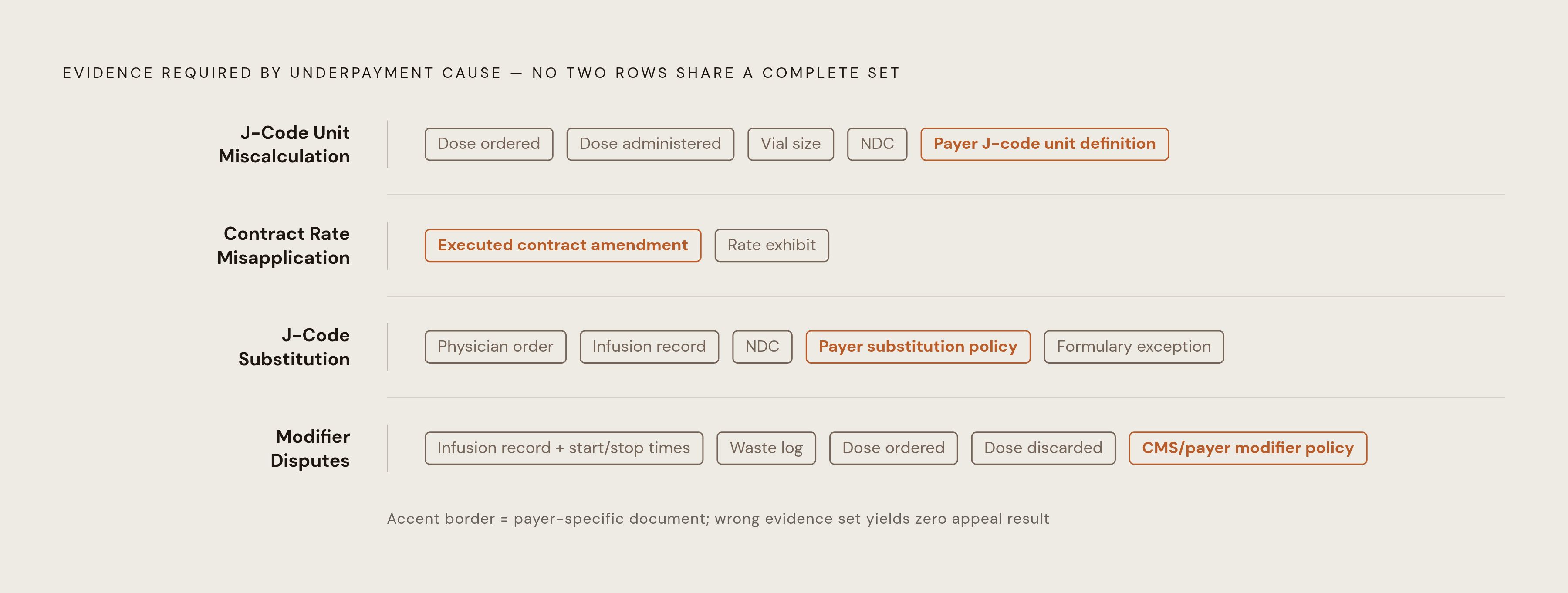
A contract rate dispute appealed with clinical documentation goes nowhere, because the payer reviewer handling that claim type is checking the rate exhibit against the remit, not checking whether the drug was medically necessary. Sending clinical notes instead of the contract amendment leaves the reviewer with nothing to compare against the actual dispute. This is the core reason a single appeal template cannot cover all four root causes: each one engages a different rule inside the payer's adjudication system, and the evidence has to speak that rule's specific language.
Unit miscalculation appeals are arithmetic disputes. Contract rate misapplication appeals are a different animal: a contractual dispute built on the executed agreement and the specific rate exhibit, arguing that the wrong fee schedule got applied and that the remedy is simply the contracted rate. No clinical argument belongs in that letter because the payer isn't disputing the treatment.
J-code substitution appeals require two separate arguments to both land. Winning only one of those arguments loses the appeal, because the payer can deny on whichever point was left unaddressed.
Modifier disputes are reconstruction work. The appeal lives or dies on the encounter timeline and the waste log, built to show that the modifier used accurately described what happened during the infusion and that the payer's reduction isn't supported by its own policy applied to those documented facts.
Technology can scan remits and flag denial or underpayment trends faster than manual review ever could, but it cannot determine on its own whether a given shortfall started at intake, documentation, authorization, coding, or billing. That determination, made by someone who understands the claim's full context, is what turns a flagged trend into an evidence package a payer can actually be forced to respond to.
Escalation path and timing logic by root cause
Even a correctly assembled evidence package fails if it goes through the wrong channel or arrives outside the window that channel allows. Root cause determines both of those things: which door to knock on and how long the practice has to knock.
Filing an underpayment dispute through the wrong channel burns the appeal clock without producing anything reviewable. Aetna's provider manual states that it routes disputes and appeals through Availity and reserves peer-to-peer review for utilization review and coverage determinations. Submit a contract rate dispute through a clinical review path built for medical necessity questions, and the claim sits in a queue that was never built to resolve it.
Timing logic also shifts by cause. Contract rate misapplication appeals need the executed contract amendment in hand before filing. An appeal submitted without that rate exhibit gives the payer a procedural reason to dismiss it, so the better order is: confirm the document, then file fast. Modifier disputes involving JW or JZ waste documentation need the complete waste log before filing; submit early without it and the resulting record is incomplete, and most payers will not offer a second attempt.
Peer-to-peer review deserves its own caution here. A site-of-care underpayment is not a clinical necessity dispute, it is the payer enforcing a location restriction, and routing it through a peer-to-peer clinical channel is a documented misstep. The right appeal instead addresses whether that location restriction is contractually permitted and whether a comparable network alternative actually exists.
Getting this right depends on combining technology with people who know how to read the data and apply it to a specific payer's behavior. The rules differ by payer, change throughout the year, and rarely appear anywhere a rules engine alone would catch them.
Building the sequencing logic: how to prioritize across a backlog of underpayments by cause and recovery probability
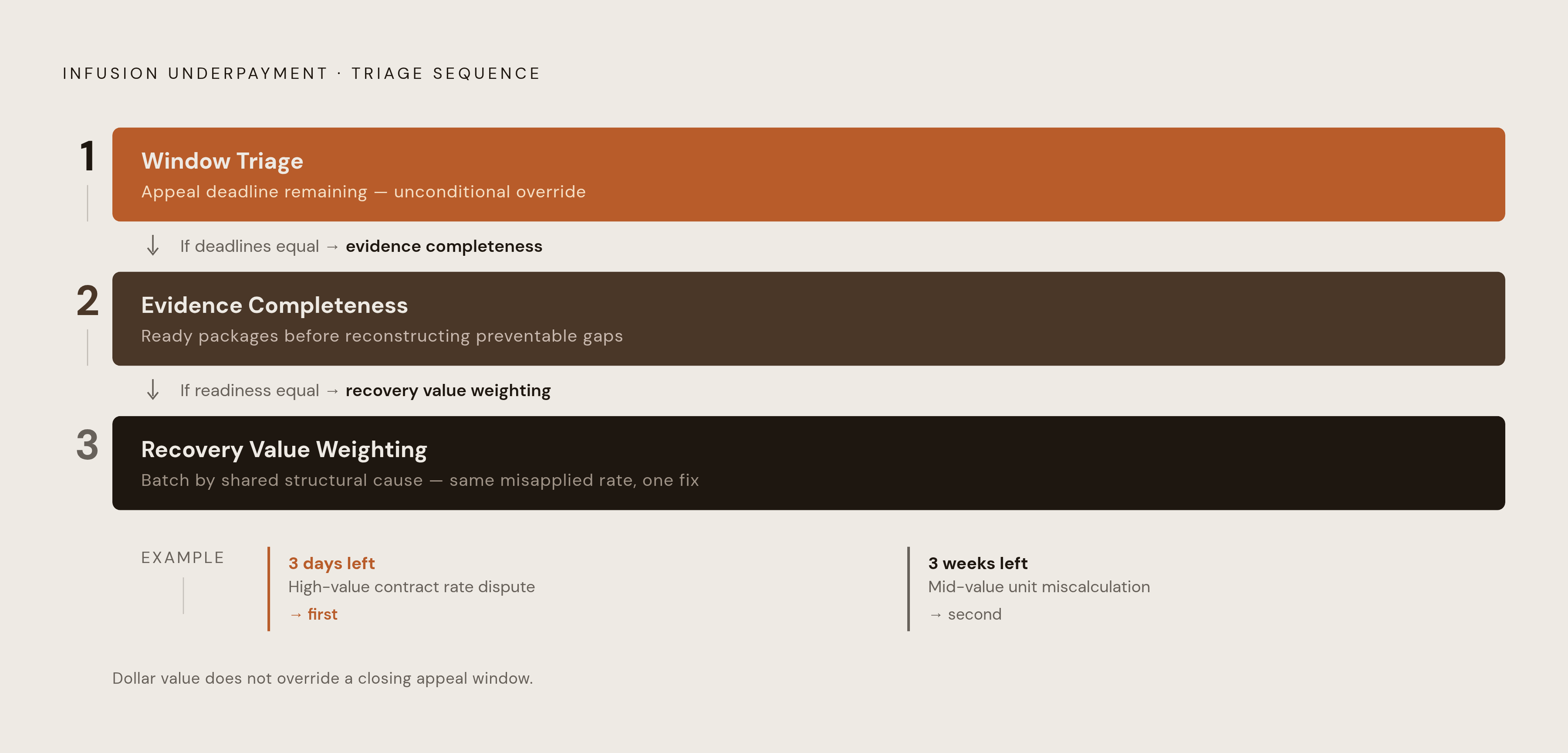
A backlog mapped by cause can be sequenced on three variables at once: how much time is left on the appeal window, how complete the evidence package already is, and how much the claim is worth to recover. Age-based queuing never accounts for any of these together, leaving recoverable money on the table.
Window triage comes first, regardless of dollar amount. A high-value contract rate dispute with three days left on its appeal window takes priority over a mid-value unit miscalculation claim with three weeks remaining, because the first one disappears if it isn't worked now. That requires tracking appeal deadlines by payer and by cause type at the moment the backlog is reviewed, rather than inferring a deadline from how long the claim has been sitting.
Once the window triage is done, evidence completeness decides what gets worked next. Every hour spent reconstructing preventable gaps in documentation is an hour not spent filing a claim that's ready to go, and that math should drive staffing on the backlog, not claim age.
Recovery value weighting adds the third layer. Contract rate misapplication often runs the same way: finding one instance of a misapplied rate under a given payer contract frequently reveals a whole cohort of claims carrying the identical error, which can then be appealed together as a batch.
Pattern detection is what turns this from claim-by-claim recovery into something larger. Denial and underpayment patterns are specific to each payer and each root cause, and reading them that way reveals where the same mistake is repeating across the backlog. Skipping that step lets the team clear the current backlog while the same structural cause keeps feeding new claims into it.
Upstream process failures behind underpayments
Every one of the four root causes starts somewhere upstream of the claim, long before a remit ever shows a shortfall. Finding that starting point is what actually breaks the cycle, rather than just working through it one appeal at a time.
Reimbursement problems begin well before a claim reaches accounts receivable. An incomplete benefit verification, a missed authorization requirement, documentation that falls short of supporting medical necessity, or a payer-specific billing rule that nobody caught before treatment, each of these feeds directly into one of the four downstream causes. A missed authorization requirement, for instance, sets up exactly the kind of substitution or denial dispute that later needs a full evidence package to fix.
Modifier disputes in particular trace back to the documentation workflow at the point of care.
Requirements for root-cause-driven appeal sequencing
Root-cause-driven sequencing is a different operating model that needs cause-level data, current payer rules knowledge, and human judgment that no rules engine supplies on its own.
On the data side, line-level remit reconciliation against contracted rates and J-code unit definitions is the baseline requirement, not summary-level payment posting. Appeal deadlines need to be tracked as their own field, tied to cause type, rather than estimated from how old the claim is, because window-first triage only works if that data is precise.
On the rules side, payer-specific substitution policies, routing requirements, and modifier rules change throughout the year, and a rule missed before treatment can put thousands of dollars at risk before a claim is even generated. Keeping current on distinctions like that, payer by payer, is ongoing operational work, not something set up once and left alone. Denial and underpayment pattern analysis needs that same segmentation, by cause and by payer, since lumping patterns together generically hides the signal needed to both fix current claims and prevent the next batch.
Technology gives visibility into where the problems are. People are what turn that visibility into results, interpreting remit data and payer behavior to make the cause-level calls that drive sequencing, evidence assembly, and escalation timing.
Ruby RCM is built around that same combination: line-level remit reconciliation, infusion-specific payer rules management, and operators with hands-on infusion billing expertise working the claims directly. Infusion centers that treat underpayment detection as a back-office task, reviewing remits at summary level on a weekly or biweekly cycle, consistently miss the narrowing appeal windows tied to each cause. Platforms built for line-level reconciliation against contracted rates catch those underpayments before the window closes, turning what would have been a permanent write-off back into a claim that can still be recovered. The gap between high-performing centers and the industry average isn't a difference in appeal writing skill. It comes from building line-level reconciliation into the workflow itself, matching actual doses and administered units against contract rates and J-code definitions before the claim ages into a bucket where the root cause is harder to prove. Because these four causes cluster by payer and by type, each demanding its own evidence and its own escalation path, appeal sequencing built to diagnose and route claims by what actually caused the underpayment will outperform age-based queuing on both recovery rate and cycle time.