Site-of-Care Denial Defense for Hospital Outpatient Infusion Patients
Hospitals must document medical necessity upfront to survive site-of-care denials.

Site-of-care denials have become one of the fastest-growing denial categories hospital outpatient infusion departments deal with, and the cause is not sloppy paperwork. It comes from federal policy and commercial payer strategy moving in the same direction at the same time, both aimed at the payment premium hospitals have long collected for administering infusions on-site.
Payers reviewing these claims already agree the patient needed the drug. The dispute is narrower and, in a way, harder to fight: where the infusion happened. Medical necessity is not in question. Location is. That distinction changes the whole defense strategy, because arguing "the patient needed this" does nothing against a denial that concedes the point and challenges the setting instead.
CMS supplied one half of the pressure. The 2026 Hospital Outpatient Prospective Payment System rule finalized site-neutral payment for drug administration services delivered in grandfathered off-campus hospital outpatient departments, paying them at rates tied to the Physician Fee Schedule rather than the OPPS rate they used to draw. Those Physician Fee Schedule rates run a fraction of what OPPS paid. Excepted, grandfathered off-campus HOPDs start absorbing the cut in January 2026, and the only carve-out goes to rural sole community hospitals.
Commercial payers supplied the other half. UnitedHealthcare and Aetna have each published site-of-care policies that limit reimbursement for hospital outpatient infusion whenever a cheaper ambulatory option exists and fits the patient clinically. Neither policy leaves room for negotiation on a case-by-case basis anymore. Both spell out defined criteria in writing. A claim either meets the bar or it doesn't.
The financial logic behind both moves is the same. Home infusion costs substantially less than hospital outpatient administration, and that gap now appears directly in Medicare's 2025 payment tables. Payers, public and private alike, are chasing that spread. For a billing team, the practical result is blunt: a claim that would have sailed through two years ago now comes back denied, on the grounds that the same drug, the same dose, and the same patient could have been treated somewhere cheaper. There's no counterargument to raise after the fact. Whatever defense exists has to already be built into the claim before it goes out the door.
How payers construct site-of-care denials
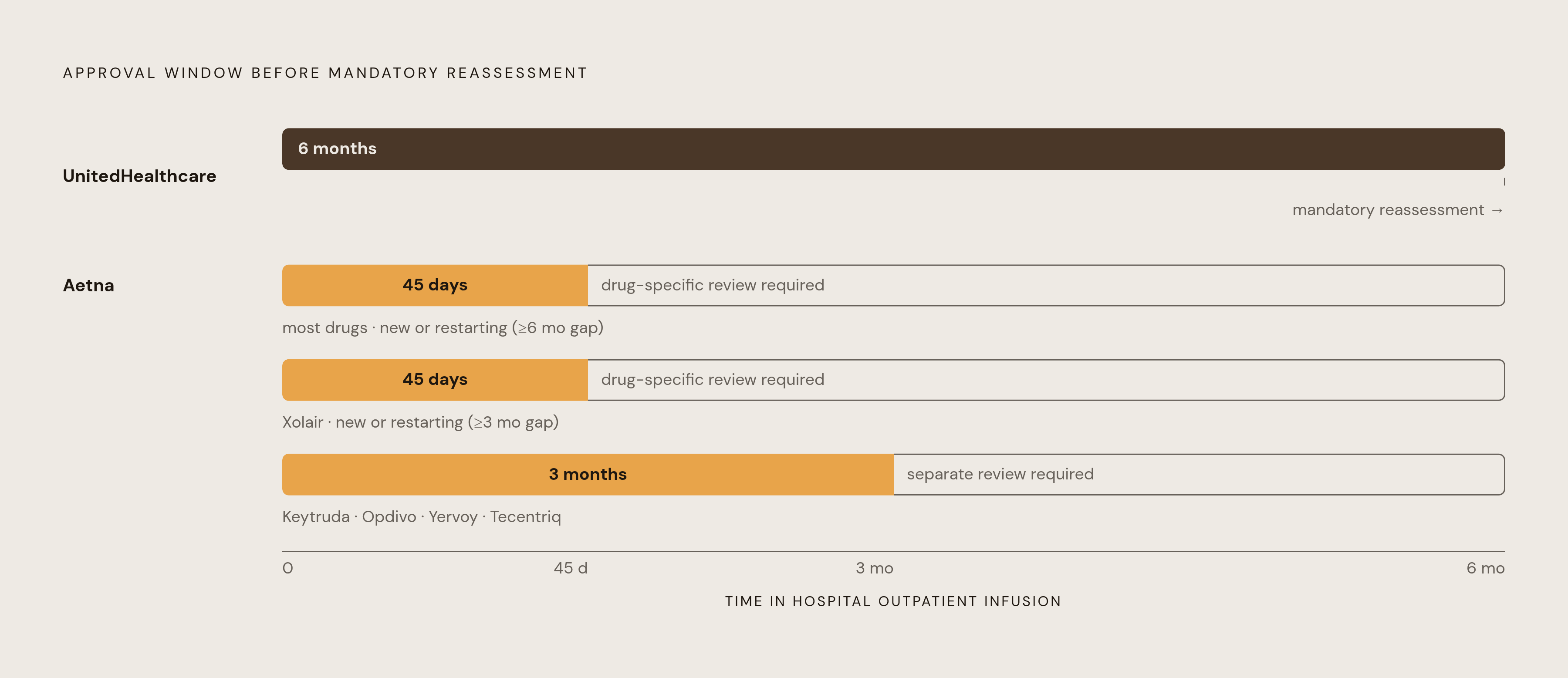
Neither UnitedHealthcare nor Aetna applies site-of-care rules as a blanket restriction. Both publish criteria that vary by drug and by patient circumstance, and a billing team that doesn't know the specific criteria in play has no real way to defend a claim before or after submission.
UnitedHealthcare's policy (Policy Number 2026D0121W, effective September 1, 2026) lays out a defined list of qualifying conditions. Hospital outpatient infusion is covered only if the patient meets at least one: medical instability requiring hospital-only equipment such as an endotracheal tube, chest tube insertion kit, cricothyroidotomy set, or mechanical ventilator; a clinically significant physical or cognitive impairment; a vascular access problem severe enough to need specialized equipment, like ultrasound guidance, only available in a hospital outpatient setting; a prior severe or life-threatening adverse event that didn't respond to standard pre-medications; or initiation or re-initiation of therapy after a gap of more than six months. The policy applies across both on-campus (Place of Service 22) and off-campus (Place of Service 19) hospital outpatient settings, and it names a long list of drugs, including the infliximab products Avsola, Inflectra, Remicade, and Renflexis, along with Entyvio, Ocrevus, Simponi Aria, Benlysta, Orencia, Tepezza, and Vyepti, among others. Even after a patient qualifies, the clock keeps running: UHC caps ongoing hospital outpatient infusion at six months before the patient has to be reassessed for a lower-cost site.
Aetna's policy works on a different structure but lands on the same principle. The first dose of a multi-dose therapy can be given wherever the provider prefers, but every dose after that has to follow the site-of-care policy, which generally pushes treatment toward a non-hospital setting unless medical necessity says otherwise. Hospital outpatient care is allowed for up to 45 days when the patient is new to a therapy, restarting after a gap of at least six months (three months for Xolair), or switching to a drug they haven't taken before. Beyond that threshold, specific approved indications may qualify based on FDA-approved dosing recommendations, but those exceptions are drug-specific and require separate review.
Aetna's medical necessity exceptions cover a fairly wide range: serious adverse reactions that don't respond to standard treatments like acetaminophen, steroids, antihistamines, or fluids; severe events such as anaphylaxis, heart attack, blood clots, or seizures; IgA deficiency with anti-IgA antibodies or the development of anti-drug antibodies; respiratory, cardiac, or renal instability; severe vascular access issues; behavioral, physical, or cognitive challenges when no capable caregiver is available; and patients under 14 receiving Perjeta, trastuzumab, or rituximab. Immune checkpoint inhibitors, including Keytruda, Opdivo, Yervoy, and Tecentriq, get their own carve-out: hospital outpatient approval applies for the first three months of treatment, for patients on a maintenance regimen combined with chemotherapy, or for patients experiencing severe toxicities that require close monitoring. Gene and cellular therapies sit in their own category. Zolgensma, Hemgenix, Casgevy, Lyfgenia, and Elevidys must be given at an Aetna Institutes network location unless the member's health plan has elected not to require it, and this applies to single-dose as well as multi-dose regimens.
None of this leaves much room for interpretation. A reviewer isn't weighing judgment calls. A reviewer is checking a claim's documentation against a published list, and if the list item that would justify hospital administration isn't in the file, the denial follows automatically.
Defending Site-of-Care Claims
Every criterion UnitedHealthcare and Aetna publish is a documentation requirement in disguise. The evidence needed to satisfy it either exists in the chart before treatment starts, or it doesn't exist at all by the time a denial letter shows up. There's no way to go back and add it retroactively.
Prior authorization is the first and best chance to get this right. Getting authorization for hospital outpatient infusion means proving, implicitly, that the patient meets one of the site-of-care criteria. That proof has to be built at intake, when the clinical picture is fresh and the physician's reasoning is easy to capture, not reconstructed weeks later from memory and scattered notes.
Authorization renewal creates a second, recurring exposure point for patients already on therapy. UHC requires reassessment every six months, so a patient who cleared the bar at the start of treatment has to be re-evaluated and re-documented before that window closes. Missing the renewal date results in a denial on an encounter that had already been approved once. That's an avoidable loss, and it happens purely because of timing, not because the patient's clinical picture changed.
CMS has started building infrastructure that makes proactive tracking more realistic than it used to be. New rules require electronic submission of prior authorizations, set ceilings on payer response times, require payers to state a reason when they deny a request, and require published benchmarks on approval rates. None of that removes the burden from the provider side, but it gives revenue cycle teams a way to monitor authorization status before a claim goes out, instead of finding out something lapsed only after a denial lands.
The gap that causes most of these denials isn't a clinical one. Physicians generally know why a given patient needs hospital-level infusion instead of a home or ambulatory setting. The gap sits between that clinical reasoning and the structured, payer-legible documentation an authorization request actually demands. The knowledge is there. It just hasn't been translated into the format the payer's checklist requires, and that translation has to happen before the first infusion, not after a denial forces the issue.
Clinical documentation required to survive a site-of-care challenge
Every qualifying criterion UnitedHealthcare and Aetna publish maps to a specific documentation requirement, and a defense is only as good as what's actually written in the chart. Vague notes lose. Specific ones hold up.
For medical instability and adverse reaction history, UHC wants the specific cardiopulmonary condition spelled out, along with its direct connection to infusion risk, or the renal instability and fluid tolerance problem described in clinical terms. A diagnosis code alone doesn't cut it. The reasoning that ties the condition to a need for hospital-level equipment has to appear in the notes themselves. Aetna asks for something similarly precise on prior reactions: what the reaction was, what treatments were tried, and why those treatments failed to resolve it. Anaphylaxis, seizures, and heart attacks specifically have to be documented as happening during or right after administration to satisfy the policy language, though blood clots are listed separately without that same timing requirement.
Antibody development and IgA deficiency cases need lab confirmation, not clinical suspicion. Both payers treat anti-drug antibodies and IgA deficiency with anti-IgA antibodies as qualifying conditions, but only when a lab result backs it up. A physician's note saying the patient "may be developing antibodies" won't satisfy either policy.
Vascular access documentation trips up more claims than it should. Both payers require proof that the patient's vascular access problem needs equipment only available in a hospital outpatient setting, such as ultrasound guidance under UHC's policy. Noting that a patient has a port or a PICC line isn't enough on its own. The chart must document the specific access problem and link it to equipment or resources only a hospital outpatient setting provides.
Cognitive or physical impairment claims carry a two-part test under Aetna's policy: serious behavioral, physical, or cognitive challenges, and the absence of a capable caregiver. Both elements need to appear in the chart. Impairment alone, without an assessment of caregiver availability, doesn't meet the bar.
New-to-therapy and re-initiation windows are easy to satisfy on paper but easy to lose on a technicality. Both payers automatically permit hospital outpatient infusion for a defined period at initiation or re-initiation after a gap, but the start date and the length of the gap have to be documented and verifiable in the authorization submission itself. An undocumented re-initiation simply won't be recognized as qualifying, no matter how clinically obvious it is.
Nursing documentation carries more weight than most departments assume. MedLearn's 2026 infusion compliance update flags start and stop times, physician orders, and nursing notes as the specific elements payers scrutinize. A missing stop time doesn't just look sloppy. It undermines the billing code selection directly and gives an auditor an obvious opening. Hydration therapy and prolonged infusions get the same scrutiny, and MedLearn names both as top audit targets for 2026. Medical necessity for these has to appear in the record as actual clinical indications, not just a standing order, and time-based coding needs documented time increments rather than rounded estimates.
J-Code and Billing Unit Errors
Clearing the site-of-care hurdle doesn't mean the claim is safe. A separate layer of risk sits in J-code accuracy and unit reporting, and because biologic drug costs per encounter can run into the tens of thousands of dollars, a coding mistake here is a cash-flow event. It's a cash-flow event.
HCPCS Level II code accuracy remains one of the top reasons claims get rejected or delayed in 2026. The code list itself changed this year, with new codes added and older ones deleted. Using a deleted code triggers an immediate denial, and sticking with an outdated general code instead of a newer, more specific one raises audit risk even when the claim technically pays.
Unit-level errors cause just as much damage, and they cut in both directions. Erroneous billing units rank among the most common causes of outpatient J-code denials. Undercount the units and the loss compounds silently across every high-volume drug line in the department. Overcount them, and the exposure flips into overpayment liability and potential OIG audit attention.
Biologic therapies for autoimmune disease draw the sharpest scrutiny because of their per-unit cost. Infliximab (J1745) and other monoclonal antibodies sit at the top of that list, and payers watch unit reporting on these drugs closely enough that improper reporting can trigger both a payment recovery and a formal audit.
Time-based coding adds one more failure point. Choosing "initial" instead of "subsequent" incorrectly, missing a stop time, or failing to report drug waste can turn a high-value encounter into a drawn-out cycle of edits and appeals. Payers in 2026 have tightened enforcement on time-based coding hierarchy, modifier integrity, and drug unit accuracy across the board.
Buy-and-bill infusion carries an especially unforgiving version of this risk. If a buy-and-bill claim gets denied, the facility is left holding the full acquisition cost of the drug with no reimbursement coming back. Once the drug has been administered, there's no fallback position left to negotiate from.
How underpayments from site-of-care claims become permanent losses
A claim can pass the site-of-care review, carry the correct J-codes, report the right units, and still come back underpaid. Payers use proprietary fee schedules, fixed percentages of ASP, or AWP baselines that don't always line up with the contracted rate, and that shortfall is visible only when someone checks the remittance line by line.
Commercial payers commonly apply a fixed percentage of ASP or an AWP baseline when pricing biologics. If that calculation reflects a lower-cost site rate on a claim that should have paid at the contracted hospital outpatient rate, the shortfall functions as a site-of-care denial in every way that matters, even though no formal denial was ever issued. It just looks like a smaller check.
CMS keeps refining how ASP data gets collected and adjusted, and any discrepancy in how a facility documents its drug acquisition costs opens the door to a retrospective adjustment down the line. Keeping accurate acquisition cost records and ASP billing documentation is a compliance obligation that protects against both the underpayment happening in the first place and a payer clawing back money later on the grounds that the original pricing basis was wrong.
None of this gets caught by a system that only reacts to outright denials. Underpayments don't generate a rejection letter or a flag in most billing systems. They arrive quietly, as a check for less than what the contract says the hospital is owed, and unless someone reconciles that line against the contracted rate, the money is simply gone. A denial at least announces itself, but an underpayment stays silent, and that silence is what makes it permanent.
Sources
- Hospital Outpatient Infusion Services: 2026 Reimbursement & Compliance Update – MedLearn Publishing
- Site of Care Denials and How Payers Are Shifting Reimbursement Rules - MDaudit
- Drug infusion/injection site-of-care policy
- Provider Administered Drugs – Site of Care Page 1 of 13
- Site of Care Optimization: How Payors Are Reshaping Infusion Delivery and What Hospitals Can Do About It - Frier Levitt Site of Care Optimization: How Payors Are Shifting Infusion Services and What Hospitals Can Do