Root Cause Categories for Infusion Claim Denials
Infusion denials cluster into five root causes that reactive billing approaches consistently miss.
Root Cause Categories for Infusion Claim Denials.
Why infusion denials are not the same as general billing denials
Denials are climbing across the board. The initial denial rate industry-wide is 11.8%, and it runs higher for Medicare Advantage, Medicaid, and ACA marketplace plans Experian Health 2025 State of Claims Report OS Healthcare, 2026. Most of that revenue never comes back either: 65% of denied claims are never reworked at all, according to MGMA. The money attached to them is simply gone MGMA.
Infusion sits on top of all that as a harder case. High drug costs, complex authorization requirements, unit-sensitive J-code billing, and recurring treatment cycles compound the financial exposure of each denial. A denied biologic infusion is tens of thousands of dollars in drug cost sitting in limbo, a cash-flow event rather than a line item that needs correcting.
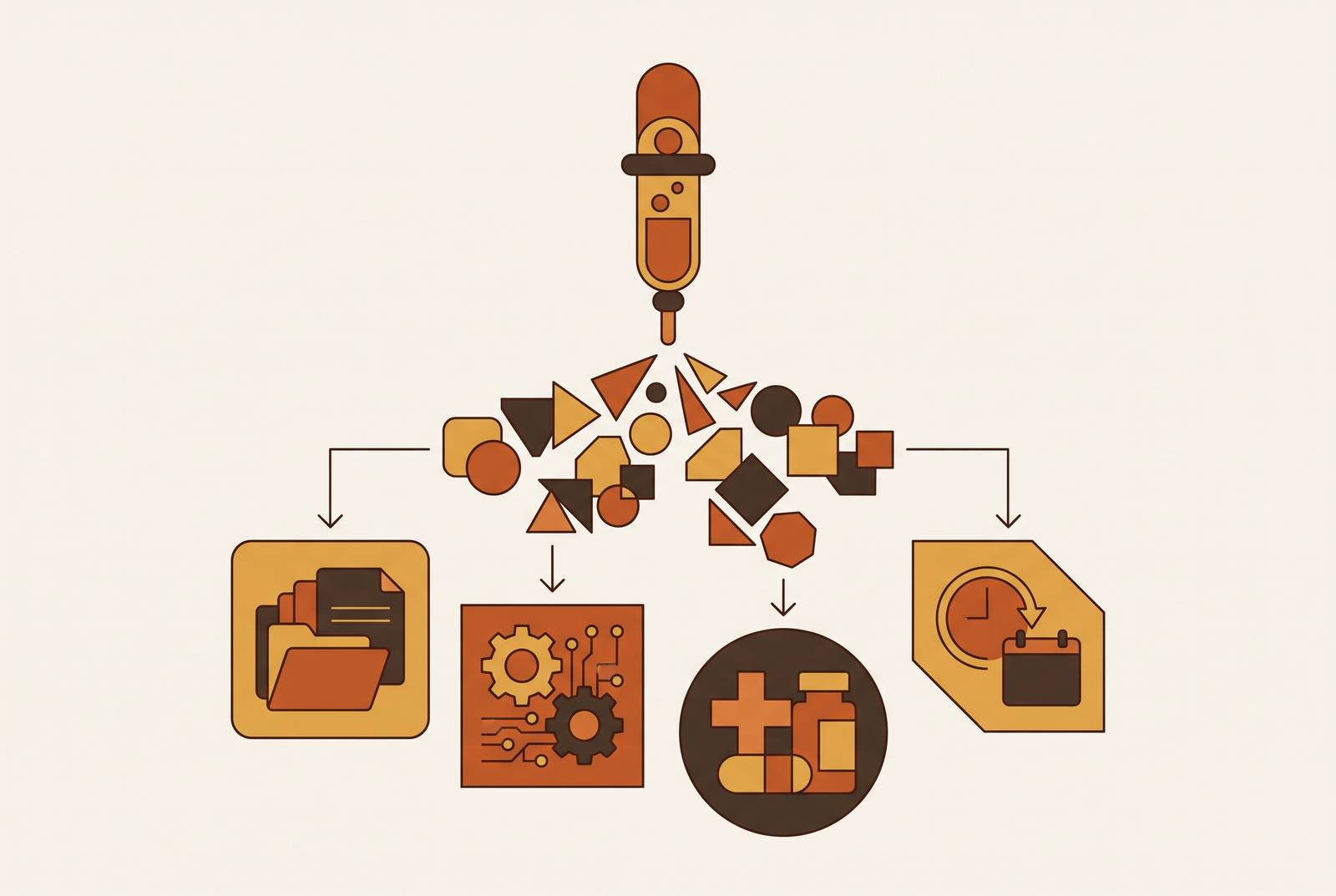
Most infusion practices still treat denials as one big pile to work through. Claim comes back, staff member picks it up, staff member fixes what looks wrong, claim goes back out. That approach misses the pattern sitting underneath the pile. Denials in infusion billing cluster into five root cause categories: authorization failures, eligibility gaps, J-code and coding errors, medical necessity deficiencies, and timely filing lapses. Treating them as one undifferentiated mass keeps practices from seeing the upstream point where each category actually starts. 41% of providers now report more than 10% of claims denied, up from 30% in 2022 and 38% in 2024, per Experian Health's 2025 State of Claims Report Experian Health 2025 State of Claims Report billingparadise.com Experian Health, 2025.
Why working denials reactively is structurally different from stopping them upstream
Not all denials are created equal, and the first distinction that matters is soft versus hard. A soft denial can be corrected and resubmitted. A hard denial is final, with no appeal path that leads anywhere. Treat both the same way and the practice ends up with the wrong response to both: chasing recoverable claims too slowly while unrecoverable ones drain the practice in silence.
Toyota's production engineers built a discipline around this exact problem decades ago, and it still applies here word for word: ask why five times, define the specific failure precisely, and follow only the evidence in front of you, not a hunch about what's probably going on. Applied to infusion billing, a prior authorization denial is a scheduling problem that was seeded long before the claim ever reached a biller's desk.
Walk the chain. Claim denied for missing prior auth. Why? Staff didn't obtain the authorization. Why? No one flagged the procedure as requiring one. Why? Scheduling and billing systems don't share authorization requirement data. The fix that actually holds isn't a reminder email to staff, it's rebuilding the scheduling workflow so authorization requirements surface automatically before the appointment is even confirmed.
That kind of fix costs something up front, but so does the alternative. Rework runs anywhere from $25 to $181 per denial depending on complexity, and for a high-volume infusion operation, that adds up to real operational drag before anyone counts the revenue that's permanently lost OS Inc. analysis qualigenix.com. Every category that follows has its own version of this same lesson: a fix that's invisible until the category is isolated from the general denial pile.
Authorization failures: the most expensive denial category in infusion billing
Prior authorization denials climbed to around 31% in 2026, and specialty infusion and biologics account for much of that growth, which makes sense given how much money payers have riding on scrutinizing these claims closely rcmworkshop.com. A KFF analysis of CMS data found that Medicare Advantage insurers fully or partially denied 4.1 million prior authorization requests in 2024 alone. In the AMA's survey of 1,000 physicians, 74% said prior auth denials have increased over the past five years, and 60% said they're worried payer use of AI is already making the problem worse AMA 2025 prior authorization survey.
Infusion carries authorization risk that general billing doesn't. Any deviation in medication, dosage, frequency, or duration from what was actually authorized can trigger a denial, since the authorization has to match the delivered treatment exactly, not approximately. Requirements also vary payer to payer and plan to plan, both in what's required and in how it gets submitted. Recurring treatment cycles add expiration risk on top of that: a lapse between authorization periods reads as an authorization failure, not a documentation slip, and it stops payment cold.
Step therapy rules stack another layer on. UnitedHealthcare, effective January 1, 2026, now requires prior authorization for medications in its Medicare Advantage Part B step therapy program, and members already mid-treatment faced new transition requirements as a result. Site-of-care policies do something similar: payers increasingly want high-cost infusible therapies delivered in lower-cost settings, and an authorization secured for one site doesn't automatically carry over if the patient moves to another.
A lot of these denials aren't clinical judgment calls either. Requests submitted without treatment history, lab values, or proper necessity documentation get denied on technical grounds, whether or not the underlying treatment decision was sound. That's where the real opportunity sits: only a small share of denied Medicare Advantage prior auth requests were ever appealed, per KFF and CMS data, yet a large majority of the appeals that did go forward were partially or fully overturned. Every practice not appealing routinely is leaving preventable, permanent revenue on the table.
None of this gets fixed at the claim submission stage. Authorization management has to start at scheduling, with unified tracking of how long each payer takes to turn requests around, first-time denial rates by therapeutic, and appeal outcomes broken out the same way. Without that tracking, the practice keeps rediscovering the same failure one denial at a time. Infusion-specific PA complications not present in general billing.
Eligibility and intake failures: the administrative denials that shouldn't exist
Experian Health's State of Claims data found that 26% of respondents traced at least one in ten of their denials back to intake errors, things like wrong policy numbers, outdated insurance cards, or missed eligibility rechecks Experian Health 2025 State of Claims aegishealth.us.
The failure modes are almost mundane, which is exactly the problem. Patient not covered on the date of service. Wrong plan billed. A demographic mismatch that triggers an identity rejection. A missing or incorrect referring provider NPI. Coordination of benefits that never got updated. None of these require a complicated explanation. They require someone to check something that wasn't checked.
Infusion makes this worse because of the calendar. Patients on recurring treatment schedules can have their coverage change between sessions, and an eligibility check that was accurate at intake can be stale by the third or fourth cycle. A verification done once at the start of care isn't a verification that holds for months.
Technically, these are soft denials. Correctable, resubmittable, recoverable. But the volume itself becomes the cost: staff time spent reworking claims that never should have gone out wrong in the first place, and cash flow delayed even on claims that eventually get paid. The claim was broken before any clinical documentation was even written.
The fix doesn't require new technology or a big process overhaul. Eligibility verification before every single encounter, mandatory rechecks built into recurring patient schedules, and a workflow gate that refuses to let scheduling get confirmed without coverage confirmation first. Simple, and high-return precisely because the failure modes it prevents are so avoidable. Eligibility and registration errors represent the largest share of denials, estimated at 27%–40% of all denials, per industry denial management studies cited in Practolytics (2025–2026). CARC CO-22 (coordination of benefits) and CO-18 (duplicate claim) often trace back to intake workflow failures rather than billing errors (the problem was seeded before any clinical documentation was created).
J-code and CPT coding errors: where infusion billing complexity concentrates
The code environment itself is enormous and moving constantly. As of 2026 there are 1,200 active J-codes, with 160 new HCPCS Level II codes added this year and 101 deleted billingparadise.com orcm.us medcaremso.com. CMS rejects claims submitted with discontinued HCPCS codes automatically at submission. That's an immediate bounce.
Outpatient coding denials rose 26% from 2024 to 2025, and a good share of that traces to front-end errors at intake or charge capture, not deep coding mistakes Experian Health 2025 State of Claims aegishealth.us. Medication-related denials now account for close to 20% of outpatient claim rejections nationwide, and infusion and injectable drug services sit among the highest-risk categories under Medicare Part B oversight 247medicalbillingservices.com.
Units are where a lot of this concentrates. CMS data found more than 14% of outpatient J-code denials came down to erroneous billing units CMS statistics Q1 2025. The mechanism is subtle but consistent: billers calculate units off vial packaging instead of the HCPCS descriptor definition, and the resulting milligram conversion error creates both overbilling and underpayment risk in the same motion.
Pairing errors add another failure surface specific to infusion. Mismatched administration paths, an intravenous J-code paired with a subcutaneous injection CPT code, are one common version. Unit redundancy is another: multiplying CPT administration units based on drug milligrams under the J-code, when CPT units actually track time, or initial versus sequential access, not drug volume at all. One wrong "initial" versus "subsequent" selection, one missing stop time, one unreported drug waste entry, and a high-value encounter flips into a denial and weeks of appeal work.
Drug waste reporting through the JW and JZ modifiers has gotten stricter since late 2023, and single-dose drugs now carry more audit exposure when waste isn't reported correctly. NDC and ASP mismatches round it out: CMS has tightened enforcement around product-specific J-codes and quarterly pricing validation. None of this is generic coding competency. It calls for quarterly charge master updates, pre-submission scrubbing against NCCI edit tables, and billing staff who know infusion coding specifically, not coding in general. J-code and CPT pairing errors specific to infusion. Most commonly affected CPT codes: 96360, 96361, 96365, 96366, 96367, 96368, and chemotherapy administration codes in the 96401–96549 range, these are the revenue-generating codes tied to chair time.
Medical necessity deficiencies: the documentation denials that are hardest to overturn
CMS's FY 2025 improper payments report put $28.83 billion in Medicare fee-for-service payments in the improper category, a 6.55% improper payment rate, and insufficient documentation topped the list of causes. The dollar amount denied specifically for medical necessity and requests for information rose 70% from 2024 to 2025 MDaudit data. This is one of the biggest exposures on the books.
Infusion carries its own version of this risk. Payers want evidence that less invasive alternatives were tried before infusion therapy started, and step therapy documentation functions as a prerequisite. Without a clear record of why infusion was the right call clinically, a claim can be denied on policy grounds even when the treatment decision itself was completely sound. Physician orders, progress notes, and infusion therapy records all have to be present and have to agree with each other. Missing even one creates denial risk on a claim that was clinically appropriate from the start.
CO-50 covers medical necessity outright. CO-16, paired with the remark code MA-130 for incomplete or invalid claim information, is something closer to a catch-all. That pairing is what makes CO-16 dangerous: without reading the RARC attached to it, a biller has no way to know if the real issue is authorization, documentation, or a missing modifier, and guessing wrong means the appeal fails too.
This is also the category getting harder to fight, not easier. Payer AI systems now review documentation at scale and flag gaps faster than any manual review process can match, and 60% of physicians surveyed by the AMA in 2025 said they're concerned payer AI is already accelerating the problem AMA 2025 prior authorization survey. Documentation built after the fact, assembled once a denial notice arrives, is documentation built too late. It has to live inside the clinical workflow before treatment happens, because by the time an appeal is due, the window for meaningfully improving the record has usually already closed.
Timely filing lapses: the denial category with no recovery path
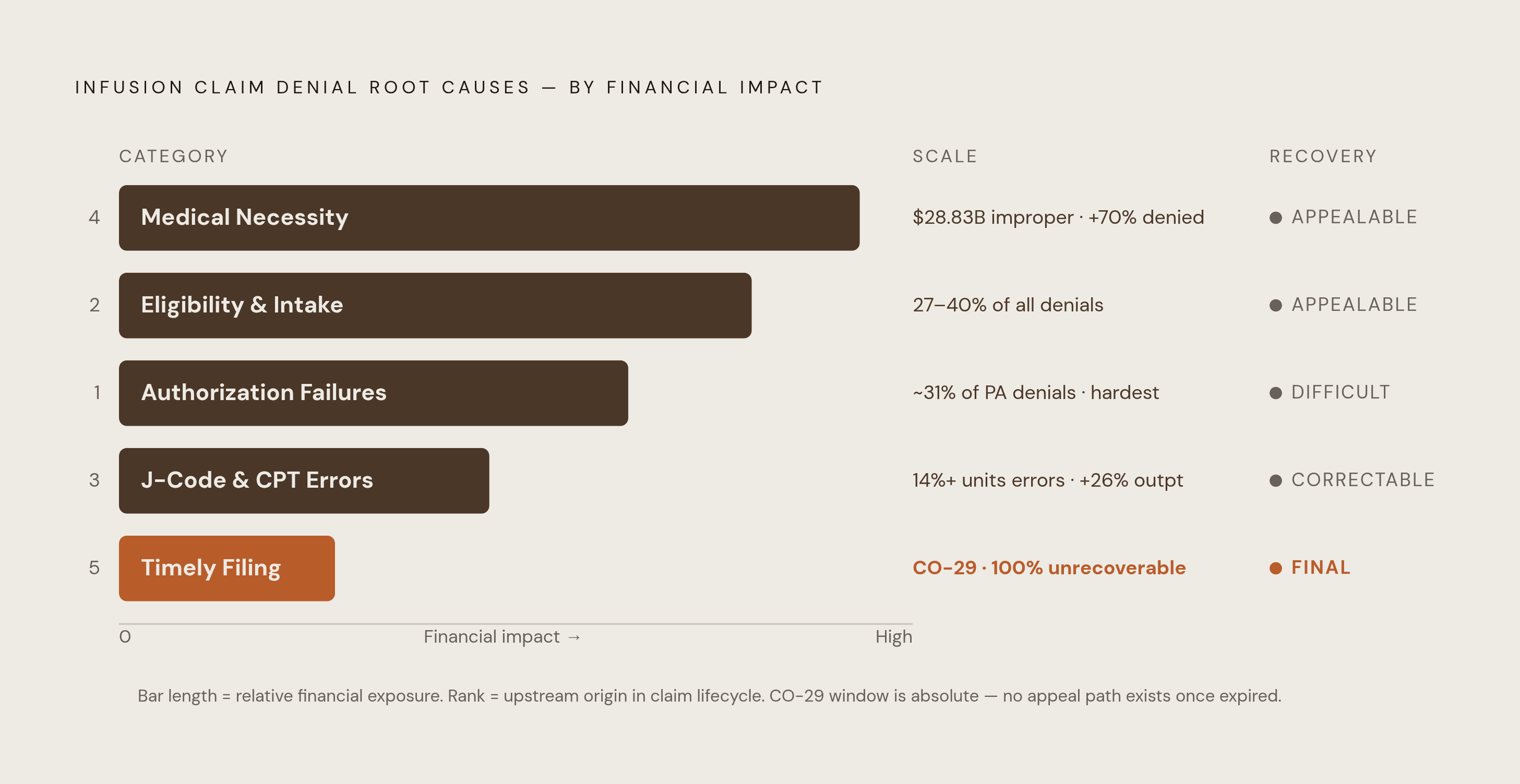
Timely filing denials, coded CO-29, are the cleanest hard denial there is. Once the filing window and the appeal window both close, there's no path back, and every dollar attached to that claim is gone for good.
Infusion's recurring cycles create a specific kind of timing exposure. A billing backlog that builds up mid-cycle can push several claims past the filing deadline all at once, not just one. Authorization delays compress the timeline from the other direction: if getting the authorization takes weeks and billing doesn't start until it's confirmed, the real filing window ends up shorter than the payer's stated deadline, even though nothing on paper looks late yet. Coordination of benefits disputes add a third path, delaying the primary payer's adjudication, which delays secondary billing, and secondary payers run their own filing clocks independent of the primary payer's timeline.
Timely filing isn't the biggest denial category by volume. Eligibility failures and authorization failures both outweigh it in raw share. But volume isn't the danger here, finality is. A claim in the CO-29 bucket has no second act, which makes prevention the only lever that matters: filing deadline calendars maintained payer by payer, claims entering the billing workflow immediately after the encounter instead of once things settle down, and authorization delays never treated as an excuse to delay claim preparation in parallel. A practice that sees timely filing denials in its data is looking at a downstream symptom, produced by failures upstream in scheduling, authorization tracking, and charge capture, never in the billing queue itself.
How the five categories interact and compound in a single infusion claim
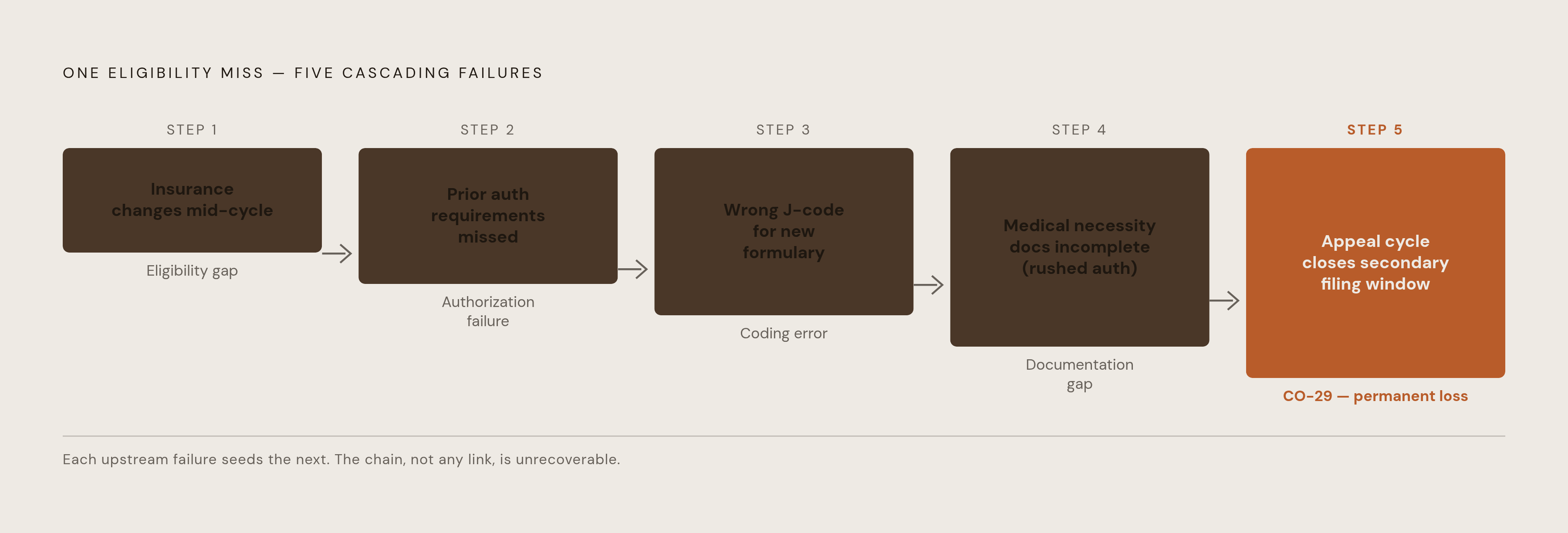
These categories rarely occur alone. A realistic version looks like this: a patient's insurance changes between infusion cycles, an eligibility gap. The new plan carries different prior auth requirements the practice doesn't catch in time, an authorization failure. Billing submits using the prior plan's J-code structure, which doesn't match the new plan's formulary rules, a coding error. The rushed new authorization means the medical necessity documentation behind it is incomplete, a documentation gap. And the resulting denial and appeal cycle eats up enough time that the claim misses the secondary payer's filing deadline, a timely filing loss, permanent this time.
One claim, five failure points, each one triggered by the one before it. Grouping all five into a single "denials" bucket is the wrong instinct. It hides the signal a practice actually needs to intervene at the right stage instead of the last one.
Payer behavior is making this faster, not slower. Commercial insurers and Medicare Advantage plans increasingly run claim review through AI tools at scale. Several failure modes can trigger denials simultaneously, faster than any manual correction process can keep up with. Regulation is shifting under this too: the CMS Interoperability and Prior Authorization Final Rule (CMS-0057-F) is tightening requirements that touch both the authorization category and the documentation category at once, and practices still running PA workflows built for the old transparency and response-time standards are stacking new exposure on top of what they already carry.
Pattern recognition becomes visible once the data is broken apart by category. Which payer generates the most authorization denials. Which codes generate the most unit errors. Which treatment protocols draw the most medical necessity challenges. These are payer-specific and protocol-specific signals, and an aggregated denial report buries every one of them under an average that means nothing operationally.
What categorical denial tracking requires from the operating model
Tracking denials by root cause instead of by volume changes what a billing team actually does day to day. It means the authorization team owns turnaround-time and appeal-rate metrics broken out by payer and therapeutic, distinct from a general "denial rate" that blends approvals delayed for a week in with claims that never had a chance. It means intake owns eligibility recheck compliance on recurring schedules as its own tracked number, separate from coding accuracy, separate from documentation completeness.
It also means accepting that the categories call for different people solving different problems. A coding fix belongs to whoever owns the charge master and the quarterly HCPCS update cycle. A medical necessity fix belongs to whoever builds documentation into the clinical workflow before treatment starts, not after a denial notice shows up. A timely filing fix belongs to whoever owns the scheduling-to-billing handoff, since that's where the clock actually starts running.
None of this works as a single denial-management function trying to touch every category with the same process. The categories don't share a root cause, so they can't share a fix. What they share is a starting point: they all get missed the moment a practice treats denials as one problem instead of five.