Peer-to-Peer Review Request Process for Infusion Denials
A peer-to-peer call can overturn infusion denials faster than written appeals.
Infusion claims get denied more, and the denials cost more, than almost any other category of medical billing. Infusion claims get denied more, and the denials cost more, than almost any other category of medical billing because high-cost drugs, recurring treatment cycles, site-of-care disputes, and thick medical necessity criteria all put them at the top of every payer's review pile. High-cost drugs, recurring treatment cycles, site-of-care disputes, and thick medical necessity criteria all put infusion claims at the top of every payer's review pile. Claim denials climbed from 30% in 2022 to 38% in 2024, and kept rising, climbing over 11% further into 2025. Prior authorization denials on their own hit around 35% in 2025.
For an infusion practice running buy-and-bill, that's not an abstract trend line. The practice buys the drug first, often somewhere between $5,000 and $50,000 a dose, and bills the payer after. If the claim gets denied, there's no reimbursement coming and the acquisition cost is already spent. That's a cash-flow emergency, and it can happen on a Tuesday afternoon with a drug already infused into a patient sitting in the chair.
Most of these denials trace back to a small set of causes. Prior authorization mismatches, where what was approved doesn't line up with what was billed. Drug-to-diagnosis inconsistencies, where the diagnosis code doesn't match what the payer's policy allows for that drug. Eligibility lapses. And step-therapy requirements the payer insists weren't met, even when the chart says otherwise. None of these are exotic. They're routine, recurring, and predictable, which is why the response to them should be routine too.
What a peer-to-peer review is
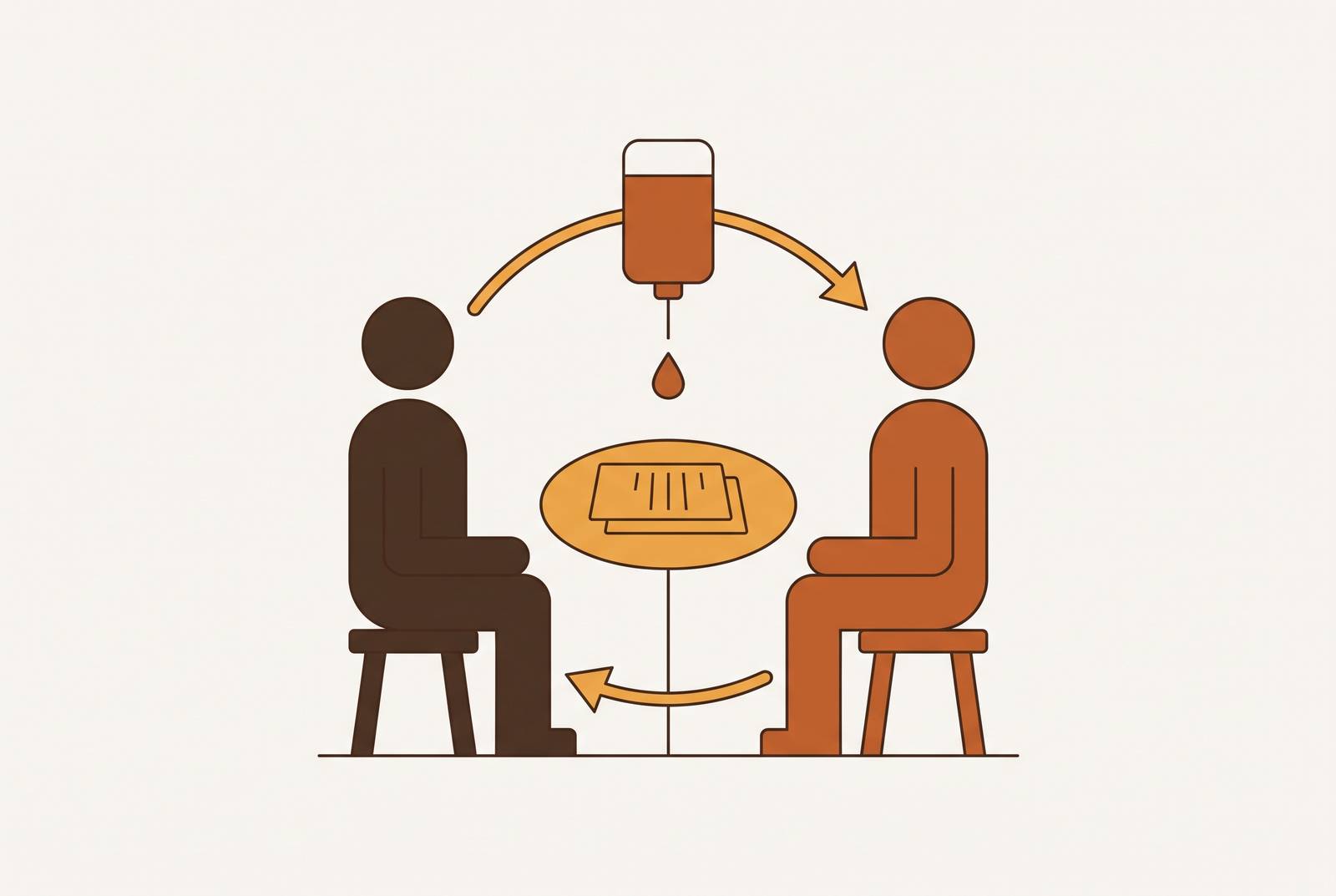
A peer-to-peer review, P2P for short, is a scheduled phone call. The ordering or treating physician talks directly with the payer's medical director or a clinical reviewer on the other end. That's the whole mechanism. No portal upload, no formal letter, no multi-week wait for a written decision. Just two clinicians on a phone line, one explaining why the treatment was ordered, the other deciding whether that explanation satisfies the payer's criteria.
It runs on a separate track from the formal written appeal. The appeal is a document-based process with fixed deadlines and a required response window. P2P is a conversation, and it exists specifically so a physician can supply context, nuance, or missing documentation that the original prior authorization submission didn't capture. Sometimes the original PA was submitted by an office staffer who didn't have the full clinical picture in front of them. P2P is the chance to fill that gap out loud.
What it isn't: a guarantee. A physician can make a strong, well-documented case on a P2P call and still get denied. It's also not a substitute for the formal appeal, and it does not pause or reset the appeal clock. That clock keeps running the moment the denial notice goes out, regardless of whether a P2P call gets scheduled, held, won, or lost. Treating P2P as a delay tactic is a mistake that costs practices their appeal rights.
Why P2P is underused
Here's the strange part: P2P works, and most practices still skip it. The AMA's 2024 Prior Authorization Physician Survey, which polled 1,000 physicians, found 65% of them regularly take part in peer-to-peer reviews. That sounds like healthy adoption until you look at what happens downstream. Most billing teams, when a denial lands, go straight to the formal written appeal and never request the call.
That's a costly habit. Across the board, 82% of prior auth appeals succeed when providers push back on them, yet fewer than 11% of patients ever file an appeal. P2P is the fastest on-ramp into that fight, and it's the step most often left out. Speed matters here in a very literal sense: a formal appeal runs on a standard 30-day decision window, while a P2P call can resolve far more quickly than a formal written appeal. For a practice sitting on unpaid drug costs, that difference is weeks of exposure avoided or incurred. It's weeks of exposure, one way or the other.
The skip-to-appeal habit carries a second cost that's easy to miss. At several major payers, filing the formal appeal before requesting P2P closes the P2P scheduling window for good. Get the order wrong, and the fastest tool in the box disappears before it's ever used.
The overturn numbers back up why this matters so much for infusion specifically. A 2023 prospective study in the journal Orthopedics (PMID 37921528), cited in a provider guide, found that nearly all peer-to-peer reviews for CT and MRI prior authorization denials in orthopedic practices ended in approval. That's a striking result for a step that happens before the formal appeal even starts, and it points to the same underlying truth for infusion: a lot of these denials aren't really clinical disagreements. They're documentation gaps, and a phone call closes them faster than a letter does.
Which denials belong in a P2P queue
Not every denial deserves a P2P call, and treating it as a universal retry button wastes a physician's time on calls that were never going to move. The sorting question is simple: is this denial about clinical judgment, or is it about paperwork?
Strong candidates share a clinical core. "Not medically necessary" Denials are at the top of the list, both because they're the most common denial category and because they turn entirely on clinical reasoning the ordering physician is positioned to argue. Step-therapy denials belong here too, specifically when the patient already tried the required first-line agent, or when trying it isn't safe, an allergy, an adverse reaction, a documented contraindication. Post-payment CO-50 denials, where medical necessity gets questioned at the claim level rather than the authorization level, also belong in the P2P queue, running alongside the formal claim appeal rather than replacing it. And there's a quieter category: cases where the payer's reviewer probably doesn't have the right specialty background. A generalist reviewing a complex biologic infusion is a mismatch built into the system, and a P2P call puts a specialist on the phone instead.
Weak candidates are administrative at heart, and no amount of clinical argument fixes an administrative problem. Wrong NPI type, missing modifiers, incorrect coding: these need a corrected resubmission, not a physician's fifteen minutes. Coverage exclusions written into the plan document aren't medical necessity decisions at all, so a P2P call can't touch them. Timely filing denials need proof of extenuating circumstances, not a clinical narrative. Eligibility lapses are, again, an administrative fix.
Infusion practices face a specific trap here. Drug-to-diagnosis mismatches and PA mismatches can look clinical on the surface, but a lot of the time they resolve faster with a corrected resubmission than with a scheduled call. Before booking a physician's time, figure out whether the denial is really about a documentation error or an actual clinical judgment call. Getting that sorting wrong burns a scarce resource on the wrong fight.
The sequencing trap: when to request P2P relative to the formal appeal
Order matters more than almost anything else in this process. A 2026 escalation guide lays out the sequence: request P2P within the payer's window first, then file an internal reconsideration with new documentation if the P2P call doesn't overturn the denial, then submit a Level 1 formal internal appeal, then request external independent review, and finally, for Medicare Advantage or Medicaid managed care cases, pursue an ALJ hearing.
Reversing that order brings consequences that are not small. At some payers, starting the formal appeal before attempting P2P can shut the P2P scheduling queue. File in the wrong sequence and the fastest, cheapest intervention available just isn't available anymore, and everything left runs slower.
P2P and the formal appeal are two separate clocks running in parallel. They're two separate clocks running in parallel, and only one of them pauses for anything. Calendar the formal appeal deadline the same day the denial arrives, no matter what happens with the P2P request. Never assume requesting a call buys extra time on the appeal side, because it doesn't. Most insurers give a limited window after the denial to request P2P, and that window is short and payer-specific, so confirm it against the actual denial notice every time, not from memory of what worked last quarter.
How to prepare the clinical argument before the call
Two different people do two different jobs here, and mixing them up is a policy violation, not just an inefficiency. Billing or revenue cycle staff schedule the call, document the process, and pull the packet together. The ordering or treating clinician is the one who gets on the phone and makes the clinical argument, because many payers require exactly that. Handing the call to office staff isn't just against policy at most payers; it's also a mismatch of skill for the task, since the conversation is clinician to clinician by design.
Before the call happens, the packet needs to include a specific set of documents. Relevant chart notes, especially anything narrative that didn't make it into the original PA submission. Lab and imaging results that weren't submitted the first time around. The payer's own Clinical Policy Bulletin or Coverage Determination Guideline for the denied service, pulled ahead of time so the physician can speak to the exact criteria rather than general clinical reasoning. Guidelines from the relevant clinical society, rheumatology, oncology, or neurology, depending on what's being infused, that support the treatment as ordered. And where step therapy is the issue, documentation proving the patient tried the required first-line agent, or a clear clinical explanation of why that agent was contraindicated: allergy records, adverse reaction notes, drug interaction flags.
Infusion therapy adds a few of its own angles. For recurring infusions, treatment response data from completed cycles matters a lot, since payers frequently deny continuation authorizations on the grounds that nothing proves the therapy is working. For biologics, disease severity scores and a record of failed conventional therapies carry real weight. For buy-and-bill drugs specifically, coding accuracy should be verified ahead of time, because administrative errors can sometimes surface as clinical denials when the underlying issue is a documentation mismatch.
Under CMS-0057-F, payers now have to state a specific reason for the denial. Use that exact language. A physician who addresses the precise criterion the payer cited is much harder to wave off than one who offers a broad defense of the treatment in general terms.
What happens on the call
The call itself tends to be short. The treating physician lays out the clinical case, and the payer's medical director may ask follow-up questions or point out a documentation gap that's still open. The physician's job on the call is narrow and specific: answer the exact criterion named in the denial, back it with clinical evidence, and, if step therapy is the sticking point, explain clearly why the required alternative wasn't right for this particular patient.
Documentation during and right after the call matters just as much as the call itself. Capture the payer medical director's name, credentials, and stated specialty. Note the date and time. Record the outcome as stated on the call, whether that's approval, continued denial, or a request for more documentation. Get a reference number for the conversation. And write down anything additional the reviewer asks for, because that list becomes the foundation of the formal appeal if the P2P call doesn't turn the denial around.
If the call ends in approval, the work isn't done yet. Get it in writing, get an authorization number, and check that the number actually covers the right drug, the right dose, and the right number of sessions before scheduling the next infusion. A verbal yes on the phone that never gets confirmed in writing is a common way denials come back around later, once the paperwork trail doesn't match what was said out loud.
Payer-by-payer variation in P2P process
P2P routing isn't standard even within a single insurer. It shifts by plan, by service line, by state, and by whichever entity has been delegated the review. That means the denial notice itself, not a workflow someone remembers from six months ago, is the only reliable source for how to request the call.
Routing patterns vary by payer. UnitedHealthcare may route requests through the provider portal or a dedicated form, and cases delegated to another vendor run through a separate clinical consultation path. Aetna's routing should be confirmed against the denial notice; Aetna Better Health handles P2P at the state level, so the right contact is that state plan's provider services line, not a national number. Affiliates of one national plan want a call to the provider number on the denial notice, but routing differs by which affiliate holds responsibility for the member. Cigna's instructions should be checked against the current denial notice rather than assumed from a prior case.
BCN Advantage offers P2P after an adverse determination, but the conversation there won't change the outcome. Its stated purpose is to inform the formal appeal, not to overturn the denial, and it's requested through case communication in e-referral, applying only to BCN Advantage inpatient facility admission PA requests. For most payers and most service lines, P2P functions as a genuine reversal mechanism. Knowing where that's not true, and BCN Advantage is a clear example, keeps a practice from expecting an overturn where the mechanism was never built to deliver one.
Sources
- New BCN Advantage inpatient facility admissions peer-to-peer review process, starting Jan. 1
- Peer-to-Peer Review for Insurance Denials: Provider Guide 2026
- Prior Authorization Denied? How to Appeal and Win (2026 Guide) | CareRoute
- What Happens If Prior Authorization Is Denied 2026: 5-Step Escalation Guide
- Peer-to-Peer Review Process for Denied Medical Claims
- Infusion Therapy Claims: Reasons for Denials
- linear.health
- medlearn.com