Step Therapy Requirements and Override Strategies in Infusion Auth
Medicare Advantage step therapy now blocks many infusions unless cheaper drugs fail first.

Step therapy in infusion authorization isn't a generic prior-auth speed bump you clear with a form. It runs on payer-specific drug hierarchies, treatment-history documentation rules, and exception criteria that billing teams need to understand before the first treatment date, not after a denial shows up in the mail.
Denial rates on biologics, oncology infusions, and high-cost autoimmune therapies commonly run between 20% and 35%, and step therapy sequencing drives a lot of that number. Most PA workflows still treat step therapy like a box to check next to "medical necessity," and that's the mistake. Step therapy is a sequence problem. The payer wants proof a cheaper drug got tried and failed before it pays for the one your patient actually needs, and the whole system runs on that logic rather than on the drug's fit for the patient in front of you.
The regulatory event that made Medicare Advantage the center of infusion step therapy exposure
August 2018 is the date to know. CMS rescinded a September 2012 memo that had barred Medicare Advantage plans from applying mandatory step therapy to Part B drugs. That single move opened the door for MA plans to apply step therapy to physician-administered drugs, the very drugs that make up most infusion practice revenue.
CMS followed up on May 16, 2019, with a final rule letting MA plans negotiate lower prices on Part B drugs. Plans moved fast. Infusion-administered biologics and specialty injectables that used to sit outside step therapy rules in Medicare Advantage got pulled into plan-by-plan drug hierarchies almost overnight.
By 2026, formularies tied to Part B and Part D infusions carry the most aggressive step escalation seen yet, as plans try to keep pace with rising drug costs nationally. Medicare Advantage covers such a large share of the infusion patient population that this isn't some edge case limited to a handful of plans. It reaches rheumatology, gastroenterology, oncology, and neurology practices at scale, and it reaches them all at once.
Biosimilars have made the sequencing logic even more layered. Plans now routinely name a biosimilar as the required first step before they'll pay for the reference biologic. Practices need to track not just "drug A before drug B," but which biosimilar, at which dose, satisfies which plan's specific step. Get the biosimilar wrong and the claim reads as if no step was ever tried.
UnitedHealthcare's Part B step therapy program structure for 2026
Guidance UHC published on its provider site states that UnitedHealthcare's Medicare Advantage Part B step therapy program went into effect January 1, 2026. A defined set of preferred products now require prior authorization:
- Asthma immunomodulators, respiratory interleukins: Fasenra (J0517)
- Colony stimulating factors, long acting: Fulphila (Q5108), Neulasta (J2506), Udenyca (Q5111)
- Colony stimulating factors, short acting: Zarxio (Q5101)
- Rituximab products: Riabni (Q5123), Ruxience (Q5119), Truxima (Q5115)
- Tocilizumab products: Tofidence (Q5133), Tyenne (Q5135)
Members with a paid claim for the drug in the past 365 days, or documented clinical evidence of current use, are exempt from the step requirement. That exemption matters most for practices absorbing patients who just switched into UHC coverage. A patient who's been stable on Truxima for a year under a different plan shouldn't have to restart the sequence. Someone has to catch that at intake and pull the claims history, though, not discover it later during a billing dispute.
New UHC enrollees without a claims history are the ones who likely need PA. Flag them at scheduling. Waiting until the claim gets billed is too late to fix anything.
UHC evaluates step therapy PA requests against Medicare coverage determination guidance, FDA-approved dosage labeling, the member's benefit plan terms, documented trial-and-failure of preferred products, and treatment history. Standard decisions come back in 72 hours, expedited in 24. Incomplete clinical documentation gets denied outright by UHC, no exceptions, and that's a loss that never had to happen. Submissions go through the UHC Provider Portal, under Prior Authorization and Notification.
BCBS Michigan / BCN Advantage and Humana step requirements in their Part B drug lists
BCBS Michigan and BCN Advantage keep a Medical Drug and Step Therapy Prior Authorization List that gets revised regularly, most recently September 2026. Treat it as a living document, not something to print once and file away in a drawer.
A few examples from that September 2026 list show how granular the sequencing gets:
- Abatacept / Orencia (J0129) requires a documented trial and failure of Inflectra or Avsola, plus Steqeyma, Pyzchiva, or Wezlana. MAPD members face an added adalimumab step. The biosimilar step drops out for rheumatoid arthritis, though, and neither the SC formulation of Orencia nor the biosimilar/adalimumab step applies for aGVHD. Missing those carve-outs causes a valid claim to be coded as a step failure that never should have happened.
- Denosumab / Xgeva (J0897) needed PA starting December 1, 2025, with the biosimilar Osenvelt as the required first step.
- Aflibercept, both Eylea HD (J0177) and Eylea (J0178), requires trial and failure of Avastin or an Avastin biosimilar first, a rule that's been in place since 2017 for Eylea and 2023 for Eylea HD.
- Cinvanti (J0185) picked up a step therapy requirement effective January 1, 2026, and submissions for it route to OncoHealth rather than the standard portal.
That routing detail isn't a footnote to skim past. Most medical benefit drugs at BCBS Michigan go through the Medical and Pharmacy Drug PA Portal, but medical oncology and supportive care drugs go to OncoHealth instead. Sending an oncology drug through the wrong channel causes a delay, or denial, that is entirely self-inflicted.
Humana runs its own Part B step therapy list, effective January 1, 2025, and revised again January 1, 2026. The list sorts drugs into preferred and nonpreferred categories, but preferred status alone doesn't guarantee an exemption from stepping. Practices still need to check the coverage criteria policies posted at Humana.com/CoveragePolicies before assuming anything. A few of the sharper distinctions:
- For aHUS, Ultomiris (J1303) is preferred. Soliris (J1300/J1299), Bkemv IV, and Epysqli IV are nonpreferred.
- In oncology, Mvasi and Zirabev (bevacizumab biosimilars) are preferred over Avastin.
- For bone resorption, Xgeva and zoledronic acid are preferred; Osenvelt and Bomyntra are listed as nonpreferred in the 2026 update.
- Retacrit and Procrit are preferred erythropoiesis-stimulating agents; Aranesp and Epogen are not.
- For Gaucher's disease, Elelyso is preferred over Vpriv and Cerezyme.
Humana mirrors UHC's existing utilizer exemption: a patient already on a nonpreferred drug, with a paid claim in the last 365 days, skips the step requirement.
Aetna splits its system in a way that trips up billing teams who aren't watching for it. Specialty drug step therapy runs through CVS Caremark's PBM system. Medical-benefit step therapy, meaning infusions and biologics given in-office, stays with Aetna directly and follows Aetna's own Clinical Policy Bulletins. Two different systems, two different rulebooks, and figuring out which one governs a given drug has to happen before the claim goes out, not after. Aetna also posts a step therapy lookup tool at its provider site, and it carries the same 365-day existing utilizer exemption as UHC and Humana.
That 365-day window applies across all three payers, and it's a documentation opportunity billing teams leave on the table more often than they should. If a patient switched plans mid-treatment, pulling proof of the last paid claim can wipe out a step requirement before it ever becomes a denial.
Rheumatology, gastroenterology, and oncology infusion schedules carry the highest step therapy exposure
A 2024 Avalere analysis, cited by Medheave, found that 54% of Medicare Advantage enrollees were in plans requiring step therapy for commonly used rheumatoid arthritis biologics. For certain products, that figure jumped to 78% of enrollees facing step edits, and 27% of those enrollees had to clear two or more required steps before reaching the drug their doctor actually prescribed.
Rheumatology, gastroenterology, dermatology, psychiatry, and endocrinology carry the heaviest step therapy load. That's not a coincidence: these are the specialties writing scripts for the biologics and specialty drugs sitting at the top of every payer's cost list.
Oncology carries its own version of the problem, and it's arguably the sharpest one. A step requirement doesn't bend just because the treating oncologist has a clear clinical reason to start with a targeted therapy. The plan's drug hierarchy runs independently of that judgment, full stop, and no amount of clinical logic changes the sequence on its own.
GLP-1 prescriptions for diabetes and weight management have added real volume to step therapy lists in the last few years. That's not traditionally been an infusion-center concern, but as infusion delivery of these drugs grows, it's turning into one.
Biosimilar-first requirements raise the stakes further. Aetna's step therapy criteria can mandate a biosimilar as the required first therapy before a reference biologic gets covered. A practice that stocks the reference biologic without checking the biosimilar step first is taking on that cost directly, no cushion, no reimbursement path. Under buy-and-bill, the drug is already purchased before the authorization clears, so the cost is committed before anyone knows the outcome. A $20,000 biologic denied on a step therapy technicality doesn't come back on its own. It comes back only through a successful override or appeal, and that's the part too many practices treat as optional.
Documentation requirements for the five recognized grounds for a step therapy override
Five grounds exist for overriding a step therapy requirement, and each one needs its own kind of proof sitting in the chart before submission, not scrambled together after a denial letter shows up.
Contraindication: the required step drug is medically contraindicated for this patient. Needs a documented allergy, an adverse reaction history, or a clear clinical contraindication in the record.
Prior trial failure: the patient already tried the required drug and it didn't work, or it caused problems. Records from a prior insurer's coverage period count as valid evidence here, which matters more than most practices realize when a patient switches plans mid-treatment.
Concurrent medication conflict: the required step drug may be contraindicated alongside other treatments the patient is receiving. Supporting clinical documentation of the conflict is needed.
Drug not accessible: the required step drug cannot be obtained as directed. Documentation supporting the access barrier is needed.
Clinical exception, or medical necessity: the patient's specific clinical picture makes the required step drug likely to be ineffective, or worse, for them. Needs a medical necessity letter from the prescribing physician laying out the patient-specific reasoning.
Across all five grounds, the supporting file looks similar: prior drug trial notes, documented side effects, contraindication records, relevant labs, and the medical necessity letter. Build that packet before submission. Assembling it after a denial just adds a delay that never had to happen.
Timelines differ by plan type. Commercial plans and Medicare Advantage plans carry different exception request windows, and MA timelines are generally shorter, so the MA workflow has to move faster from day one, with no room to wait and see.
State law is starting to override payer discretion, and this is where the ground shifts fastest. New Jersey's law, effective January 1, 2026 (C.30:4D-7xx and C.52:14-17.28j), requires Medicaid, SHBP, and SEHBP to grant a step therapy exception when a provider shows contraindication, expected ineffectiveness based on the patient's clinical characteristics, or prior failure or adverse reaction across all formulary options. Connecticut goes further: effective January 1, 2026, insurers face strict limits on step therapy requirements for drugs treating multiple sclerosis or rheumatoid arthritis, and it's among the strongest state-level restrictions yet seen. For MS and RA drugs under the Connecticut law, a provider can deem a required step drug ineffective and move to the originally prescribed drug, as long as it's covered under the plan.
More than 30 states now have step therapy reform laws giving patients a right to request an override. Practices working across multiple states need a state-by-state reference on hand, because state law can grant more than any individual payer advertises in its own policy documents. Louisiana, for instance, requires plans to approve or deny a step therapy override within 72 hours, or 24 hours in exigent circumstances.
An internal appeal that upholds the original denial isn't the end of the road, either. External review under the applicable Health Carrier External Review Act is still available, and it's a right that goes underused far more than it should.
Using peer-to-peer review as a step therapy override lever
Peer-to-peer review is a direct phone conversation between the prescribing physician and the insurance company's medical director, where the physician lays out, patient by patient, why the denied drug is medically necessary.
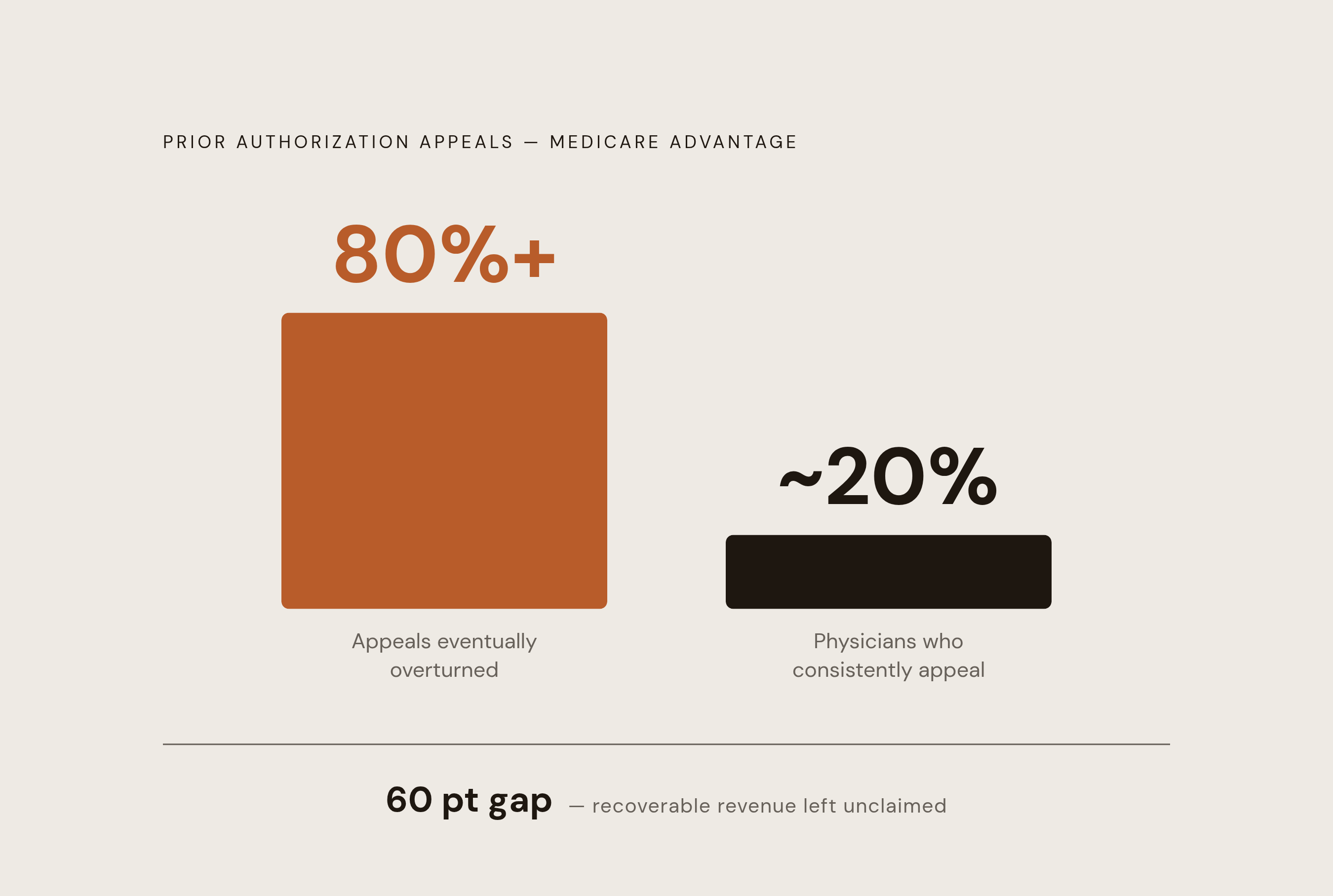
More than 80% of prior authorization appeals to Medicare Advantage plans eventually get overturned, yet only about 20% of physicians consistently follow through and appeal. That gap, between what wins and what actually gets challenged, is where a lot of recoverable revenue quietly disappears, and it disappears for no better reason than nobody picked up the phone.
Peer-to-peer review does the most good on exactly the drugs covered here: biologics, oncology infusions, and autoimmune medications caught in step therapy denials. The usual path runs internal appeal first, then peer-to-peer with the payer's medical director if the internal appeal doesn't resolve it. Response times mirror what's already been covered: 72 hours standard, 24 hours for urgent cases, in line with both UHC's own timelines and Louisiana's state law.
Take a Crohn's disease patient prescribed Humira, denied because the insurer wants two immunosuppressants tried first. The physician files a step therapy exception documenting prior failure of both methotrexate and azathioprine, pulling records from a different insurer's coverage period that show the adverse reactions. Strong upfront documentation can resolve a step therapy issue before it ever reaches the peer-to-peer stage.
Prior treatment history doesn't stop counting just because the insurer changed. Billing teams that track it, paired with physicians willing to pick up the phone for peer-to-peer, turn a step therapy denial that would otherwise die on the desk back into revenue.
Sources
- Updated Medicare Part B step therapy prior authorization requirements | UHCprovider.com
- Medical Drug and Step Therapy Prior Authorization List for Medicare Plus Blue and BCN Advantage members
- assets.humana.com
- Medicare Part B Drug Requirements & Coverage - Step Therapy | Aetna
- Medicare Advantage Prior Authorization and Step Therapy for Part B Drugs
- Medicare Step Therapy Explained for Part B Drugs
- Medicare Part B Step Therapy Programs – Medicare Advantage Medical Policy
- legis.la.gov