Medicare Advantage Prior Auth Burden in Infusion Settings
Denied infusion authorizations create solvency crises for practices treating chronic disease.

Prior authorization in Medicare Advantage is a cash flow problem for infusion practices. It's a cash flow problem, because a delayed or denied auth on a biologic can tie up tens of thousands of dollars in drug cost before a single claim ever goes out the door. The math changes the stakes: a denial on a modestly priced office visit is an annoyance, a denial on a high-cost infusion cycle running into the tens of thousands is a solvency event. Understanding how MA plans actually handle prior auth for infusion-administered drugs, and where that process diverges from traditional Medicare, is the starting point for managing the risk instead of absorbing it every quarter.
The scale of MA prior auth denials and what the aggregate numbers hide
MA insurers processed nearly 53 million prior authorization determinations in 2024. Of those, roughly 4.1 million got denied, a rate close to 8%. That number has been climbing steadily: under 6% every year from 2019 through 2021, up to 7.4% in 2022, then 7.7% by 2024. And 73% of those 2024 denials weren't partial cuts or downgrades, they were full denials. No drug, no visit, no reimbursement.
The blended rate hides more than it reveals, though. Denial rates by individual payer ranged from 5% at Elevance to 17% at UnitedHealth in 2025 (a comparable 2024 spread ran from 4.2% to 12.8%, same two companies on opposite ends). A threefold gap between the most and least restrictive payer disappears the moment you average across the whole MA market.
For infusion practices, that average is close to useless as a planning number anyway. It blends routine, high-volume, low-denial categories (imaging, physical therapy referrals, that kind of thing) with the high-cost, high-scrutiny categories where biologics and infused therapies live. A practice built around chronic disease treatment, rheumatoid arthritis, Crohn's, primary immunodeficiency, needs to know its payer mix's denial rate for infused biologics specifically. The 8% headline figure tells a practice almost nothing about its actual exposure.
How MA plans deny infusion-specific services differently than traditional Medicare
Traditional Medicare covers most infusion-administered biologics through national and local coverage policies. Those documents lay out coverage criteria without layering step therapy on top of most established drugs. If a therapy is indicated and documented, fee-for-service Medicare pays.
MA plans don't work that way. They build their own clinical criteria on top of the same underlying coverage rules, and step therapy is the most common mechanism for denying infusion claims. A plan can require a patient to fail one or two cheaper alternatives, methotrexate before a biologic, for instance, before it will approve the drug the physician actually wants to start with. That requirement can exist even when the prescribing physician has documented clear clinical rationale for skipping straight to the targeted therapy. Medicare fee-for-service would cover the exact same service. The MA plan denies it anyway, because its criteria aren't the same criteria.
Layered on top of that is automated review. Roughly 75% of health plans report using AI systems to process prior auth requests, and those systems can return a decision in seconds, often measured against plan-specific criteria that have no direct relationship to Medicare's own coverage standards. Speed isn't the issue. A machine applies proprietary thresholds without a clinician looking at the chart; speed isn't the issue.
Texas moved on this in 2025. SB 815 prohibits automated adverse determinations without human oversight: a plan can't let an algorithm issue a denial without a person reviewing it first. That's a state fix, not a federal one, and it exists because regulators recognized the pattern: automated denial at scale, on drugs that cost tens of thousands of dollars per cycle, with no clinical judgment in the loop.
The recurring-treatment re-authorization trap in infusion practices
Infusion therapy isn't a one-time event for most of the patient population that matters here. Autoimmune biologics, immunoglobulin therapy, oncology agents, these are treatments patients stay on for years, and every one of them requires re-authorization on some defined cycle. That cycle is where a lot of practices bleed revenue without realizing it until the denial hits.
Re-authorization gets triggered by more than the calendar. A plan year rolling over resets it. A formulary change resets it. A patient switching prescribing physicians resets it. A patient moving to a different state or a different provider network resets it. Any one of these can interrupt a treatment plan that, clinically, hasn't changed.
A lapsed authorization gets treated exactly the same as no authorization ever existing, which catches practices off guard. There's no partial credit, no grace period built into most plans' claims logic. The claim denies in full, on a drug that may already be sitting in the patient's system.
The fix is procedural. Authorization expiration needs its own tracking system, with alerts firing at 30 days, 14 days, and 7 days before an authorization runs out. Re-authorization requests need to go in at least two weeks ahead of expiration. Treated as a recurring workflow with its own deadlines, this is manageable. It isn't an afterthought that surfaces only when a claim bounces.
The 2026 CMS prior auth rule's changes and limits
CMS-0057-F is the biggest federal move on prior authorization in years, and its core provisions took effect January 1, 2026. It reaches Medicare Advantage organizations, state Medicaid and CHIP fee-for-service programs, Medicaid managed care plans, CHIP managed care entities, and QHP issuers on the Federally-Facilitated Exchanges.
The process changes are concrete. Standard prior auth decisions now have to come back within 7 calendar days, down from a prior standard that allowed up to 14. Expedited or urgent requests get 72 hours. Denials can no longer hide behind a generic "does not meet criteria" line, plans have to state the specific reason. And payers now have to publicly report their own prior auth numbers each year, approval rates, denial rates, turnaround times, appeal outcomes, with the first reporting period covering 2025 and data due by March 31, 2026.
There's an interoperability piece coming too. A FHIR-based API called PARDD is set for full go-live by January 1, 2027. Once it's live, providers should be able to check prior auth requirements, see what documentation a payer wants, and submit the request directly from the EHR instead of a separate portal.
None of that touches drugs billed under the pharmacy benefit, though, at least not yet. A proposed rule, CMS-0062-P, released in April 2026, would extend similar interoperability and timeline requirements to pharmacy-benefit drugs, but it runs on a separate set of pharmacy data standards rather than the same clinical data framework used for medical services. That rule is still a proposal. The comment period runs through June 15, 2026, and it isn't final. Faster decisions and clearer denial reasons are coming for the services CMS-0057-F covers. Whether that same discipline reaches every drug an infusion practice bills, including anything routed through the pharmacy benefit, is still an open question.
Why most infusion practices leave MA prior auth appeal value on the table
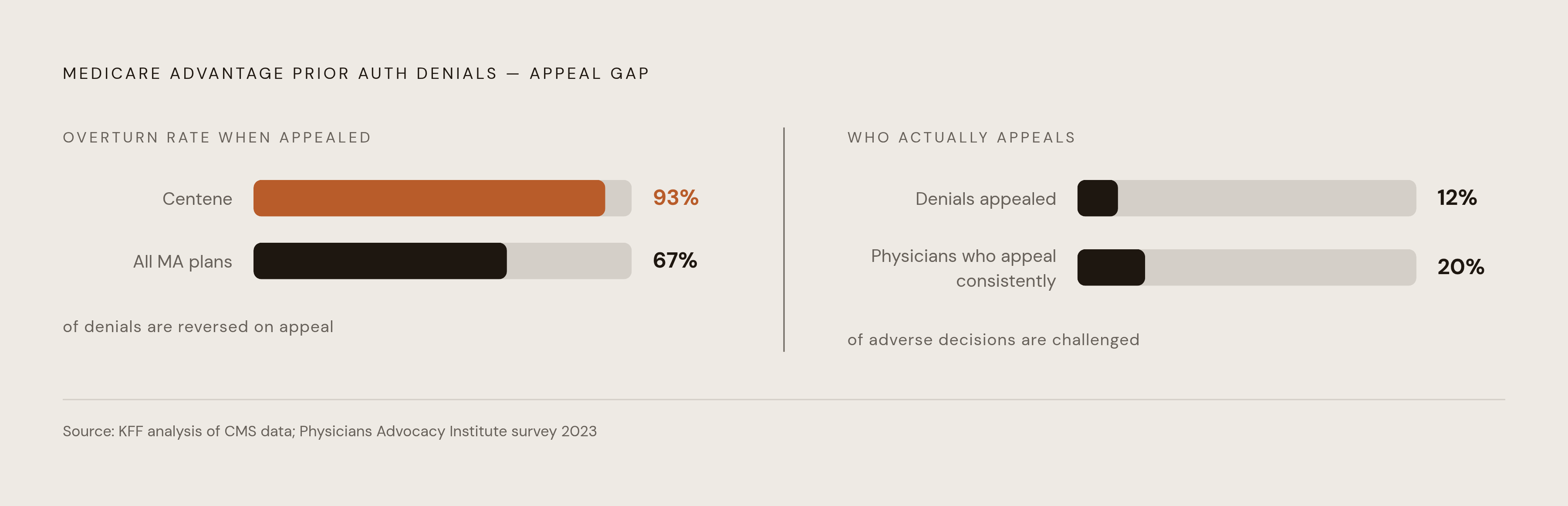
The numbers here point in one direction. 67% of MA prior auth denials that actually get appealed are overturned. At some plans, Centene among them, the overturn rate on appeal reaches 93%. That means the majority of denials, once challenged, don't hold up.
Almost nobody challenges them, though. Only about 20% of physicians appeal adverse decisions consistently, and KFF's research puts the share of MA denials that ever get appealed at under 12%. Most denials are winnable, and most denials never get contested, a stark combination.
According to Becker's Hospital Review, an estimated 90% of denials are preventable in the first place, and close to 60% never get reworked at all, which amounts to a write-off, not a delay in revenue. The money doesn't show up late, it doesn't show up at all.
None of this is because practices are careless. Appeals cost real staff time, chart pulls, letter writing, sometimes a peer-to-peer call with a plan's medical director. For a service priced in the low hundreds of dollars, the labor cost of an appeal can exceed the recovery, and skipping it is the rational call. For a biologic infusion costing well into the tens of thousands of dollars, that math flips entirely, and treating every denial the same way, appeal or don't, regardless of dollar value, is where practices leave the most money sitting on the table.
The operational model infusion practices need to manage MA prior auth without constant revenue exposure
Revenue cycle control for infusion has to start at scheduling, not at claims submission. By the time a claim goes out the door, the financial exposure already happened, the drug got ordered, the chair got booked, and the authorization either held up or it didn't. Fixing the process after the claim denies is fixing it too late.
Four things need to be in place operationally. First, pre-treatment authorization confirmation: no chair gets booked and no drug gets ordered without a verified, unexpired authorization on file, and that status has to be visible right in the scheduling workflow, not buried in a separate billing portal that nobody checks until the claim's already been submitted.
Second, expiration tracking with real lead time, the 30/14/7-day alert cadence, re-auth work starting at least two weeks out, and re-authorization treated as its own recurring task rather than something staff remember to do only when a denial forces the issue.
Third, tracking denial patterns by payer. Something like 70 to 80% of denials cluster around a small number of root causes, and those causes concentrate by payer and by therapy type. Without analytics that reveal the pattern, staff spend their time re-fighting the same individual claim over and over instead of fixing whatever's broken upstream, whether that's a documentation gap or a step therapy requirement nobody flagged going in.
Fourth, appeal as standing policy applied automatically claim by claim. Given overturn rates that hold for a substantial majority of appeals and drug costs that run into five figures per encounter, any denied biologic infusion authorization above a set dollar threshold should trigger an appeal automatically, no debate required.
The average practice completes 39 prior authorizations, and physicians and staff together spend 13 hours a week on the paperwork tied to them. That's an average across all specialties. Infusion practices, concentrated as they are in exactly the drug categories that draw the most PA scrutiny, sit well above that baseline.
General revenue cycle management tools were built for claim submission and denial management after a claim has already been filed and rejected. They're good at claim submission and denial management after a claim has already been filed and rejected. But the infusion prior auth process runs through benefits verification, auth initiation, expiration tracking, re-auth, peer-to-peer review, and appeal, all of it happening before or alongside the clinical encounter, not after it. That calls for a workflow built specifically around infusion scheduling, one that connects to the calendar before a claim ever exists.
Sources
- Prior authorization denials up big in Medicare Advantage
- Medicare Advantage Prior Auth Denials Up 56% in 2026
- Prior Authorization Best Practices 2026
- Medicare Advantage Prior Auth Denial Spike
- Medicare Advantage Insurers Made Nearly 53 Million Prior Authorization Determinations in 2024 | KFF
- Payers Ranked by Denial Rates 2025
- stealthagents.com