Mid-Cycle Authorization Lapses and Emergency Escalation Workflows
Practices that automate authorization tracking prevent costly mid-cycle denials before they happen.

A prior authorization that expires mid-treatment is not a paperwork problem. The drug is already bought, already infused, and the money's already spent by the time anyone notices the gap. According to ACU-Serve, infusion billing denials aren't isolated billing events at all, they're symptoms of something that broke weeks earlier, further up the chain. Buy-and-bill makes this worse, not better: a practice holds acquisition costs of $5,000 to $50,000 per infusion encounter (per qualigenix.com), so a lapsed auth doesn't sit as a future risk. It lands as a cash-flow hole the same day. Practices that keep their footing here didn't get lucky reacting well. They built the escalation steps before the lapse happened, and that's the whole difference.
Why authorizations expire mid-cycle
Authorization for recurring infusion therapy isn't a one-and-done approval. It has to name the drug, dose, frequency, and duration, and annexmed.com notes payers typically require renewal every three to six months. Changing the regimen at all, even a small dose adjustment, retriggers the whole approval from scratch. Missing that window means the claim gets treated exactly like one with no authorization at all: a full denial, not something patched after the fact.
A missing, invalid, or inapplicable authorization number produces the CO-15 denial code: "authorization number is missing, invalid, or does not apply to the billed services or provider." That code covers a handful of distinct root causes, and each one needs a different fix. The authorization was never submitted. Someone typed the wrong number into Box 23 of the CMS-1500 form. The CPT code, NPI, or service location on the approved auth doesn't match the claim. Or, one of the most operationally damaging root causes MBW RCM highlights: the infusion happened outside the approved date range.
A patient can have a technically valid, technically approved authorization and still get denied because the date window closed three days before the visit, and that is the real trap. A patient can have a technically valid, technically approved authorization and still get denied because the date window closed three days before the visit.
Industry trends through 2026 show more mid-treatment reauthorization requirements, not fewer, especially for specialty biologics. Payers aren't just checking in at the start of therapy anymore. They're checking mid-course, sometimes without much warning, and that shift alone explains a lot of the lapses that follow.
Billing teams are already stretched before any of this happens. Practolytics.com found that 70% of PA requests need extra work just to get approved in the first place, and half of all infusion drug PAs face at least one denial somewhere along the way. That's the baseline workload, before a renewal even enters the picture. Neurology infusions carry particular risk here: the monoclonal antibodies used in that space demand tight, predictable scheduling and close monitoring, and Mordor Intelligence has flagged the category as outpacing every other infusion therapeutic area in growth. More volume, tighter windows, more room for a renewal to slip through the cracks.
Payers have also started leaning on AI to scrutinize documentation quality itself. MBW RCM notes that incomplete staging details, missing biomarker results, or a vague medical necessity statement can trigger a denial even when the authorization was technically approved on paper. The gap isn't always administrative anymore. Sometimes it's a documentation standard nobody flagged as thin until the algorithm caught it.
The tracking infrastructure that prevents most mid-cycle lapses
Most of this is preventable, and prevention starts with treating expiration dates as scheduling data, not billing trivia. 247medicalbillingservices.com recommends automated alerts at 30, 14, and 7 days out, built directly into the scheduling system. Not a sticky note. Not someone's memory of when a patient's last renewal came through.
For infusion therapies running on three-to-six-month renewal cycles, every patient's auth expiration date has to sit next to their infusion calendar, tracked actively, not filed away until someone remembers to check. The renewal request itself should go out at least two weeks before the current authorization runs out, giving the payer time to respond before a scheduled infusion shows up with nothing behind it.
Tying authorization status directly to the scheduling software closes the most dangerous gap of all: administration before approval. Rcmworkshop.com describes what happens next in blunt terms: "usually outright non-payment." No gray area there.
Renewal documentation has its own standard too. rcmworkshop.com's analysis finds that it needs to connect diagnosis, the patient's response to prior treatment, and the relevant clinical guidelines directly to the drug regimen being requested. Leaving one of those threads loose puts the renewal at risk of delay, partial payment, or outright denial. Any time a physician changes drug, dose, or frequency, a new authorization requirement gets created, and it needs to be flagged the moment the order is entered.
The numbers show the gap between practices that do this well and practices that don't. Infusionbillingservices.com puts high-performing centers at a 95% or higher authorization approval rate, against an industry standard of 85% to 90%. Turnaround time tells the same story: 2 to 4 business days for the strong performers versus 5 to 10 days industry-wide. That difference comes down to process, not payer behavior. It's earned, not luck, and any practice still blaming payers for its turnaround time is looking in the wrong place.
Even so, no tracking system catches everything. A payer delay or a sudden mid-cycle policy change gets through even well-run tracking. The escalation workflow has to take over once tracking has done its job, caught the lapse, and still couldn't stop it from happening.
The first hours of a mid-cycle lapse
The clock starts the second the lapse is detected: an expired auth flag, a CO-15 denial landing in the inbox, or a scheduling system alert can each trigger it. Every hour that passes narrows what's recoverable, and it raises the odds the infusion happens anyway, uncovered.
The first move is triage, and not every lapse is the same emergency. An administrative gap, a wrong date, a mismatched NPI, a typo, gets fixed by resubmission with no clinical escalation needed. A renewal that was never submitted needs urgent resubmission, and the infusion holds until it's approved or a documented exception is in place. A renewal that's been submitted but sits with no payer response now runs against a hard deadline: CMS-0057-F, effective January 1, 2026, sets urgent PA decisions at 72 hours and standard decisions at 7 calendar days as escalation triggers, not suggestions. A renewal that comes back denied moves straight into the appeals path.
CMS-0057-F sets specific timing rules for Medicare Advantage, Medicaid managed care, and ACA qualified health plans: the payer has to acknowledge receipt within 24 hours and respond to urgent requests within 72 hours. These need to be hard triggers in the practice management system, not soft reminders. For standard requests, flag internally at day 6, escalate at day 7, report it overdue at day 8. For expedited requests, that same sequence compresses to flagging at hour 24, escalating at hour 48, and reporting overdue at hour 72.
If the patient has an infusion appointment coming up, clinical and billing teams need to be talking within hours, not days, about whether to hold, proceed under a documented exception, or reschedule. For a patient mid-course of treatment, care interruption isn't a small thing. An expedited appeal can be requested by phone, internal and external appeals can run at the same time instead of one after the other, and the physician can file the expedited request on the patient's behalf. Under CMS-0057-F, payers must respond to urgent prior authorization requests within 72 hours.
Don't plan around retroactive authorization. The reality is direct: most payers limit retroactive authorization to clearly defined emergency or urgent scenarios, and practices that treat it as a fallback plan usually end up eating the cost. Anyone building a workflow around "we'll just get it approved after the fact" is building on sand.
The escalation hierarchy: who acts, in what order, and with what authority
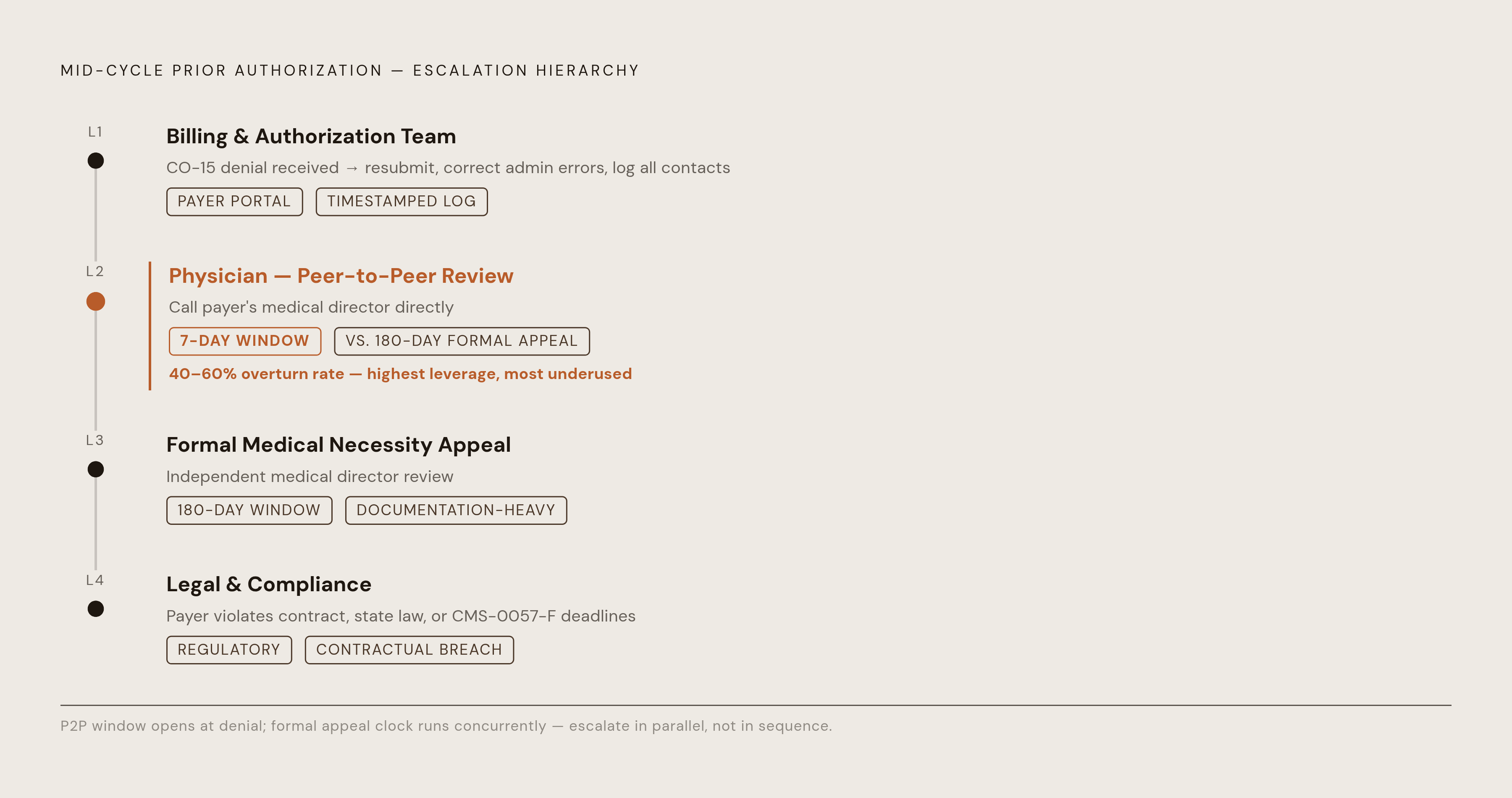
Escalation only works if it assigns decision rights. Telling five people about a lapse produces a meeting. Telling one person they own the decision, with a deadline attached, produces a resolution.
Level 1 sits with the billing and authorization team: correcting administrative errors, resubmitting CO-15-type denials, contacting the payer portal directly for status on pending renewals, and logging every communication with a timestamp. This is the fastest layer and handles the largest share of lapses.
Level 2 brings in the physician for a clinical appeal, and the peer-to-peer review is the single highest-leverage move available here. It's a direct phone call between the ordering physician and the payer's medical director, and quickintell.com puts the overturn rate at 40% to 60%, a number that stays strangely underused given how well it works. The appeal and the P2P request need to go out the same day the denial arrives, because muni.health flags a detail that trips up a lot of teams: EviCore denial letters prominently display a 180-day formal appeal window, but bury the 7-day window for requesting a P2P review. Teams that only read the appeal deadline miss the P2P opportunity every single time, and that miss should never happen twice at the same practice. Make it a named, required step in denial intake.
Level 3 is a formal medical necessity appeal with independent medical director review, built around the same clinical documentation package: diagnosis, treatment response, and guideline alignment, all connected explicitly.
Level 4 is legal and compliance, reserved for cases where the payer decision violates contract terms, state law, or federal rules, including CMS-0057-F's response deadlines.
Skipping levels is the mistake that costs the most money, and the appeal data proves it. 247medicalbillingservices.com found that more than 80% of prior authorization appeals to Medicare Advantage plans eventually get overturned, yet only about 20% of physicians consistently appeal adverse decisions. That gap turns denials that should have been reversed into permanent revenue loss. Every denial nobody had time to appeal is money gone for good, and that's not a risk worth accepting quietly.
Unlike a policy document sitting in a binder, a real workflow has an ownership matrix that names who holds decision authority at each level, names what triggers escalation to the next one, and sets the maximum time window before it escalates automatically even if no human remembered to push it.
The operational infrastructure that keeps escalation workflows from collapsing
A workflow that lives only in a policy manual is an aspiration nobody follows under pressure, because pressure is exactly when people stop checking the manual.
Technology helps here, but it doesn't fix the underlying problem on its own. ACU-Serve, citing an Eliciting Insights survey, reported that the share of healthcare organizations investing in multiple automation tools grew substantially from 2025 to 2026. Automation surfaces denial trends faster, but it doesn't tell anyone whether the denial started at intake, documentation, authorization, coding, or billing. If the underlying workflow is broken, automation just moves the errors through faster. Speed and accuracy aren't the same thing, and treating them as interchangeable is how practices end up denying claims twice as fast as before.
The infrastructure that holds up under pressure needs a few specific pieces. Authorization expiration dates should tie directly to the scheduled infusion appointment, flagged before the visit instead of discovered after the denial. Denial intake triage should run as a same-day protocol, never batched into an end-of-week review. Payer-specific documentation of P2P windows, appeal deadlines, and escalation contacts belongs at the payer level where anyone can pull it up, not locked in one biller's head. And billing, clinical, and scheduling need a shared channel that runs on hours during an active lapse, not days.
Payers are shifting PA reviews to in-house clinical teams, rolling out new submission portals, and changing documentation rules on their own timeline. MBW RCM notes this creates a real staffing problem: a generalist billing team covering a broad book of plans can't stay current on all of it at once. Dedicated authorization roles, focused specifically on infusion payer behavior, hold that knowledge in a way a generalist rotation never will.
None of this replaces judgment, either. A rules engine can't decide when a clinical situation genuinely warrants urgent escalation, when a payer's behavior falls outside contract terms, or when the timing of a P2P request will actually move the outcome. Those calls need someone who's handled infusion billing specifically, because the stakes and the players differ from general medical billing. Infusion-specialized revenue cycle operations run benefits verification, the prior auth lifecycle, denial management, and AR management as one connected system. General-purpose billing platforms run those same four pieces as separate modules that happen to share a login, and that difference is why the specialized setup wins.
Using lapse data to close the gaps that keep producing mid-cycle failures
Every lapse that gets escalated leaves behind a data trail: where in the lifecycle it broke, which payer was involved, which drug, and which failure mode, expired, mismatched, never submitted, or denied on renewal. That data does nothing sitting in a closed ticket. It only pays off if someone reviews it on a schedule, month over month, not once a year when someone remembers.
Lumping everything into one bucket called "authorization denials" hides the real signal, and this is where most practices get it wrong. A practice seeing repeated CO-15 denials tied to one payer's oncology biologics has a different root cause, and needs a different fix, than a practice seeing renewal lapses spread evenly across every payer it works with. Monthly review needs to break it down that finely: tracking accuracy, denial patterns by payer and by drug, and escalation outcomes such as appeals overturned, P2P success rate, and write-offs taken. Treating this data as a compliance checkbox makes it do nothing. Treating it as a calibration tool shows a practice exactly where its process leaks.
The math backs up why this matters. Health Data Management reported that reworking a denied claim costs roughly $180 per attempt. Multiplying that across hundreds of weekly infusion encounters means rework alone starts eating into margin before a single write-off gets counted. The same Health Data Management reporting puts oncology denial rates around 15% on average, and because specialty drug claims carry five- and six-figure price tags, even a small cut in lapse-driven denials produces an outsized recovery in dollar terms.
The regulatory ground is shifting too, though not in a way that makes any of this less urgent. Pcghealthpolicy.com reported that leading carriers have eliminated 11% of prior authorizations for services. Fewer auths required sounds like relief, and in some ways it is, but scrutiny on the authorizations that remain is only getting sharper. The lapses that still happen are happening in a tighter, more closely watched system. The cost of getting caught flat-footed keeps climbing even as the paperwork volume shrinks.
Sources
- Oncology Prior Auth: Medicare CO-15 Denial Checklist - MBW RCM
- Revenue Cycle Management for Infusion Providers | ACU-Serve
- Best Infusion Revenue Cycle Management in 2026 for providers
- From Chair Time to Denial: Prior Authorization Errors Collapse Infusion Billing - rcmworkshop
- How to take advantage of the oncology infusion revenue opportunity - Health Data Management
- qualigenix.com
- cevi.ai
- quickintell.com