Commercial Payer Denial Patterns for Biologic Infusions
Biologic infusion denials follow predictable patterns most practices never learn to read.
Commercial Payer Denial Patterns for Biologic Infusions.
Patterns in biologic infusion denials that most billing teams miss
Commercial payer denials on biologic infusions are not random noise. They follow logic that's specific to each payer and each root cause, and once a billing team learns to read that logic, denials stop looking like bad luck and start looking like a forecast. Most teams never get there, because they're still treating each denial as its own isolated event, something to fight one claim at a time rather than a signal repeating across a whole book of business.
Biologic infusion billing is in a different category than general revenue cycle work, and the difference matters more than most practices give it credit for. The drug cost is baked directly into the claim. Authorization attaches to a specific drug. And a single line item can represent a purchase in the tens or hundreds of thousands of dollars that the practice has already made, before the payer has said a word about paying for it. That last part is the whole problem in miniature: the money is already out the door by the time a denial is issued.
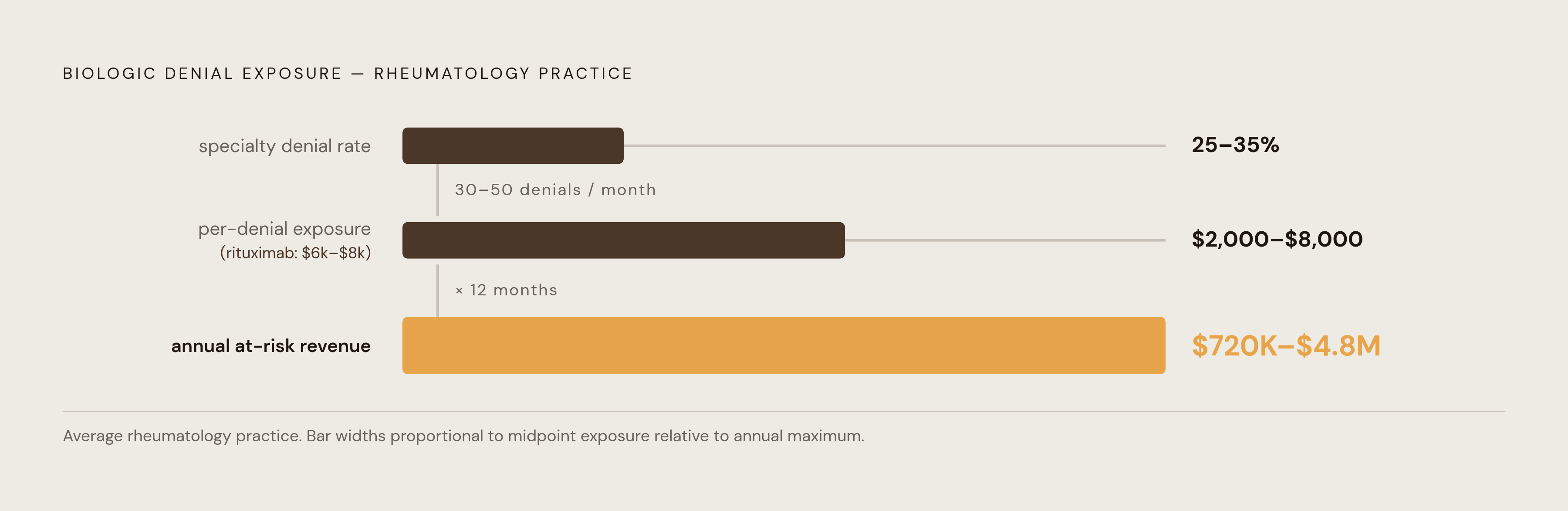
The scale backs this up. Biologic therapies make up 60 to 70% of revenue in a typical rheumatology practice, and denial rates for specialty medications have climbed to 25 to 35% Counterforce Health. That's the difference between a practice that grows and one that quietly bleeds out.
So why does this keep happening? Mostly because the data that would reveal the pattern gets buried before anyone looks at it. Denial reason codes get lumped together generically in practice reporting, and CARC and RARC codes rarely get broken out by payer, therapy type, or site of service. Without that breakdown, every denial looks like a one-off. Patterns are payer-specific and root-cause-specific, and lumping them into one undifferentiated category is exactly what makes them so expensive. Understanding why requires looking at the structural features of biologic billing that create the exposure. Biologic infusion denials carry per-denial revenue exposure of $2,000–$8,000 in the rheumatology context, with a single denied rituximab infusion specifically representing $6,000–$8,000 Counterforce Health. At 30–50 denials monthly, annual at-risk revenue for an average rheumatology practice runs $720,000–$4,800,000 RazSomeChLab.
The structural features of biologic infusion billing that create predictable denial exposure
The buy-and-bill model is where the risk starts. A practice purchases the biologic before it ever submits a claim for reimbursement, so a denial after the fact doesn't just cost time, it means the practice has already paid for a drug it may never get reimbursed for. That single fact changes the stakes of every other structural issue that follows.
Layered on top of that is a split most people outside billing don't think about: medical benefit versus pharmacy benefit. IV biologics run through the medical benefit and need medical prior authorization, with its own forms, its own reviewers, and its own appeal path. Self-administered subcutaneous biologics run through the pharmacy benefit instead, a completely separate system. Practices managing both drug types at once are essentially running two authorization pipelines that don't talk to each other, doubling the surface area for something to fall through.
Authorization itself is drug-specific, not service-specific, and this trips up practices constantly. An authorization for rituximab doesn't cover infliximab. If a physician switches the patient mid-treatment without securing a new authorization, that's a denial waiting to happen. Authorizations have to specify drug, dose, frequency, and duration, and they need renewal at intervals the payer sets, often every three to six months. Any change to the drug, the dose, or the frequency resets the clock and re-triggers the requirement. Miss that, and the claim is dead before it's submitted.
Then there's the technical layer, where J-code precision becomes its own minefield. A single claim needs the drug name, the correct J-code, the administered dose divided correctly by the HCPCS per-unit dose, the NDC number, the right CPT administration code, and the correct modifier, all matched on one line. A biosimilar NDC mismatch, where the code on the claim doesn't match the authorized drug name, is one of the most common technical triggers in this space.
Administration coding adds one more layer of failure risk. Chemotherapy infusion outranks every other infusion type in billing hierarchy, therapeutic drug infusion comes next, and hydration can't be billed as primary if a drug infusion happened in the same visit. Get the sequence wrong, and the claim bundles into a denial, even when every individual service was rendered and coded accurately. These structural features don't change from payer to payer. What does change is how aggressively, and in what order, each payer exploits them, which is exactly why Medicare Advantage and commercial plans need to be looked at separately.
Medicare Advantage denial behavior versus commercial payers for infusion claims
Start with the rate gap, because it tells the whole story before any other detail matters. Medicare Advantage claims denied at a median of 11.4% on first submission in 2026, compared to 5.7% for traditional Medicare, roughly double Revenue Synergy. That gap isn't static either.
Oncology sits at the center of this, as the highest-density infusion specialty in the data. Its denial rate runs 12.7%, concentrated in J-code drug claims and step-therapy edits applied directly to infusions Revenue Synergy. For context, behavioral health posted the highest rate of any specialty at 14.1%, while primary care sat lowest at 5.8%.
Three CARC codes account for most of the damage. CARC 197, tied to chemotherapy and infusion authorization, is the single largest category, accounting for 38% of denials on its own. That's not a coincidence; it's a target list.
Automation is driving the surge in these numbers. MA payers are running AI-driven adjudication that uses natural language processing to check clinical notes against submitted codes, and even claims that are technically clean are facing 18 to 20% higher denial rates in high-cost categories as a result MBW RCM. Clean coding used to be enough. It isn't anymore, not when the payer's algorithm is reading the chart note itself and flagging anything that doesn't line up perfectly with the code submitted.
White-bagging is the other MA-specific wrinkle MBW RCM. A growing share of MA plans are pushing to shift drug billing off the medical benefit entirely through white-bagging arrangements, and for any practice still running buy-and-bill infrastructure, keeping track of which patients fall under which model has become a real financial exposure. And none of this stays contained to MA Revenue Synergy. The gap widened by 1.1 percentage points year over year from the 2025 baseline Revenue Synergy. Top CARC codes driving MA infusion denials include the following. CARC 96 covers biosimilar substitution and step therapy. CARC 109 covers specialty pharmacy carve-outs. MA is setting the documentation and authorization bar that commercial plans are observing, as the NLP audit and step-therapy trends are not MA-exclusive.
The commercial payer denial patterns infusion billing teams encounter most, and the causes behind each one
Commercial payers don't deny for the same reasons in the same proportions, and that's the whole reason segmenting by CARC code and payer matters. Teams working off an aggregate denial rate never see the root causes that a payer-by-payer breakdown reveals immediately.
Prior authorization mismatches are the top denial reason by volume. The single most frequent PA denial reason is incomplete evidence that the patient tried and failed conventional therapy before moving to the biologic, and missing or inconsistent clinical notes, unclear diagnosis codes, or absent step-therapy documentation all trigger immediate denials. This isn't a minor administrative friction either. Authorizations also expire mid-cycle if practices don't build a per-encounter check into the workflow, and any drug switch without a fresh authorization is a guaranteed denial.
Medical necessity denials work differently, because they hit after the payer already said yes. A claim gets pre-authorized, care gets delivered, and then the payer denies on medical necessity grounds anyway. The triggers vary: documentation that doesn't match the payer's own severity criteria, treatment frequency that exceeds a payer-set limit, combination therapy denied despite clinical support, off-label use denied despite the evidence behind it. The mechanism producing this is simple but frustrating: a payer's severity criteria can diverge from FDA labeling and clinical guidelines entirely, so a physician can document to a clinical standard and still fail the payer's internal bar.
Biosimilar substitution conflicts are newer, and they've made things more complicated rather than less. Many commercial payers now run biosimilar-first policies, requiring patients to start on biosimilar adalimumab or infliximab before the reference product gets covered. The NDC mismatch occurs constantly here: the drug name on the authorization doesn't match the NDC on the claim, usually because a formulary substitution happened at the acquisition step without the authorization getting updated to match.
Dosing and frequency denials create a direct conflict between what the FDA allows and what payers are willing to pay for. Higher doses for patients outside standard weight ranges get denied. Accelerated schedules for severe disease get denied. Extended infusion times ordered for safety get denied. The FDA approves flexible dosing on many of these drugs, but payers apply rigid limits that contradict the prescribing information outright, which means the clinical documentation has to satisfy the payer's specific criteria, not just describe the clinical picture the physician is actually looking at.
Then there's the technical layer, where the most common single error is unit miscalculation, when the per-unit dose in the HCPCS descriptor doesn't match how the billing team calculated units from what was actually administered. Missing or incorrect JW/JZ modifiers on single-dose vials, and bundling denials from a wrong CPT hierarchy sequence, both fall into this same bucket. Missing NDC reporting on the line item is a direct driver of CO-16 denials, since most payers now require it on every drug claim.
Eligibility problems round out the list, and they're often invisible until the claim bounces. Mid-year coverage changes, employer plan shifts, and Medicaid redeterminations all create mismatches at the point of infusion, and in some states, 20% of Medicaid patients lose coverage mid-year MBW RCM. These lapses tend to cascade into secondary claim timely-filing failures too, since practices often don't catch the coverage change before the primary claim's filing window closes. Specialty pharmacy carve-outs close out the pattern: a payer requires the drug to come through its own designated specialty pharmacy, and a practice that bills under buy-and-bill anyway gets a carve-out denial that has nothing to do with coding accuracy and nothing to do with clinical merit. It's a sourcing failure, not an appeals opportunity. 96% of rheumatologists report that prior authorization requirements significantly impact patient care. 38% of initially approved treatments face subsequent medical necessity challenges requiring appeal.
The revenue gap appeals alone cannot close
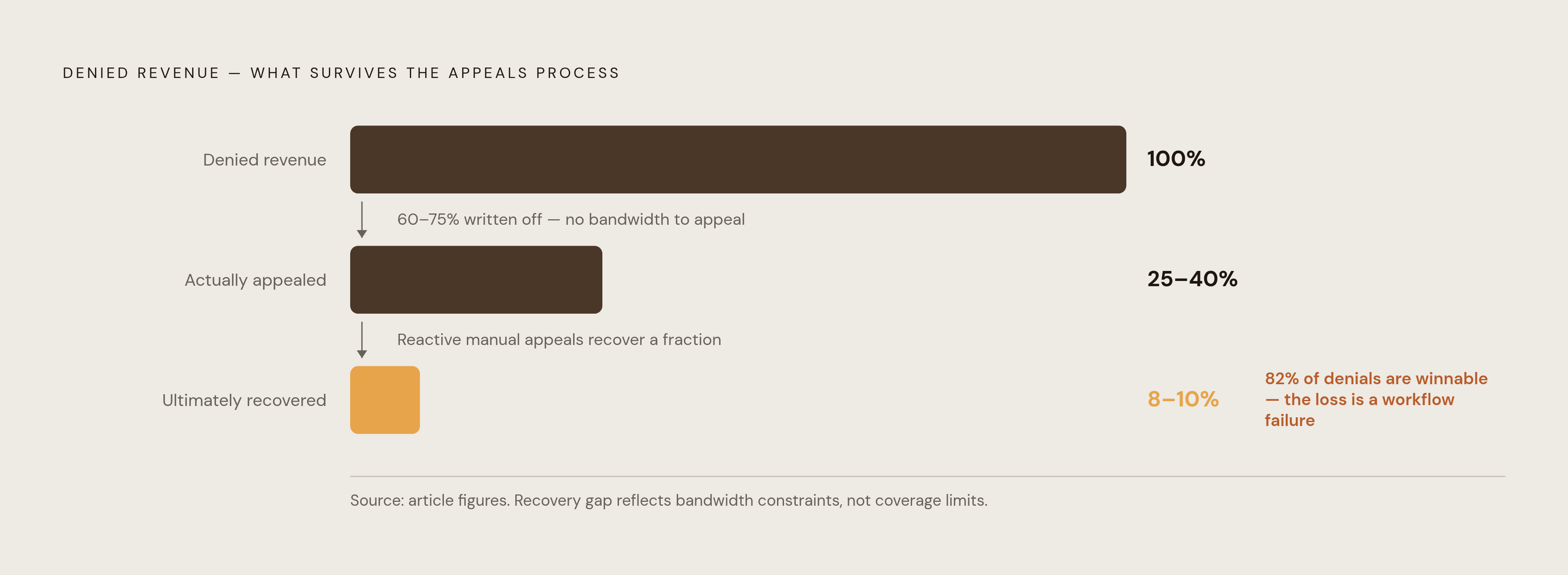
Appeals feel like the natural response to a denial, but the numbers make clear they can't carry the weight most practices put on them. Reactive manual appeals recover just 8 to 10% of denied revenue, which means the overwhelming majority of what's denied simply gets written off because nobody had the bandwidth to fight for it, even when it was payable.
The resource math explains why. A single appeal takes four to six hours of staff time and 45 to 90 days to resolve. At that cost, practices end up appealing only 25 to 40% of denials, which means most denials never even get a second look, let alone a successful one. The claim was payable the entire time. The money was never actually in dispute, it was just lost to a workflow gap.
That timeline creates a cash-flow problem that exists independent of whether the appeal ever succeeds. Practices end up financing their own payer disputes out of their own cash reserves.
There's a patient-care dimension in the revenue numbers too. Lost revenue and compromised patient care come from the same event. They're the same event, seen from two different sides of the same claim. Nearly 82% of denials are eventually overturned due to administrative errors, so the claim was payable all along and the loss is entirely a workflow failure rather than a coverage failure Pharmko. A denied rituximab infusion at $6,000–$8,000 is frozen capital for 45–90 days minimum, and for a practice with 30–50 denials per month, the cumulative AR backlog is a working capital problem. 89% of rheumatologists experience regular delays in patient access to prescribed treatments due to insurance barriers.
The point in the infusion workflow where denial prevention has to happen
By the time a claim gets submitted, most of what's recoverable has already been decided. The real control point in this revenue cycle isn't billing, it's scheduling, and that's a genuinely uncomfortable thing for most billing teams to accept, since it means the fix lives upstream of where they usually operate.
Real-time eligibility verification needs to happen at every single encounter, not just at onboarding, because coverage changes mid-cycle happen constantly and stay invisible without a per-encounter check. Authorization needs confirming against the specific drug, dose, frequency, and duration ordered. And white-bagging requirements need confirming before the drug ever gets ordered, because a specialty pharmacy carve-out denial isn't something an appeal can fix after the fact.
Before any authorization request goes out, the clinical documentation needs to be built to the payer's specific criteria. That means assembling DMARD failure records, disease activity scores, lab results, and imaging, whatever the particular payer is asking for, before the request is filed. The CMS-0057-F final rule, taking effect in 2026, caps standard PA decisions at seven calendar days and urgent reviews at 72 hours RazSomeChLab. Faster turnaround sounds like relief, but it actually raises the stakes: an incomplete request now gets denied faster, so the quality of what goes in on day one becomes more important. And that rule doesn't cover every biologic either. Physician-administered drugs that fall outside the rule's specified benefit categories aren't protected by it at all, which means infusion providers can't lean on this regulation as a safety net for their full drug list. The gap has to be closed by the practice's own workflow, well before the claim ever reaches a payer's desk.