Payer-Specific Denial Pattern Analysis for Infusion Therapy Reimbursement
Payer-specific denial patterns, not generic reason codes, unlock infusion claim recovery.

Infusion denial management works best when billing teams stop sorting denials by generic reason code and start sorting them by payer-specific policy behavior. If you want to recover denied infusion claims fast, you need a map of why denials happen, payer by payer and root cause by root cause, so you can fix the upstream workflow that creates each pattern before the claim ever goes out. If a practice treats denials as random noise, it chases the same losses every billing cycle. Practices that treat denials as payer behavior can predict them.
Why infusion denials concentrate by payer and service category
Infusion denials are not evenly distributed noise. They cluster by payer, by service category, and by denial type, and those clusters repeat reliably across billing cycles. A practice that pulls six months of denial data will find the same payers denying the same drugs for the same reasons, over and over, in a pattern as predictable as a payer's own policy manual.
Infusion drugs can cost tens of thousands of dollars per course of treatment, which makes payers prioritize them for prior authorization scrutiny. Payers have the strongest incentive to deny exactly where claim value is highest, so the clustering around infusion and injectable therapy is not an accident of claims volume. It reflects where payers have built the most aggressive review processes.
Most practices cannot see this pattern because their tools are not built to show it. General-purpose RCM platforms aggregate denials into broad buckets like "authorization," "medical necessity," and "coding." Those buckets flatten out the payer-specific logic that actually drives each cluster, so a practice looking at an aggregate "authorization" bucket has no way to tell whether a Medicare Advantage plan's step therapy rule and a commercial carrier's re-authorization timeline are behind the same number. A practice cannot fix what it cannot distinguish. Infusion-specialized platforms like Ruby RCM segment denial data by payer, service category, and denial type from the ground up, so you can see the operational signal instead of losing it inside aggregate reporting.
This is a structural information problem. Adding more billers to work a denial queue does not help if the queue itself hides which payer is doing what. The same denial reason code can mean entirely different things depending on which payer issued it and which policy criteria that payer applies, so a billing team working off aggregate CARC totals is often solving the wrong problem by volume instead of the right problem by payer. Denial prevention and appeal strategy built on aggregate data will always lag behind actual payer behavior, because the data was never organized to reveal that behavior.
The three denial categories that account for most infusion revenue loss
Infusion denials collapse into three root-cause categories: prior authorization failures, coding and hierarchy errors, and medical necessity challenges. Each one behaves differently depending on which payer is involved and which service line the claim covers, and understanding the distinctions gives a billing team the scaffold it needs to start sorting its own denial data by cause instead of by symptom.
Prior authorization failures take several specific forms. Authorization expiry mid-treatment cycle happens because infusion therapies run over extended periods in cycles, and if the original authorization covers only a fixed number of sessions or a set window, sessions delivered after that window close go out with no valid authorization on file, a condition that stays invisible until the denial appears on a remittance. Silent payer policy changes compound this problem: payers update their prior authorization requirement lists throughout the year, sometimes without notifying infusion centers, so a drug or code that needed no authorization last cycle can require one now. Code mismatches between the authorization and the claim cause denials even when the clinical intent is the same. An authorization approved for one CPT code or J-code will not cover a slightly different code used at billing. Medicare Advantage plans represent the sharpest version of this entire category. MA plans deploy AI-assisted utilization review that issues first-pass denials faster than many billing teams can respond to them, and they enforce step therapy requirements on biologics, so they demand documented fail-first on cheaper alternatives more aggressively than traditional Medicare does.
Coding and hierarchy errors stem from how infusion billing is structured around sequence and time. The billing hierarchy, which determines which CPT code counts as "initial" versus "subsequent" and whether administration was concurrent or sequential, is a primary source of errors because payers adjudicate based on documented start and stop times, correct initial-versus-subsequent selection, and correct separation of sequential from concurrent services. The 30-minute rule for add-on hours under CPT 96366 gets misapplied constantly: an infusion lasting 1 hour and 25 minutes bills as 96365 alone, while one lasting 1 hour and 35 minutes bills as 96365 plus one unit of 96366. Undercoding this distinction loses revenue outright, and overcoding it creates audit risk. NDC reporting adds another layer: many payers require the National Drug Code alongside the J-code and unit quantity, and a missing or mismatched NDC often triggers a rejection or denial, though payers vary in how hard they enforce it. Biosimilar J-code errors round out the category: biosimilar versions of biologics carry J-codes distinct from the reference product, and billing the reference product's code when a biosimilar was administered, or the reverse, is both a compliance risk and a common audit trigger that some payers enforce selectively on specific drugs.
Medical necessity challenges round out the third category, where payers push back on whether the documented clinical picture supports the treatment billed, a determination that varies by payer-built clinical criteria rather than a single universal standard. Sorting denials into these three categories, and then further by payer, turns a pile of rejected claims into a readable map of where a practice's exposure actually sits.
Building a payer-specific denial pattern map from your own claims data
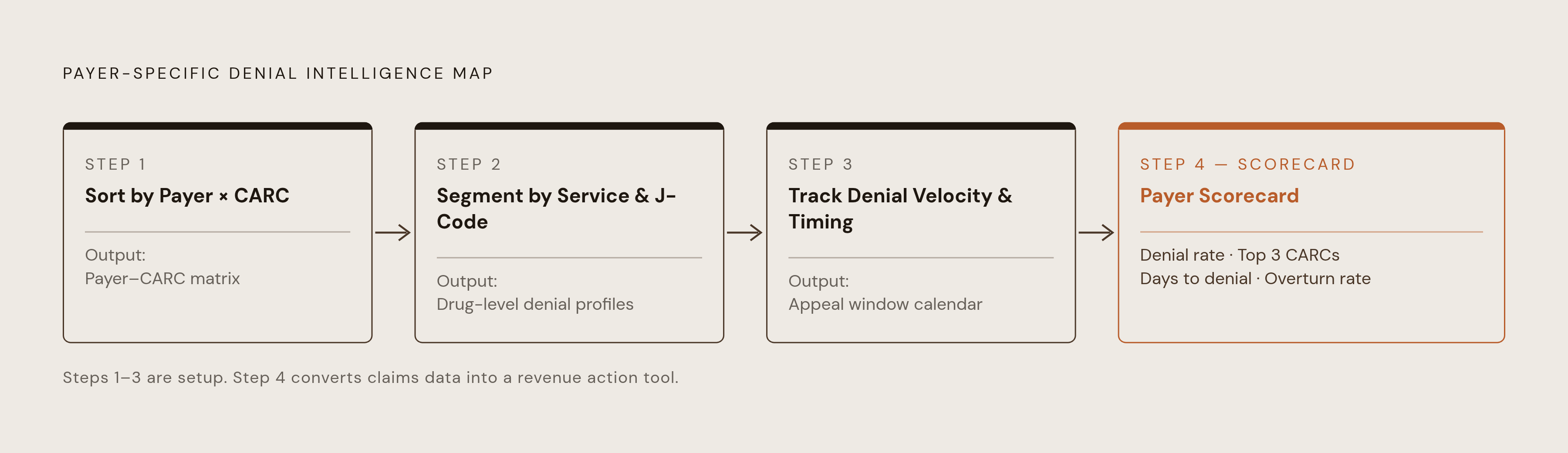
Payer-specific denial intelligence does not come from a vendor report or an industry benchmark. It gets built from a practice's own claims data, sorted along four dimensions: payer, denial reason code (CARC), service category, and time.
The first step is pulling denial data by payer, not by reason code alone. You should start the sort with the payer times CARC combination, because when CARC 197 fires on a chemotherapy infusion authorization, it means something different coming from a Medicare Advantage plan than from a commercial carrier running its own step therapy protocol. Within Medicare Advantage specifically, the top oncology denial drivers concentrate around three codes: CARC 197 for chemotherapy and infusion authorization, CARC 96 for non-covered charges, and CARC 109 for claims not covered by that payer, often triggered by specialty pharmacy carve-out misrouting. MA plans push step therapy on biologics harder than traditional Medicare, and they require pre-treatment fail-first documentation that traditional Medicare does not ask for. When a payer fires CARC 197 repeatedly on one specific J-code, that is a policy enforcement pattern in the data.
The second step is segmenting by service category and by drug. Denial behavior differs across oncology infusions, autoimmune biologics, and IVIG, and within each of those categories it differs further by the specific drug and J-code involved. Specialty injectables have become a particular denial magnet for Medicare Advantage plans because of step therapy requirements, with elevated denial rates affecting biologics, oncology infusions, and high-cost autoimmune therapies. The same drug can carry an entirely different denial profile under a commercial plan that has not adopted mandatory biosimilar substitution, so segmenting by drug and payer together is what reveals the real exposure.
The third step is tracking denial velocity and timing. By the time a denial appears on an aging report, the operational decision that caused it, an authorization that went unrenewed, benefits that went unverified, documentation that never got completed, often happened days or weeks earlier. Payers are rolling out AI tools that review and issue first-pass denials faster than many billing teams can respond, and that compresses the window between a denial being issued and the appeal deadline passing. You now need to track denial velocity by payer just to protect appeal eligibility, not as optional diligence.
The fourth step is building payer-specific scorecards from the first three. A useful scorecard shows, for each payer, the denial rate by service category, the top three CARC codes by volume and dollar value, average days to denial, and the appeal overturn rate. Scorecards that compare expected reimbursement against actual reimbursement by payer and by site serve a parallel purpose: they are the primary tool for catching underpayment patterns and contract compliance gaps, and they reinforce the denial analysis because a systematic underpayment and a systematic denial frequently trace back to the same root cause, whether that is a code mismatch or a misapplied contract term. Running this process once produces a snapshot. Running it every billing cycle produces a live map of payer behavior, and that map only pays off if it drives a change in how claims get built before they are submitted.
Keeping this map current across every billing cycle is itself an operational workload, so this is where you need to combine automation with experienced review. Ruby RCM combines automated sorting and flagging of payer-specific denial clusters with hands-on review by operators who understand the clinical and billing context behind each one, so new patterns get caught and acted on before they compound into larger revenue loss.
Translating the denial map into targeted prevention, starting upstream at scheduling
Once a practice knows which payer denies which service for which reason, the next move is pushing the intervention point upstream, because most recoverable denial conditions get seeded at scheduling and benefits verification, long before a claim exists. An infusion claim's outcome is set by everything that happens before it gets submitted: whether the authorization was still current, whether benefits were fully verified, whether clinical documentation supported medical necessity, and whether a treatment plan change triggered a re-authorization requirement that nobody caught.
Authorization management has to run as a recurring operational obligation. Most specialty therapies need periodic reauthorization tied to clinical response or a fixed interval, so authorization expiry mid-cycle is predictable, and you can prevent it once you map the payer-specific renewal timeline in advance and track it against the treatment calendar. Regulation is starting to standardize some of this, as the NAIC's December 2025 Prior Authorization White Paper describes the NCOIL Prior Authorization Reform Model Act, which calls for prior authorizations on chronic or long-term conditions to stay valid for 12 months or the duration of treatment, whichever is shorter. These rules have not been adopted uniformly across states or payers, so you still need to track payer-specific validity windows instead of assuming one standard applies everywhere. Payer policy monitoring has to stay active for the same reason: payers update authorization requirement lists throughout the year, often without notice, and a drug that needed no authorization last quarter can require one now. Revenue cycle operations built specifically for infusion can track authorization window expiry in advance at the point of scheduling, which turns what would otherwise be a reactive denial into a proactive control exercised weeks ahead of the treatment date.
Documentation readiness has to be built payer by payer, before the patient ever sits down in the chair. Missing or insufficient clinical documentation at the point of authorization submission is a leading denial driver, and for biologics specifically, that documentation includes prior DMARD trial records, current disease activity scores, recent lab results, and ICD-10 codes that match the approved biologic indication precisely. Medicare Advantage plans build their own clinical criteria, separate from Medicare's National Coverage Determinations, so the payer-specific denial map you built in the previous stage tells you exactly which payer requires which documentation elements. Submission packages built to each payer's actual criteria replace a generic template that was never going to satisfy an MA plan's specific review standard.
White bagging policies deserve the same payer-specific treatment at intake. White bagging rules vary by payer, and a practice that has already mapped which payers apply white bagging to which drugs can flag those cases at scheduling, before the drug is ever ordered or administered, instead of discovering the policy only when the claim is billed and no recovery path remains.
Coding and hierarchy controls belong at the point of documentation, not at the point of claim submission. Infusion start and stop times need to be recorded for each drug administered, and nursing flow sheets or electronic infusion records are the standard for doing that reliably. Hand-written start and stop times on paper superbills remain the most common source of time-based hierarchy errors and the most vulnerable to an audit challenge. J-code unit selection and NDC reporting need the same real-time verification against the specific product administered; you cannot just reconstruct them from memory once the claim reaches billing. Billing the reference product's J-code when a biosimilar was the drug actually administered carries both a compliance risk and an audit trigger that no amount of billing-stage correction can fully undo after the fact.
Segmenting denial data by payer, service line, and root cause shows which payer-specific behaviors are actually driving the revenue loss a practice is seeing. Isolating these patterns at the line level, instead of reporting denials in aggregate, lets platforms identify the recurring conditions that upstream prevention work should target first. The scorecard built from a practice's own claims data is only as useful as the scheduling and documentation changes it drives, and those changes work because they are calibrated to a specific payer's known behavior rather than built from a generic checklist that treats every payer the same.