Contractual Allowable Versus Actual Payment Variance Detection
Catch silent underpayments before they disappear into contractual adjustments.

A paid infusion claim and a correctly paid infusion claim are two different things, and the gap between them is where physician groups lose money without ever seeing it happen. A claim can clear adjudication, post to the ledger, and close out with zero denial codes attached, while the payer has still remitted less than the contract requires. This piece walks through why that gap exists, why infusion billing is especially exposed to it, and what a reconciliation workflow has to do to catch it before the money is gone for good.
Accepted, paid infusion claims versus correctly paid infusion claims
If a payment posts without a denial attached, a billing team can't tell whether the amount was right. It only tells them the payer processed the claim and sent money. Most revenue cycle dashboards are built to track denials: rejected claims, missing documentation, medical necessity disputes, timely filing issues. None of that infrastructure looks at whether the dollar amount on the remittance matches what the contract actually promised.
That's the blind spot. A payer can remit substantially less than the contracted allowable, and if the claim isn't denied, the billing system marks it resolved. No flag gets raised, no human reviews it twice, and the account moves on to the next claim in the queue. The revenue is gone because nobody checked.
It gets worse when underpayments get coded as contractual adjustments. A contractual adjustment is supposed to reflect that billed charges exceed the allowable rate the practice agreed to accept, not an unexplained shortfall. When a short payment gets lumped into that write-off category automatically, it disappears into a bucket that looks completely normal on a monthly report. The dashboard stays clean. The money stays gone.
Silent underpayments are the biggest invisible leak in a physician group's revenue cycle, and they happen for exactly this reason: a payer remits less than the contracted allowable, and the billing system posts it as a fully resolved claim with nothing distinguishing it from a correctly paid one. Very few billing workflows include a step where someone checks the posted payment against what the payer was contractually obligated to pay. The standard RCM dashboard flags denials. It does not flag the gap between what a payer owed and what it actually sent. Infusion-focused platforms like Ruby RCM build contract-level reconciliation into the core workflow because infusion claims carry enough dollar weight per line that a silent underpayment, left unchecked, becomes a permanent write-off rather than a correctable error.
Why infusion and buy-and-bill claims are disproportionately exposed to payment variance
Every specialty has some exposure to payment variance. Infusion has more of it, and the reason comes down to how the money moves. Infusion claims carry high drug acquisition costs, unit-sensitive J-code billing, and ASP-based reimbursement formulas, so a small percentage error turns into a large dollar loss on a single claim.
Buy-and-bill providers purchase the drug before they know how the claim will adjudicate. They carry that acquisition cost no matter what the payer eventually decides to remit. The margin between what ASP-based reimbursement pays and what the practice actually spent to acquire the drug is the operating buffer that keeps an infusion center solvent, and any underpayment eats directly into that buffer. There's no deferring the cost. The drug is already bought and administered by the time the remittance arrives.
J-code unit accuracy adds another layer of exposure. A single miscalculation in how units are counted, or an incorrect rate applied by the payer at the line level, appears on a standard remittance advice as a normal payment, with nothing to distinguish it from a correct one. It only becomes visible when someone compares the paid amount against the contracted rate for that specific code, at that specific unit count. Without that comparison, the error just sits there, repeating on every similar claim that payer processes.
Payers also revise fee schedules, coverage policies, and reimbursement methodologies on their own schedule, and those changes don't always come with a clear notice to the practice. Payments keep arriving. They just arrive at a different rate than the contract specifies, and nothing about the remittance format tells the billing team that the underlying rate shifted. Outdated or inaccurate fee schedules can leave providers underpaid across an entire payer agreement, not just one claim, and that kind of systemic error goes unnoticed without structured review built specifically to catch it.
Infusion contracts make it harder still, because they carry specialty-specific carve-outs, modifier rules, and place-of-service distinctions that a generic reconciliation tool isn't built to model. You need contract logic built specifically for infusion billing to calculate the variance correctly. Infusion contracts frequently carry specialty-specific carve-outs, modifier rules, and place-of-service distinctions that generic reconciliation tools are not built to model. A revenue cycle platform built specifically for infusion billing, which is the approach Ruby RCM takes, embeds those contract nuances directly into the payment engine, so the variance calculation reflects the reimbursement logic that actually applies to buy-and-bill and center-based infusion practices.
How Payers Generate Payment Variances
Underpayments from payers aren't random mistakes. They follow patterns, and those patterns make systematic detection possible.
Incorrect rate application is the most common pattern. A payer applies an outdated fee schedule, or pulls a rate from a different contract tier than the one that actually governs the claim. The remittance still shows a real payment. It's simply the wrong amount, and nothing on the face of the document indicates that.
Bundling errors work differently. The payer collapses reimbursement for line items that should be billed and paid separately, beyond what applicable NCCI edits actually require. The claim pays. The total is just lower than it should be, and the practice has no automatic flag telling them a bundling rule was applied incorrectly.
Modifier misapplication follows a similar logic. A payer adjudicates a claim without properly recognizing a modifier that would have changed the payable rate. The claim doesn't deny. It pays, just at a fraction of what the contract specifies for that service with that modifier attached.
Reimbursement logic errors cause all three of these. When claims get processed under the wrong set of payer rules, the underpayments can persist across many claims before anyone notices, because the error sits in the payer's processing logic itself, not in any single claim.
Two more patterns deserve attention because they're harder to spot. Payers periodically revise reimbursement methodologies and fee schedules, and if a practice's internal contract model doesn't get updated at the same time, the comparison between expected and actual payment produces false positives or misses real variances. Pre-payment audits add a different wrinkle: when a payer holds a payment and releases it only after reviewing documentation, the amount that eventually gets paid can reflect the payer's interpretation of the documentation rather than the rate the contract actually specifies. That kind of variance never gets coded as a denial, so it never triggers an appeal workflow.
What ties all of these together is that none of them produce a denial code, an appeal trigger, or a visible flag in a standard billing workflow. Payer underpayments follow recognizable, payer-specific patterns, and a contract-aware system designed for infusion can identify them, while a standard posting workflow treats the payment as resolved and moves on. This is where denial recovery strategy has to change: instead of grouping variance into generic error buckets, infusion billing teams need to track which payers generate which patterns and which contract rules are being misapplied. That shift turns variance detection into a source of ongoing contract intelligence.
What contract-to-remittance reconciliation requires at the claim-line level
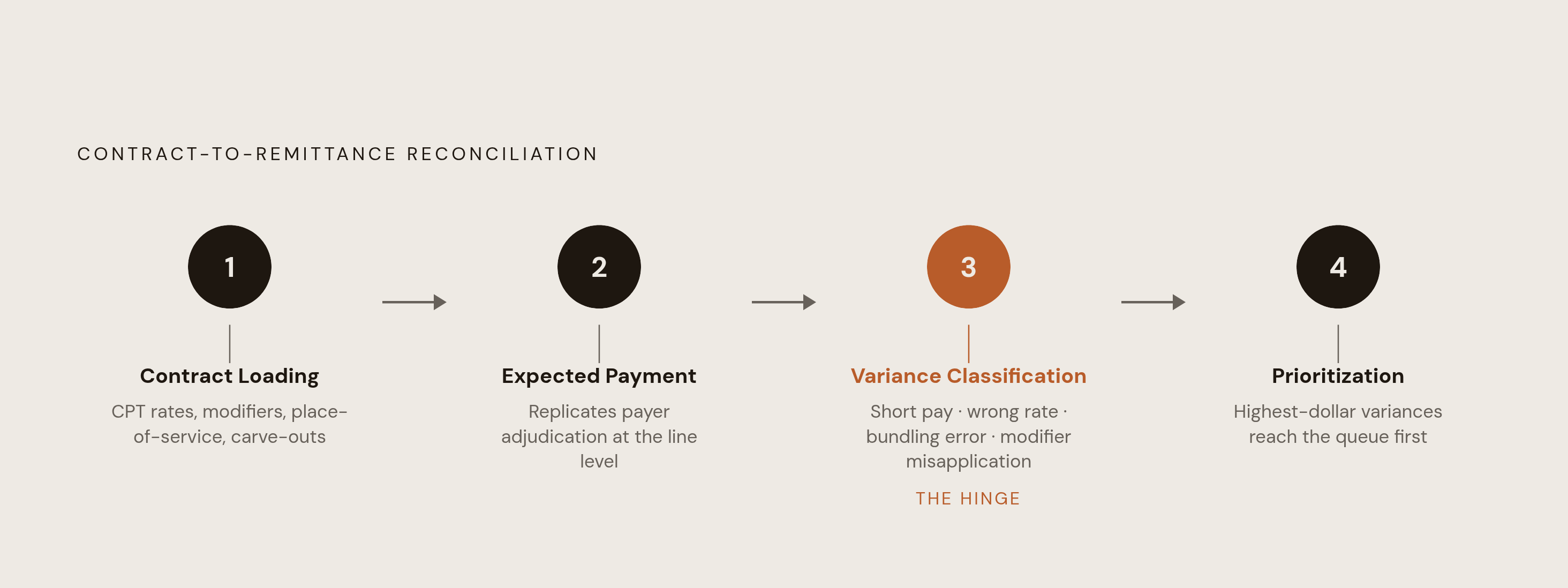
Finding payment variance at scale takes a structured process, not manual spot-checking and not a glance at a generic dashboard. The workflow runs in four steps, and each one depends on the one before it.
The first step is contract loading and fee schedule management. Every payer contract has to be loaded into a payment engine at the CPT level, including modifiers, place-of-service rules, carve-outs, and exclusions. Underpayment analysis is only as accurate as the contract data sitting underneath it. If the contract loading is outdated or incomplete, blind spots open up, and underpayments can continue across an entire payer agreement without anyone catching them.
The second step is expected payment calculation. For every claim that gets adjudicated, the system calculates what the contract says the payment should be at the line level, essentially replicating the payer's own adjudication logic using the terms that were loaded in step one.
The third step is variance identification and classification. The actual payment gets compared against the expected payment, and any gap gets quantified in dollars and classified by type: short payment, incorrect rate application, bundling error, modifier misapplication. Classification matters because it determines which recovery path the claim takes next. A bundling error gets appealed differently than a rate misapplication.
The fourth step is threshold-based prioritization. Not every variance deserves the same urgency. Prioritizing by dollar value puts the highest-value recovery opportunities at the front of the queue, and that matters more in infusion than almost anywhere else, since a single claim can carry a large drug cost tied to it.
Rivet Health's framework shows what this architecture looks like in practice: centralized payer contracts and fee schedules, always-on auditing for short payments, line-item detail that shows exactly where the variance occurred, and automatic grouping of similar discrepancies into recovery projects with an estimated dollar value attached. TruBridge applies a comparable model on the hospital side, with contract database setup, claim-level reimbursement validation, variance categorization by payer and service type, and a structured appeals process for recovery. Ruby RCM, built specifically for infusion, combines software automation with hands-on billers managing benefits, authorizations, denials, underpayments, cash posting, and accounts receivable, reconciling payments against expected reimbursement line by line so a short payment becomes a flagged recovery instead of a quiet write-off.
Manual spot-checking can catch a sample of errors, but it can't catch patterns. A single underpayment on one claim is a billing error. The same underpayment recurring across a payer's entire book of claims is a payer behavior, and that distinction is only visible once the comparison runs systematically across every claim, not just a handful.
How infusion-specific denial patterns reveal contract intelligence
Reviewing variance claim by claim finds individual dollars. Reviewing it by payer, CPT code, and modifier finds patterns, and patterns are what a practice can actually act on, whether that action is an appeal escalation or a renegotiated contract term.
A single underpayment might just be a processing mistake. The same variance appearing across dozens of claims from the same payer constitutes a pattern, and once documented, that pattern becomes a payer behavior that can be escalated directly, with contract compliance scores by payer feeding into negotiation priorities for the next renewal cycle. Pattern detection at the payer level turns a one-off appeal into a contract interpretation dispute, a fundamentally different conversation with the payer and a higher ceiling on what can be recovered.
Salem Gastroenterology's experience with Rivet shows what this looks like when it actually happens. What first looked like a minor reimbursement inconsistency turned out, once the claims data was reviewed systematically, to be a contract interpretation difference worth hundreds of thousands of dollars. Nobody found that by reviewing claims one at a time. It surfaced because the data was aggregated and analyzed as a pattern.
The same logic applies to rate increases payers announce publicly. A headline rate increase doesn't automatically mean more revenue if the increase is concentrated on codes the practice rarely bills. You need code-level analysis weighted by actual claim volume to see whether a contract change actually helped. If you model a proposed rate change against real claims data before signing anything, variance data becomes a negotiating asset, not just a recovery tool. Patterns documented through ongoing variance analysis feed directly into the next contract renewal, so a practice can manage contracts proactively before problems compound, instead of just reacting to bad payments after the fact.
Underpayment recovery appeals versus denial appeals
A denial appeal argues that the payer was wrong to reject the claim. An underpayment appeal argues that the payer calculated the claim's value incorrectly. Those are different disputes that require different documentation, different arguments, and often a different escalation path. Most infusion practices have built denial workflows. Very few have built underpayment-specific ones, and that gap is exactly where recoverable revenue turns into permanent loss.
Underpayment appeals succeed when they're specific. A strong appeal packet references the exact contract clause, the fee schedule exhibit, or the rate language that the payer misapplied, along with supporting documentation tied directly to that claim line. A generic complaint that simply says "this payment seems low" doesn't carry the same weight and doesn't get treated the same way by a payer's appeals desk.
Timing is the operational constraint that decides whether any of this matters. Underpayments not appealed within a payer's filing window become unrecoverable, regardless of how valid the original claim was. Missing a deadline converts a correctly identified variance into a permanent loss, and in environments without active contract management, underpayments often don't get detected at all until the appeal window has already closed.
Infusion carries an added wrinkle: prior authorization. A payment can look correct relative to the authorization on file while still being wrong relative to the actual claim and the contracted rate. Fixing authorization accuracy upstream is part of underpayment recovery, not a separate workstream from it. Clearview Cancer Institute's revenue analyst found that prior authorization issues were directly suppressing correct payment, to the tune of tens of thousands of dollars per patient, and that connection only showed up once claim-level analysis was done systematically. Nobody found it by looking at one claim at a time.
Escalation protocols matter just as much as the initial appeal. When a payer doesn't respond to a first appeal, resubmitting the same documentation again rarely changes the outcome. A structured escalation path, not repeated identical submissions, is a required part of any underpayment recovery workflow, not an optional add-on for difficult payers.
Ongoing variance detection inside an infusion practice
Catching payment variance consistently requires a reconciliation operation that runs continuously. Infusion claim volumes are high, drug costs attached to those claims are high, and appeal windows are short enough that a quarterly or even monthly batch review routinely misses the deadline to recover money that was genuinely owed.
Always-on auditing compares every adjudicated payment against the contract at the claim line as soon as it posts, giving a practice the baseline it needs to protect revenue in real time. With a batch approach, reviewing claims in bulk every few weeks or months, underpayments sit unnoticed in the gaps and age past the point where an appeal is even possible. By the time a quarterly audit catches the pattern, half the claims affected by it may already be outside their filing window.
That operational reality is why variance detection has to be built into the daily workflow rather than treated as a separate audit project layered on top of it. When infusion practices embed contract-level reconciliation into claim posting itself, rather than reviewing it after the fact, they can convert underpayments into recoveries instead of write-offs. The alternative, waiting for a periodic review to catch what the posting process missed, keeps leaving money on the table precisely in the specialty that can least afford to lose it.
Sources
- Payer Behavior and Revenue Leakage: The Hidden Cost of Payer Variability in Radiology Reimbursement - ImagineSoftware
- Ruby RCM | Revenue Cycle Management Built for Infusion
- Curing the Buy-and-Bill Blues: A Financial Health Check for Your Infusion Center
- Infusion & Injection Therapy Billing Terms Explained — AMBCI
- Challenges Facing Providers with Revenue Cycle Management
- Appealing Denied Claims FAQ