Line-Level Remittance Posting for Infusion Claims
Underpayments in infusion claims hide in plain sight without line-level remittance auditing.
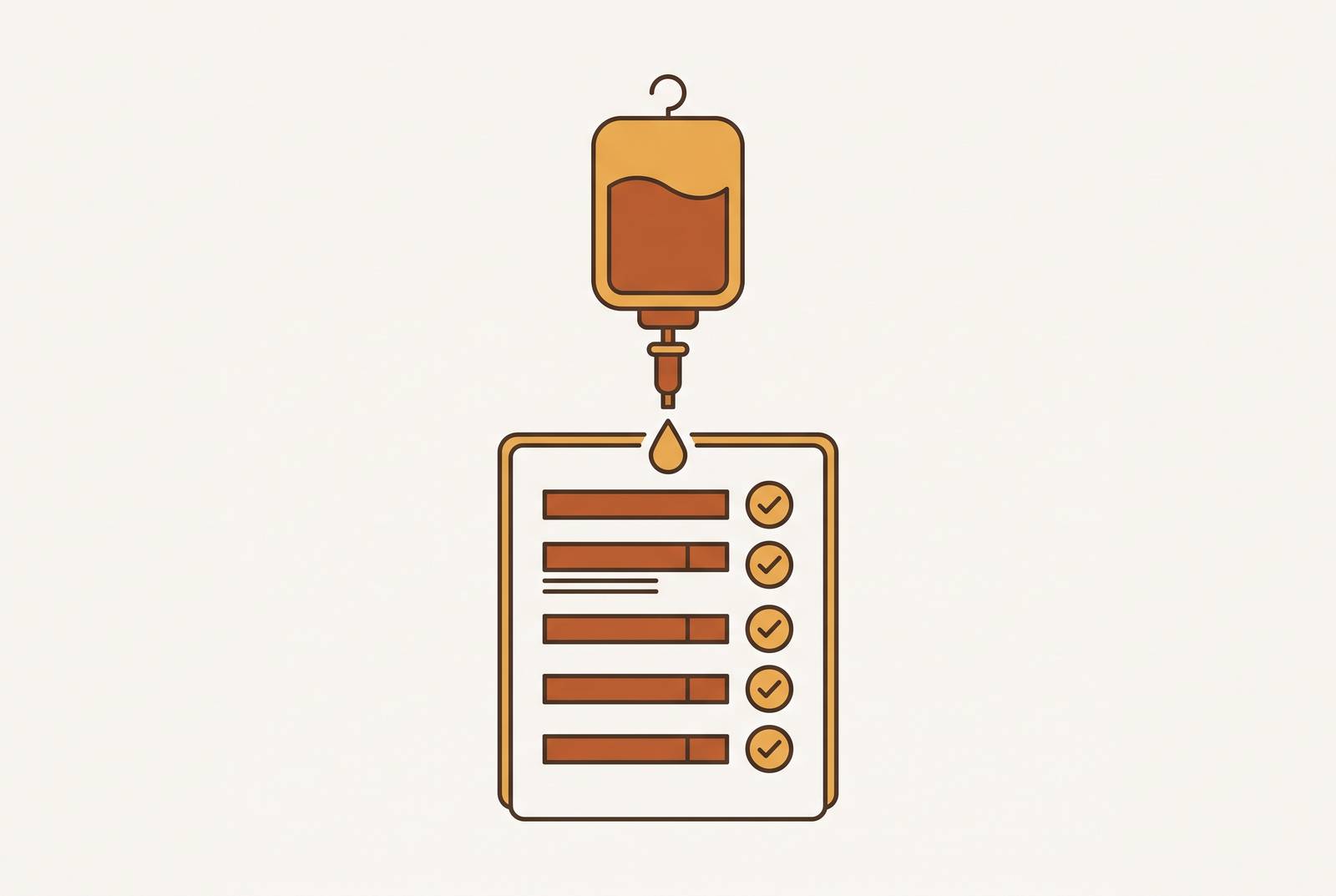
Infusion billing runs on two separate payment streams inside a single claim. One is the drug charge, billed under a J-code and tied directly to what the practice paid to acquire the drug. The other is the administration service, billed under a CPT hierarchy and driven by time and complexity. These two streams are adjudicated independently. A payer can underpay, adjust, or deny the drug line while paying the administration line in full, or the reverse, and nothing about that split appears as an obvious error on the remittance.
The dollar amounts involved make this more than a technical detail. The margin on the drug portion of that visit, under a buy-and-bill arrangement, is the gap between what the payer reimburses (ASP plus a percentage) and what the practice actually paid to acquire the drug. If the J-code line is underpaid, or if the unit count on the claim is wrong, the margin does not shrink. It disappears.
Multi-drug infusion encounters add another layer of risk. Billing has to sequence CPT codes correctly across primary, concurrent, sequential, and push services. A sequencing mistake, or a missing add-on code, rarely triggers a denial that someone would notice and investigate. It produces a lower payment that posts without friction, looking like a normal remittance rather than an error. Because infusion treatment for chronic conditions happens on a fixed, recurring schedule, whatever mistake happens on visit one at a given dose does not stay isolated to that visit. It replicates at the same dose, visit after visit, compounding a single undetected error into a pattern of loss that episodic, one-off outpatient care never produces.
What an 835 ERA contains
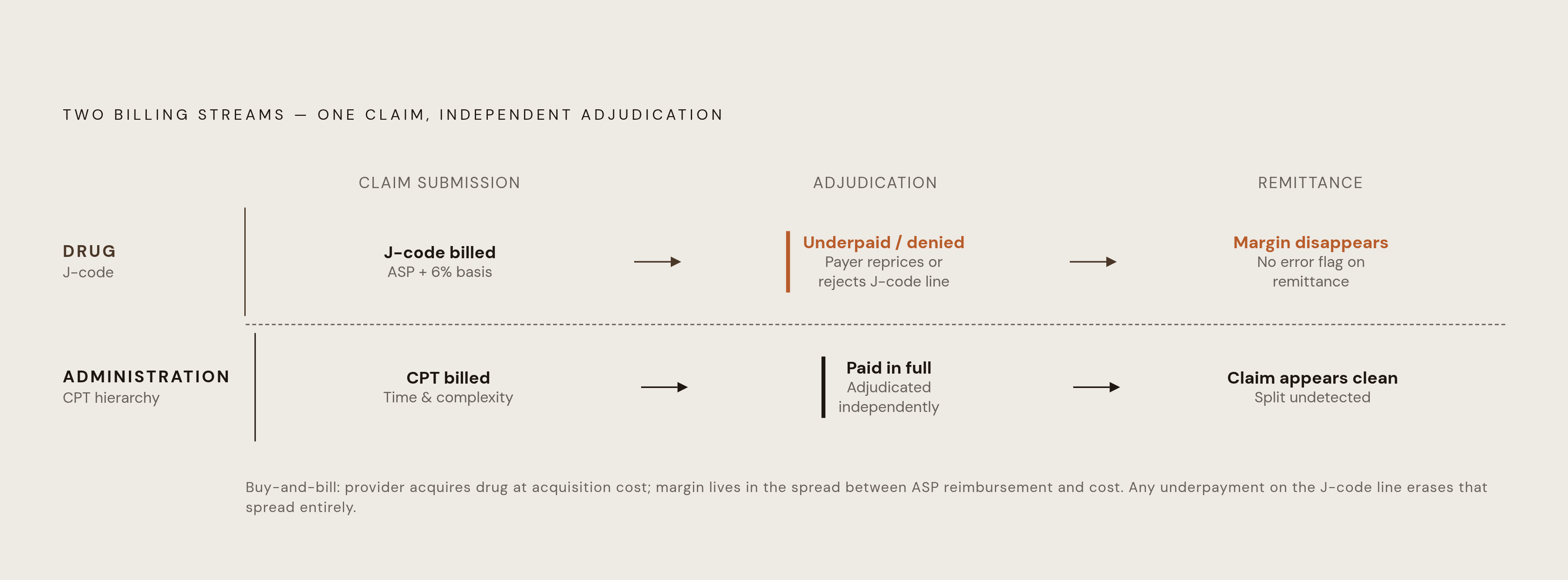
The 835 electronic remittance advice is the payer's full account of how it adjudicated the claim, not a payment notice in the way a receipt is, and it holds far more detail than most posting workflows ever use. Buried inside that file, at the line level, is the exact information needed to tell a clean payment apart from a quiet underpayment.
Each service line carries its own adjustment amount, a group code (CO for contractual obligation, OA for other adjustment, PR for patient responsibility), a Claim Adjustment Reason Code, and a Remittance Advice Remark Code attached specifically to that line. Separately, the file can carry Provider-Level Balance adjustments: interest, recoupments, or other non-claim-specific movements that have nothing to do with any particular service line. Group codes, CARCs, and RARCs explain what happened at the claim or line level, while PLB codes explain what happened at the provider level, and a posting workflow can only read them separately if it preserves that separation. CMS's own transmittals on CARC and RARC code sets confirm this isn't a vendor convenience; it is a regulatory structure built specifically so that adjudication decisions can be tied back to the exact claims and lines a provider submitted.
The practical danger is that most billing staff never see this layer directly. What they see is a translated payment screen inside the practice management system, a summary that tells them a claim paid. That translation strips out the detail. A remittance that looks like a clean, full payment on screen may be carrying a CARC on one specific service line that, read in isolation, looks like noise, but read across remittances, signals a systematic underpayment pattern from that payer. The 835 transaction is not a receipt; it is the payer's adjudication story, and it carries more information than most posting workflows actually use.
Aggregate-level posting and the permanent write-off
Underpayment recovery and dispute filings depend on an audit trail, and aggregate posting is what destroys it. A claim that posts as "paid" at the total level can be hiding a line-level short payment, and once that account closes, the money is gone for good.
The failure is built into how auto-posting works, not a staffing problem or an attention problem. The claim closes, the posting team moves on, and the underpayment only resurfaces later, during a contract review or while assembling an Independent Dispute Resolution packet, by which point it is buried under clean-looking balances and too many other priorities. Auto-posting is the central mechanism behind this. It should never run as an all-or-nothing switch. It needs rules for small-dollar variances, a CARC-to-action mapping, and payer-specific exceptions built in. Without those rules, recoupments sitting unflagged in a batch, denials carrying unfamiliar code patterns, and claims that posted with no usable explanation all get swept into closed status along with everything else.
Infusion billing makes this especially expensive, because drug reimbursement under buy-and-bill has to be checked against the contracted rate, typically ASP plus a set percentage under Medicare, at the line level. The loss is never visible anywhere in the posting workflow.
The infrastructure gap is measurable. High-performing infusion centers that build that infrastructure catch the large majority of their underpayments, while typical centers catch far fewer, and for centers without systematic tracking, underpayments represent a meaningful share of net revenue every year. Centers that pair automated posting with rules built around payer-specific reimbursement logic are the ones that can tell a legitimate variance apart from a J-code shortfall, because that distinction requires treating buy-and-bill drug margin as its own audit point rather than a line item folded into an aggregate total.
What line-level posting requires operationally
Line-level posting means matching every service-line detail in the 835 back to the corresponding line on the submitted claim, checking the payment against the contracted rate for that specific line, and sending any variance, not only outright denials, into a work queue before the account is allowed to close. Building it into daily operations takes four things working together at once.
The first is a CARC-to-action mapping: a system that tells staff what to do with each adjustment code the moment it appears, whether that means closing the line, routing it for review, flagging it for appeal, or triggering secondary billing. A payer that consistently applies a particular CARC to infusion add-on codes needs its own dedicated routing rule rather than a generic catch-all exception. The third is contract rate logic built directly into the posting workflow itself, with the expected reimbursement for each J-code and CPT line known in advance and updated whenever ASP changes or a payer contract gets renegotiated. The fourth is PLB monitoring run as its own separate function, since provider-level recoupments arrive in the 835 without being attached to any specific claim line, and someone has to trace each one back to its originating claim before accepting it as legitimate.
A well-formed 835 file makes this work considerably easier, because it allows staff to match payment references and adjustments directly rather than reconstructing the story from free text or scanned paper documents. It is a discipline, not a feature a system simply has. It is a discipline a team builds and maintains, requiring human judgment on top of system rules, especially where payer behavior shifts.
Done well, clean line-level posting tightens everything downstream of it. Appeal documentation is already assembled straight from the remittance record rather than built from scratch later.
How 2025–2026 payer behavior makes line-level visibility more urgent
Payers have moved toward algorithmic front-end scrutiny that produces denials faster and with less explanation attached to them. That shift means the actual reasoning behind a denial increasingly lives inside the CARC and RARC codes on the remittance itself rather than in any denial letter a practice receives. Two specific patterns matter for infusion.
Infusion therapies and specialty medications absorb a disproportionate share of these denials. Commercial payers are converging on the same handful of themes: diagnosis specificity, step therapy requirements, and site-of-care preference. The same J-codes and CPT combinations appear as targets across remittances, a pattern that is visible only to a practice reading remittances at the line level. A practice reading at the aggregate level sees a denial rate, a single number trailing behind what already happened. A practice reading at the line level sees which CARC is driving volume, on which drug, on which CPT code, with which payer, information a billing team can act on before the next claim goes out.
The obvious counterargument is that the real defense against algorithmic denials is tightening the front end, cleaner prior authorizations and better documentation before the claim ever goes out. That is true as far as it goes, but payer AI systems are evolving on both sides of the transaction, surfacing patterns of payers misapplying their own rules that only the remittance record can expose after the claim has already been adjudicated. Front-end discipline and line-level remittance reading are not substitutes for each other. They catch different failures at different points in the process.
Why prior authorization tracking and remittance posting must be connected, not siloed
Whether a claim is payable at all is often decided before the infusion ever happens, at the authorization stage, but an authorization-related denial becomes visible only in the remittance. Line-level posting can tell whether a denial is rooted in an expired or mismatched authorization or in a coding or coverage problem. Most practices run authorization tracking and remittance posting as two separate departments with two separate systems. That separation is where recoverable revenue quietly gets lost.
Recurring infusion treatment makes this worse. When reauthorization lapses, the resulting denial does not look like an authorization problem on the remittance. It looks like an ordinary payment variance, easy to miss inside an aggregate posting workflow, even though it is a recoverable claim with its own specific appeal path.
The connection between these two functions has to run in both directions to actually work. Posting teams that can identify auth-related CARCs at the line level should feed that information straight back to the authorization team before the next infusion cycle starts, which prevents the next denial instead of only appealing the one that already happened. Running these as separate silos means both teams are independently rebuilding half of the same picture. Connecting authorization tracking to remittance posting is not a matter of administrative tidiness. It closes a specific, recurring channel through which revenue otherwise leaks on a predictable schedule.
Recovering underpayments that survive posting
Not every practice has line-level posting running cleanly today, and underpayments that slip through still have a recovery path, but only if the record needed to support it was preserved. Recovery depends entirely on whether the line-level remittance record survived. A claim posted and closed at the aggregate level leaves no audit trail capable of supporting an IDR filing or a payer contract dispute.
Where that record does exist, recovery follows a specific sequence. Contract rate validation comes first, identifying the gap between what the payer actually remitted and what the contract requires at the line level. This step needs the contracted rate for the specific J-code or CPT, the ASP quarter that applied on the date of service, and the exact remitted amount for that line. Next comes CARC-to-root-cause mapping, which sorts out whether the underpayment came from a contractual reduction applied where it shouldn't have been, a bundling edit that doesn't actually apply to this claim, or a straightforward ASP miscalculation. From there, the documentation package for an IDR filing or appeal gets built directly from the remittance record combined with the contract itself. Without the line-level remittance, there is no package to assemble.
Timing matters here as much as process. The objection that recovery work costs more staff time than small-dollar variances are worth misses how payer behavior actually operates. The same pattern that produces a small variance on one claim produces it on every claim of the same type from the same payer, and recovery pursued at the payer-and-CARC pattern level, rather than claim by claim, is what changes that math.
Line-level posting done correctly, and where Ruby RCM fits
A line-level posting operation that actually works combines three things: system rules capable of reading CARC, RARC, and PLB detail at the line it belongs to, contract rate logic that stays current as ASP and payer contracts change, and staff trained to treat variances as signals worth routing rather than noise to clear. None of the three substitutes for the others. Rules without trained staff miss context; staff without rules drown in volume; either without current contract logic is just reading remittances without any benchmark to check them against.
Because infusion drug reimbursement rests on the accuracy of a single J-code line, one that can represent tens of thousands of dollars in acquisition cost on its own, any posting workflow that collapses the drug stream and the administration stream into one aggregate reconciliation loses sight of exactly the point where underpayments most often happen. On a recurring treatment schedule, that blind spot does not stay contained to one visit. It compounds across every visit that follows at the same dose.
Ruby RCM is built specifically around this problem: preserving line-level ERA detail, mapping CARC and RARC codes to infusion-specific denial and appeal workflows, and keeping contract rate logic current against ASP and payer changes, so that a variance gets caught and routed before the claim closes rather than discovered months later during a contract review. Line-level posting is what turns that leak into something a practice can see, measure, and recover.