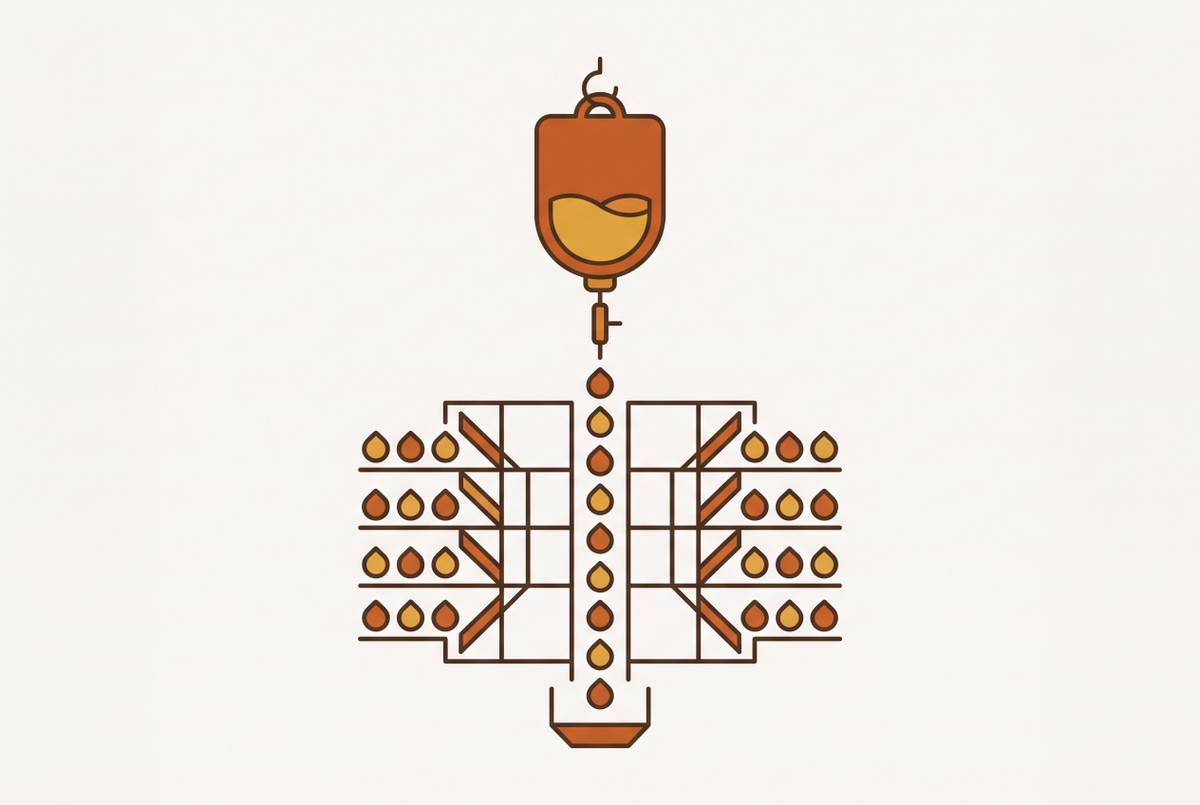
Denial Workflow Design by Root Cause Category
Design denial workflows separately by root cause to match each problem to its actual fix.

A denial queue that keeps growing week over week, staff spending more hours reworking claims than filing new ones, cash flow that swings depending on which payer decided to push back this month: that pattern is familiar to anyone running an infusion practice. The usual response is to add more staff to the queue, or add software that sorts it faster. Neither fixes the underlying problem, because a prior auth failure, a J-code unit error, an eligibility lapse, and a medical necessity gap each start at a different point in the revenue cycle, involve different people, and need a different fix. Treating all four as the same kind of problem, just because they land in the same queue, means treating things as equivalent that are not.
ACU-Serve's 2026 analysis states that infusion billing denials are symptoms of operational problems upstream, not isolated billing errors. A denial for missing prior authorization means a process broke down before the claim ever existed. It is not something a biller can rework into a clean claim after the fact.
The financial exposure in infusion makes this design flaw expensive in a way it might not be elsewhere. A single denied biologic can represent tens of thousands of dollars in drug acquisition cost with no reimbursement coming back. A slow, generic queue that treats every denial the same way has far less room for error in infusion than it would in a specialty with lower-cost claims.
Payer behavior has raised the stakes further. A recent survey by Eliciting Insights found that healthcare organizations investing in multiple automation tools for administrative tasks rose sharply from 2025 to 2026. More automation sounds like the fix, but software alone cannot tell a practice whether a given denial started at intake, at authorization, in coding, or in billing, unless a root-cause framework already exists to sort it. Technology without a structural map just processes the same confusion faster.
Each root cause category in infusion follows its own chain of events, and that means each one needs its own workflow, its own escalation path, and its own point of prevention. The rest of this piece maps what those workflows look like, category by category.
The six root cause categories that infusion denials fall into
Infusion denials sort into six root cause categories, and each one connects to a different stage of the revenue cycle: front-end registration and eligibility, prior authorization, clinical documentation and medical necessity, coding (J-codes, units, modifiers), claim submission mechanics, and payer processing. This is the map the rest of this piece works from, not an academic exercise. It's the structure that determines where a denial gets routed and who owns the fix.
The remittance code a payer sends back tells a biller how the payer labeled the denial, but it does not say which internal process actually failed. A denial coded "patient not eligible" could mean the wrong insurance was selected at registration, a coordination-of-benefits order was wrong, the subscriber relationship was entered incorrectly, or the payer's own system had an error. Each of those has a different fix, and none of them get solved by appealing the claim the same way twice.
These six categories do not carry equal financial weight in an infusion setting. Prior authorization denials carry the highest dollar exposure per incident, because authorization gates the entire treatment and the drug cost behind it. J-code and unit coding errors often appear as underpayments rather than full denials, which makes them harder to catch even though they add up across a patient panel. Eligibility and registration errors happen at high volume and are largely preventable before a claim is ever built. Medical necessity denials are the hardest to appeal, since they require clinical documentation rather than a data correction. Payer processing errors, like contract loading mistakes, incorrect bundling, or wrong network status, need a completely different channel: escalation with the payer, not internal rework.
None of this is sorting for its own sake. Denial root cause guidance is explicit that the correction has to match the cause: appealing a claim that actually needs corrected subscriber data wastes time, and billing a patient for a prior authorization failure that was the practice's fault is both wrong and impossible to recover from once the patient has paid or refused to pay.
Prior authorization denials: managing the full lifecycle
Prior authorization is the largest root cause category specific to infusion, and it needs its own lifecycle workflow rather than a step inside the general denial queue. By the time a PA denial appears on a remittance, the practice has already bought and administered a high-cost drug without secured reimbursement. There is no version of back-end rework that recovers that position cleanly. The workflow has to start before treatment, not after the claim is filed.
Inside this category, the causes are varied and each needs a different fix. Treatment can start with no authorization obtained. Authorization can be secured for the wrong provider or the wrong place of service. It can expire, which is especially dangerous in recurring infusion therapy, since reauthorization windows vary by plan and are easy to lose track of. Units administered can exceed what the original authorization covered. The payer's data on file can mismatch what's on the claim. Or the authorization number itself can simply be missing from the submitted claim. Each of these has a different point of failure: expired authorization is a tracking and scheduling problem, a wrong provider is a credentialing problem, a missing auth number is a claim-build problem. Grouping all of them under one label of "PA denial" hides exactly which upstream step needs fixing.
Recurring infusion treatment makes this harder to manage, not easier. Authorization lifecycle guidance notes that ongoing treatments need reauthorization once the initial approval period runs out, and the practices that handle this well assign one person to track PA submissions, follow up on anything pending, and renew authorizations before they lapse. Without that dedicated ownership, lapses happen quietly until a denial becomes visible on a remittance weeks later.
Securing approval before treatment consistently beats appealing a denial after the fact. Getting approval up front avoids the slow, often unsuccessful path of appealing a denied claim, since overturn rates on appeal run low compared to the odds of a favorable decision obtained before treatment starts. Prior authorization denials rose to around 31% in 2026, an rcmworkshop 2026 analysis found, and the volume of back-end rework created by reactive handling has never cost more.
Regulation is moving in a helpful direction but doesn't close the gap yet. CMS rules effective January 1, 2026 require mandated response time ceilings and denial reason disclosure, with electronic PA submission through FHIR-based APIs required by January 1, 2027. Infusion-specific RCM analysis points out that these rules don't address physician-administered treatments, which is exactly the category most associated with infusion therapy. Practices cannot lean on regulation yet to ease the PA burden for their highest-risk patients.
Payer policy can also shift mid-treatment, adding to the burden. CareFirst expanded prior authorization requirements and site-of-care management for commercial members starting July 1, 2025. A change like that can apply to patients already partway through a treatment plan, forcing a reassessment of authorization status for people who were previously cleared.
The workflow conclusion is straightforward: prior auth management has to begin at scheduling, with a system that tracks pending requests, expiration dates, unit counts, and payer-specific submission rules, not at the point where a denial shows up on a remittance.
Eligibility and registration denials: high volume and front-end origin
Eligibility and registration denials are largely preventable, and when they keep recurring at volume, the problem sits in the front-end workflow design. These denials belong to intake, and they need to be solved there.
Root cause analysis draws a useful distinction here. A claim denied as "patient not eligible" might need corrected subscriber data, which calls for a corrected claim. It might need proof of eligibility, which calls for a reconsideration request. Or it might trace back to a payer system error, which calls for an escalation. Three different responses to the same denial code, and the only way to pick the right one is to identify what actually happened operationally.
Infusion adds a layer that a basic eligibility check doesn't catch. Payers increasingly attach site-of-care requirements, infusion benefit carve-outs, and step therapy conditions that a standard active-coverage check does not catch. A patient can be fully "eligible" under their plan and still have an infusion claim denied for a benefit-level restriction that nobody identified at intake.
The recurring nature of infusion treatment creates a false sense of security on top of this. A patient verified once at the start of a treatment cycle can still run into trouble later: a plan change, a deductible reset, an authorization that quietly expired. Eligibility has to be re-verified for every single visit. Confirming it once at the start of a cycle and assuming it holds is how these denials keep recurring.
The fix lives entirely at the front end. A structured benefits verification protocol, tied directly into the scheduling workflow and run against each treatment date rather than once per patient relationship, is what actually prevents this category of denial. According to the Comprehensive Guide to Denials Prevention and Management, 60% of front-desk teams still fail to reverify eligibility at the point of care. That number confirms this is an intake design problem, not something a billing department can clean up after the claim has already gone out.
Medical necessity and clinical documentation denials: the category where appeals require clinical fluency
Medical necessity denials are the hardest category to resolve after the fact, because the payer has made a coverage determination that only clinical evidence can overturn, and that evidence has to exist before treatment happens, not get assembled afterward to fit the denial.
Payers deny for medical necessity in two distinct situations: either the service genuinely doesn't meet their coverage criteria for the patient's diagnosis, or the documentation submitted simply fails to show that it does. Those are different problems requiring different workflows. A documentation gap means the service was appropriate, but the clinical record didn't capture enough to prove it, which is addressable through a reconsideration with additional records attached. A criteria gap means the payer's coverage policy demands something specific, like step therapy, a particular diagnosis code, or documentation of a prior treatment failure, and that gap can only be closed if the clinical record already reflects the required pathway.
Denial management guidance is clear that clinical denials require detailed clinical documentation proving the patient's condition warranted the treatment. A simple resubmission or corrected claim does not work here. The appeal needs a physician or clinical staff member directly involved, because billing staff don't have the clinical authority to make that case.
Root cause analysis points to the specific documentation failures that generate this category: missing medical records, insufficient support for medical necessity, unsigned orders, unclear laterality, missing time documentation for timed services, or incomplete diagnosis support. Each of these should trigger a fix at the documentation template or clinical workflow level.
The prevention workflow for this category is clinical by nature. Medical necessity criteria for each biologic therapy, and for each payer, need to be built directly into the pre-treatment documentation protocol, so the clinical record generated during the visit already satisfies what the payer will check during adjudication. When an appeal is still needed, it has to route to a clinician-assisted track with a realistic timeline attached, not drop into the standard rework queue where billing staff have no way to respond with clinical authority.
J-code and unit-level coding denials: where errors surface as underpayments, not rejections
J-code and unit-level coding errors in infusion carry a distinct danger: they often produce underpayments rather than outright denials. The claim passes adjudication, appears paid, and looks fine on the surface, while the practice is quietly leaving revenue on the table. Only line-level reconciliation against contracted rates catches this category, since nothing about it trips an alarm the way a rejected claim does.
The buy-and-bill model raises the stakes considerably. The practice buys the drug upfront, typically at ASP or a negotiated acquisition price, and bills for reimbursement afterward. An undercount of even a single billing unit on one claim erodes the margin on that dose, and across a full patient panel, that kind of small error compounds into a real revenue gap.
Several sources of error feed into this category, and none of them are rare. Incorrect unit calculation is the most direct: unit counts have to be derived from the drug quantity administered divided by the HCPCS unit definition, and a single-unit error on a high-cost biologic can mean hundreds to thousands of dollars per claim. Invalid or deleted J-codes are another recurring source, since the HCPCS Level II code list changes every year. Billing error guidance for 2026 notes that many codes were added and many deleted that year, and providers who don't update their systems accordingly risk denied claims and lost revenue. Wrong modifier usage adds a third source of error: JW and JZ modifiers, used for drug wastage, and modifier 25, used for an E/M service billed the same day as a procedure, each carry specific requirements, and misapplying any of them generates claim-level errors or compliance exposure. Mismatched administration codes round out the list: the drug code and the administration code both need to align with the drug actually given and the method used to administer it.
Medicare adds a quarterly dimension to this risk. Medicare reimburses J-code drugs at a fixed percentage above ASP, with the exact percentage varying by setting and drug type, and ASP figures update every quarter. A practice that doesn't update its billing system each quarter risks underpayments that look correct against an outdated fee schedule, or, in the opposite direction, risks billing against a prior higher rate and facing compliance exposure for overpayment recoupment.
The workflow this category demands is a calendar discipline as much as a coding discipline: a quarterly review of codes and fee schedules built into the billing calendar, and unit verification against the actual dose administered built into charge capture, not something only triggered when an obvious denial shows up.
Sources
- A Comprehensive Guide To Healthcare Denial Management 2026
- Revenue Cycle Management for Infusion Providers
- Medical Claim Denials 2026: Types, Rates & Appeals
- Denial Root Cause Analysis and Corrections
- From Chair Time to Denial: Prior Authorization Errors Collapse Infusion Billing - rcmworkshop
- Comprehensive Guide to Denials Prevention and Management — AMBCI
- Medications Requiring Prior Authorization Effective July 2025