Benefits Investigation Workflow for New Infusion Patients
Catching billing mistakes at intake prevents thousands in losses when the infusion is given.
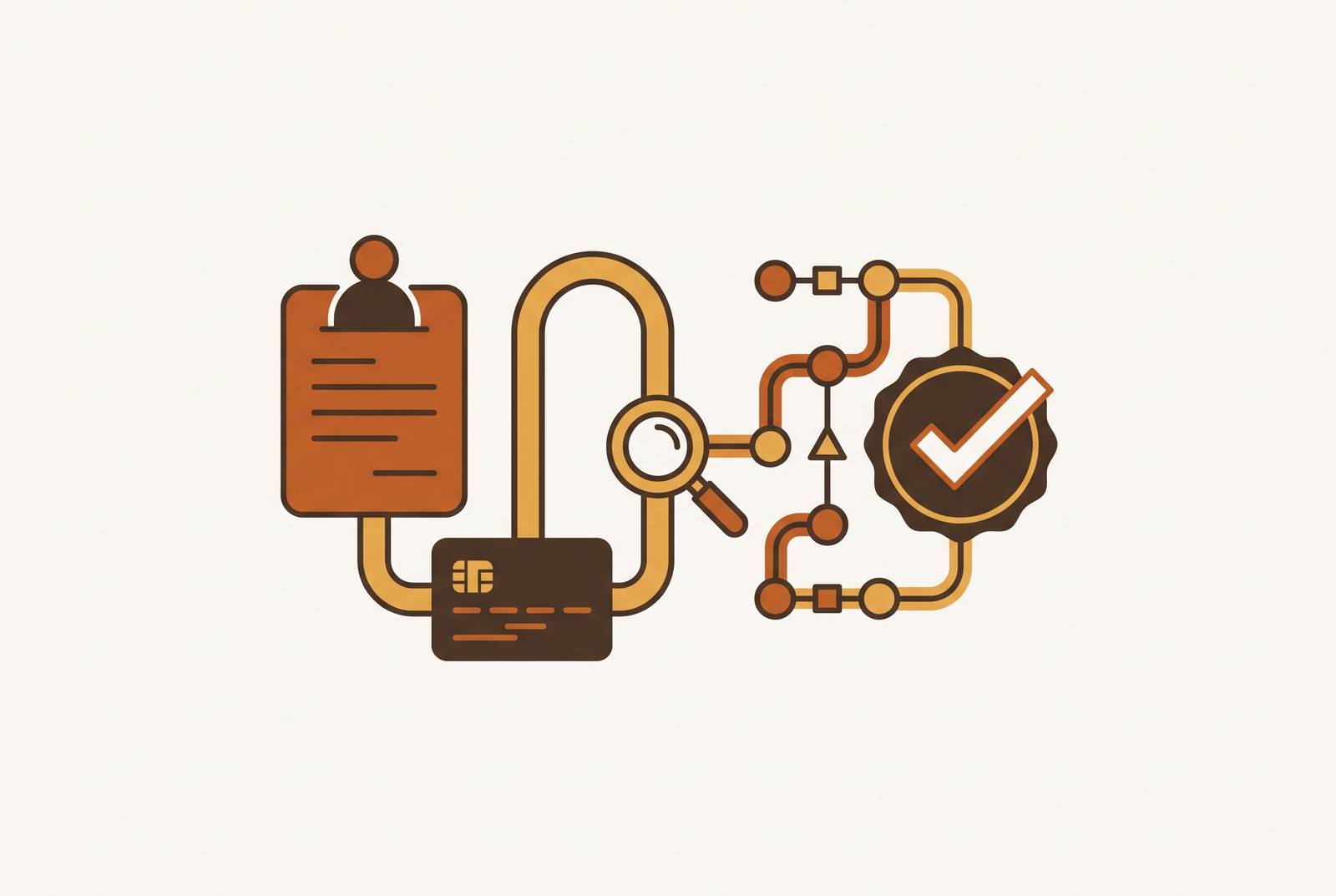
Benefits investigation is the point in the infusion patient journey where the biggest revenue risks get caught, or get locked in for good. By the time a claim goes out the door, most of the problems that come back to bite a practice, the wrong benefit bucket, a missing authorization, a drug billed under the wrong model, were already decided weeks earlier, at intake. A well-run in-office infusion workflow has seven steps: prescription receipt, benefits verification, drug procurement, patient scheduling and communication, infusion administration, physician oversight, and follow-up and monitoring. Benefits verification sits second, ahead of drug procurement, and that placement isn't an accident of habit. It reflects a basic fact about how infusion billing works: once the drug is bought and given to the patient, the financial decisions tied to that purchase can no longer be undone. What follows maps each step of that investigation and shows what breaks when a step gets skipped or done out of order.
What a complete benefits investigation must determine
A proper benefits investigation for an infusion patient answers at least five separate questions, and confirming the patient has active coverage is just the first one. Each of the other four carries its own set of consequences if it's missed, and together they decide how the entire encounter gets billed, scheduled, and paid.
Eligibility comes first: the patient must be covered, and that coverage must still be active on the date treatment is scheduled to happen. This sounds basic, but plans lapse, employers change carriers, and a verification done three weeks before the appointment can be stale by the time the patient sits down in the chair.
Which benefit pays for the drug, medical or pharmacy, determines how the whole claim gets built. Drugs covered under the medical benefit get billed as medical claims using J-codes, which is the standard path for buy-and-bill. Drugs that fall under the pharmacy benefit follow a completely different reimbursement and dispensing setup. Get this wrong, and the claim structure built around it is wrong from the start.
The third question is whether prior authorization is required, and if so, what clinical documentation this specific payer wants for this specific therapy. Payer requirements aren't uniform. A diagnosis code that satisfies one insurer's medical necessity criteria might not satisfy another's, and finding that out after the fact costs time the practice doesn't have.
The fourth question is what the patient will owe out of pocket: deductible status, coinsurance, whether the patient has already hit an out-of-pocket maximum. That answer should shape how the patient gets scheduled and whether a financial counseling conversation needs to happen before the appointment, not during it.
The fifth question is whether the payer requires white-bagging or specialty pharmacy dispensing for this drug, or whether buy-and-bill will be accepted. This is where benefits investigation overlaps directly with financial exposure, since the answer determines who buys the drug and who carries the risk if the claim doesn't pay.
The medical-versus-pharmacy determination and whether white-bagging applies are the two most consequential items on this list, and they're also the two most commonly rushed or skipped. High-performing intake teams treat benefits verification less like a coverage check and more like an audit of what this specific payer requires for this specific drug and this specific patient. Every one of these five questions changes what has to happen before the first appointment ever gets put on the calendar.
Mapping prior authorization requirements at the start of the intake workflow
Prior authorization is the biggest chokepoint in infusion intake, and treating it as something that happens after benefits verification instead of something that starts inside it makes the problem worse. Most infusion drugs require prior authorization, and that approval isn't permanent. Ongoing treatments need reauthorization tied to dosing cycles or updates on how the patient is responding clinically, so the PA lifecycle for a new patient starts at intake and simply doesn't stop.
This sequencing error produces real delay: a peer-reviewed cohort study found that prior authorization requirements are tied to a meaningfully longer wait before treatment starts, compared to patients who don't need one. For a patient on a scheduled biologic, that delay is a missed dose, a disrupted treatment protocol, and a hole in the schedule the practice can't easily fill with another patient on short notice.
The most common reason PA requests get delayed is incomplete or inconsistent documentation: missing clinical notes, diagnosis codes that don't line up with what the payer expects, or step-therapy requirements the patient hasn't yet satisfied. Nearly all of these gaps could have been caught and closed during benefits investigation, if someone had mapped the PA requirements at that stage instead of waiting to discover them when the submission bounces back.
A complete PA submission needs recent progress notes from the referring physician, lab results and treatment history that match this payer's medical necessity criteria, and step-therapy documentation if the payer requires it. None of that should be assembled under time pressure after a denial. It should be pulled together while there's still room to fix problems before they cost a patient their appointment.
Surveys of infusion providers show a large majority report that the prior authorization process has a negative effect on patient care. It reflects what happens when authorization work gets bolted onto the end of intake instead of built into the start of it. Managing authorizations costs a significant chunk of staff time, something in the range of a couple of full business days a week for the people handling it, and renewal reminders, documentation checklists, and payer communication protocols built after a problem surfaces add to that burden. Tying authorization status directly to the scheduling system, so that an appointment simply cannot get booked without approval in hand, turns a manual habit into a structural safeguard. Practices without that safeguard sometimes administer treatment before authorization is confirmed, and that usually ends in a claim that doesn't get paid.
Identifying the correct benefit and dispensing model before drug procurement as a financial control
Under buy-and-bill, the practice pays for the drug before a single claim goes out. Carrying that acquisition cost up front is why the benefit and dispensing model determination is a financial decision that has to happen before procurement.
In a buy-and-bill arrangement, the provider purchases the specialty drug directly, administers it to the patient, and bills the medical benefit using a J-code. Until reimbursement comes back, the practice is carrying that acquisition cost on its own books, with full exposure if anything goes wrong. And biologics aren't cheap. A single denied claim at this drug's typical cost, which can run into the tens of thousands of dollars per encounter, leaves the practice holding the full purchase price with no path to get it back.
The risk compounds if the payer turns out to require white-bagging instead of buy-and-bill. In that scenario, the payer's specialty pharmacy ships the drug directly, and the facility only bills for administering it. There's no drug claim at all under that model. If the practice already bought the drug expecting to bill it under buy-and-bill, that acquisition cost simply isn't recoverable. Figuring out which payers require which dispensing model for which drugs is a benefits investigation task, and it has to be answered before procurement, not discovered when the remittance comes back wrong.
This is the same sequencing principle from prior authorization, applied to money instead of time. Just as PA has to be resolved before the appointment is scheduled, the benefit bucket and dispensing model have to be resolved before the drug is ordered. Both are checks that only work if they happen early enough to change a decision that hasn't been made yet.
The benefit determination also sets up the billing codes that will apply later. Most infusion drugs bill under a HCPCS J-code, though biosimilars use a Q-code, blood products use a P-code, and hospital outpatient settings sometimes use C9399. Drug units have to be calculated as the administered dose divided by the J-code's unit size, and newly approved drugs that don't yet have an assigned J-code have to be billed with unlisted or NOC codes, J3490, J3590, or J9999. That NOC category draws automatic scrutiny from payers and demands a heavier documentation package to support the claim. Spotting a drug that falls into the NOC category at intake gives the team time to build that package properly. Finding out at charge entry does not.
Where benefits investigation breaks down
Benefits investigation failures aren't scattered at random. They cluster around a handful of predictable points, and each one sets up a specific downstream cost that only gets harder and more expensive to fix the later it's discovered.
Skipping or rushing the benefit bucket determination is the first failure point. A practice procures and administers a drug assuming buy-and-bill will apply, only to learn the payer routes it through the pharmacy benefit or requires white-bagging instead. The drug claim is denied, or it simply doesn't exist under the model that actually applies, and because procurement has already happened, that loss can't be recovered.
Confirming coverage while skipping the check on authorization requirements is the second failure point. The team sees active coverage, schedules the appointment, and either never obtains authorization or starts the process too late to finish it before the patient arrives. Administering treatment before authorization is confirmed usually ends in a claim that doesn't get paid at all, and roughly one in five infusion drug claims get denied specifically for missing prior authorization.
Incomplete documentation collection during intake is the third failure point. A PA submission goes out missing clinical notes or carrying diagnosis codes that don't match what the payer expects, and the payer responds with follow-up requests that stretch the approval timeline by weeks. The practice either delays treatment or administers on a pending authorization, absorbing the financial risk either way.
A wrong or missing J-code unit calculation that only gets caught at charge entry instead of at intake is the fourth failure point. A unit-count mistake on a high-dose biologic claim can produce a significant underpayment on that single encounter, and across a practice's weekly volume, repeated errors of this kind add up to a substantial loss over the course of a year.
Patient financial responsibility that never gets surfaced during intake is the fifth failure point. The patient shows up without any sense of what treatment will cost out of pocket, financial counseling has to happen at or after the infusion chair, and the practice ends up with a collections problem and a frustrated patient, both of which are far harder to resolve after the fact than they would have been in a conversation held before scheduling.
Every one of these five failures is recoverable if caught before the drug is procured and administered. None of them is fully recoverable once that line is crossed.
Structuring the benefits investigation workflow so each step gates the next
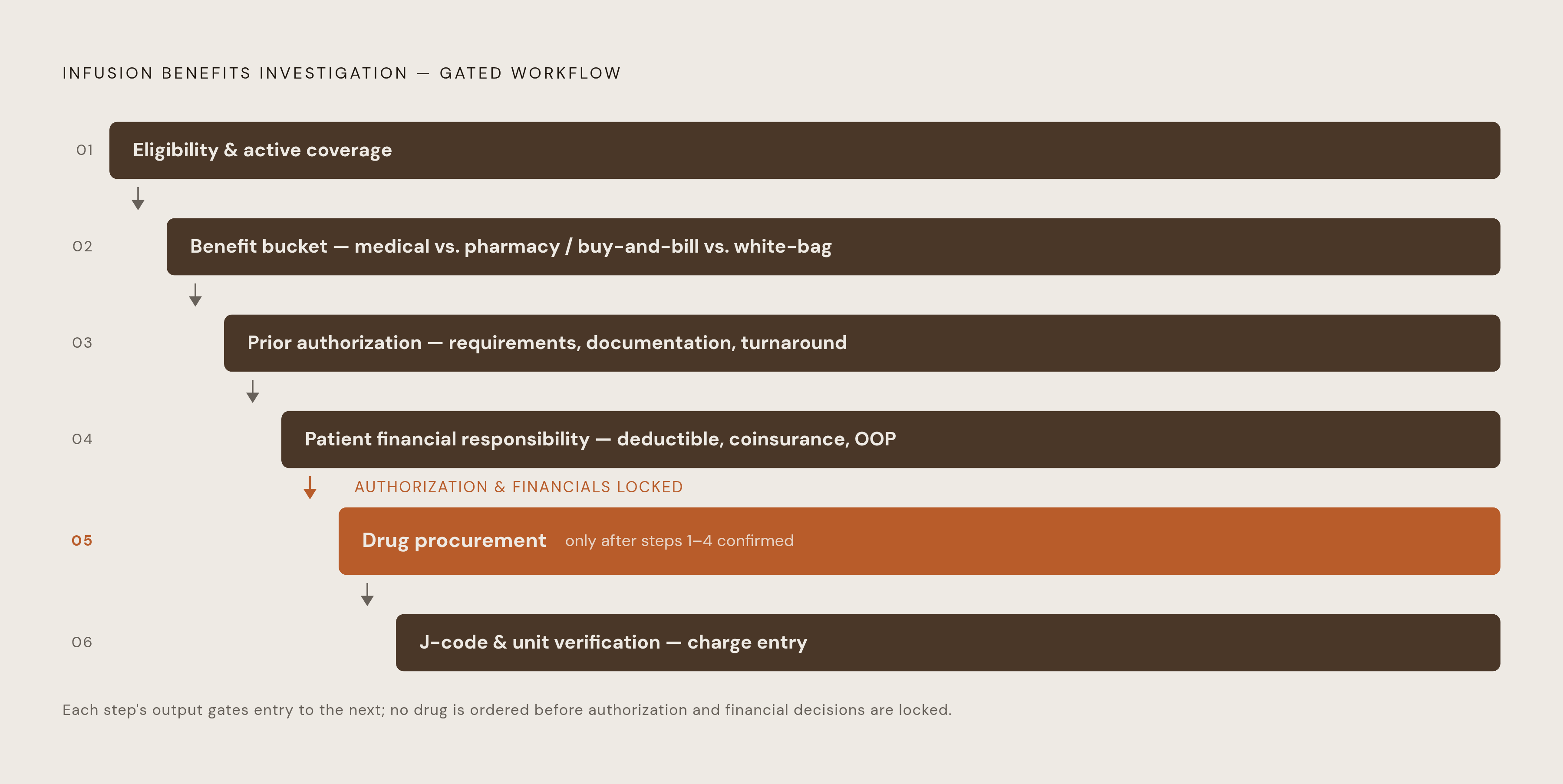
Preventing these failures means designing a workflow where each step's output is required before the next step can begin, with drug procurement placed at the end of that sequence.
The sequence starts with eligibility and active coverage confirmation, which establishes that the patient will be covered on the expected treatment date and gates everything that follows. From there, the workflow moves to the benefit bucket determination, medical versus pharmacy, and the dispensing model, buy-and-bill versus white-bagging, which decides the reimbursement pathway and whether the practice will be the one holding drug acquisition cost. That decision has to gate any procurement planning. Next comes mapping the prior authorization requirements: whether PA is needed, what clinical documentation this particular payer wants for this particular therapy, and what turnaround time to expect. That step gates the documentation collection that follows it. Patient financial responsibility gets determined next, surfacing deductible status, coinsurance, and out-of-pocket exposure so the patient gets an accurate cost estimate before the appointment is ever booked. Only after authorization is confirmed, or a clear bridge protocol is in place for cases where it isn't yet final, does drug procurement happen, making that the last gate before scheduling gets locked in. The final step is verifying the J-code and unit calculation at charge entry setup rather than waiting until billing, so that any drug falling into the NOC category gets flagged with its documentation package already built.
Linking authorization status directly to the scheduling system, so an appointment can't be confirmed until authorization is confirmed, turns this sequence from a set of good intentions into an actual structural control. The value of this kind of gated workflow comes from pairing software that enforces the order of operations with staff experienced enough to handle the judgment calls no system can automate on its own, like how to manage a payer-specific documentation gap or a bridge-therapy situation while an authorization is still pending.
The benefits investigation record as the foundation for the authorization lifecycle and AR management
The record built during benefits investigation doesn't stop mattering once the first infusion is given. It becomes the reference document every later revenue cycle function depends on, and a thin or incomplete record at intake means every function downstream is operating without the information it needs.
Authorization renewals for ongoing infusion treatment depend on knowing when the current authorization period runs out, what clinical evidence the payer will expect to approve a renewal, and what the dosing schedule looks like going forward, all of which should already be sitting in the intake record if the workflow was done completely. Denial management works better when a denial can be checked against what was already known at intake. If the record shows the PA was obtained and the documentation was complete, a denial citing lack of authorization is a payer error that can be appealed with the supporting paperwork already on hand, and that distinction matters given that RCM teams spend somewhere between 51 and 75 hours a week on denial-related work. Spotting an underpayment at the remittance stage depends on knowing what the contract rate should be for this drug, under this benefit, at this unit count, information that only exists because the benefit bucket and J-code were confirmed back at intake. Prioritizing accounts receivable for high-dollar infusion claims works better when the team handling aging accounts knows the authorization status, how this payer tends to adjudicate this therapy, and how much the drug cost to acquire in the first place, all of which the intake record should already capture. Payer rules shift often, and a practice that leans on outdated benefit determinations from a previous patient's case is exposing itself to authorization denials and dispensing-model mismatches that the current patient's intake should have caught.
Intake is the start of the revenue cycle itself, and the quality of the benefits investigation record sets the ceiling on everything that comes after it. Practices that treat this step as a revenue control function, not administrative paperwork, catch problems while they're still cheap to fix. Practices that treat it as a formality find out how expensive those same problems become once a drug has already been bought and given to a patient who's still waiting to find out what it's going to cost.