Eligibility Verification Timing and Frequency for Recurring Infusion Appointments
Coverage changes between infusion visits; single intake checks cannot catch them.

A patient confirmed active on Monday can have terminated coverage by Thursday, and a one-time intake check has no way to catch it. That's the structural failure at the center of infusion eligibility verification: coverage changes continuously between appointments, but most practices only check once, at intake or at the start of the plan year.
Why a single eligibility check at intake fails recurring infusion patients
Three distinct mechanisms drive mid-treatment coverage loss, and none of them announce themselves. An employer transition can terminate group coverage between one infusion appointment and the next, with no notice reaching the billing office. A Medicaid redetermination cycle can drop a patient who was active last month, often without the patient fully understanding why. And premium non-payment can end an individual market plan after a grace period, generally 31 days for most enrollees and up to 90 days for those receiving advance premium tax credits, if the premium goes unpaid.
Each of these can happen quietly, between visits, with no event that triggers a new check. A patient confirmed active on Monday can have terminated coverage by Thursday. That gap sits squarely inside the time most practices leave unchecked.
Infusion carries a kind of exposure that primary care doesn't. A denied claim on a high-cost biologic or specialty drug leaves the practice holding the acquisition cost of that drug with no reimbursement coming back. The dollar amount at risk on a single infusion visit can be enormous compared to a routine office visit, and the timing of eligibility checks matters more in this setting than in most other parts of medicine.
A Layered Verification Cadence for Recurring Patients
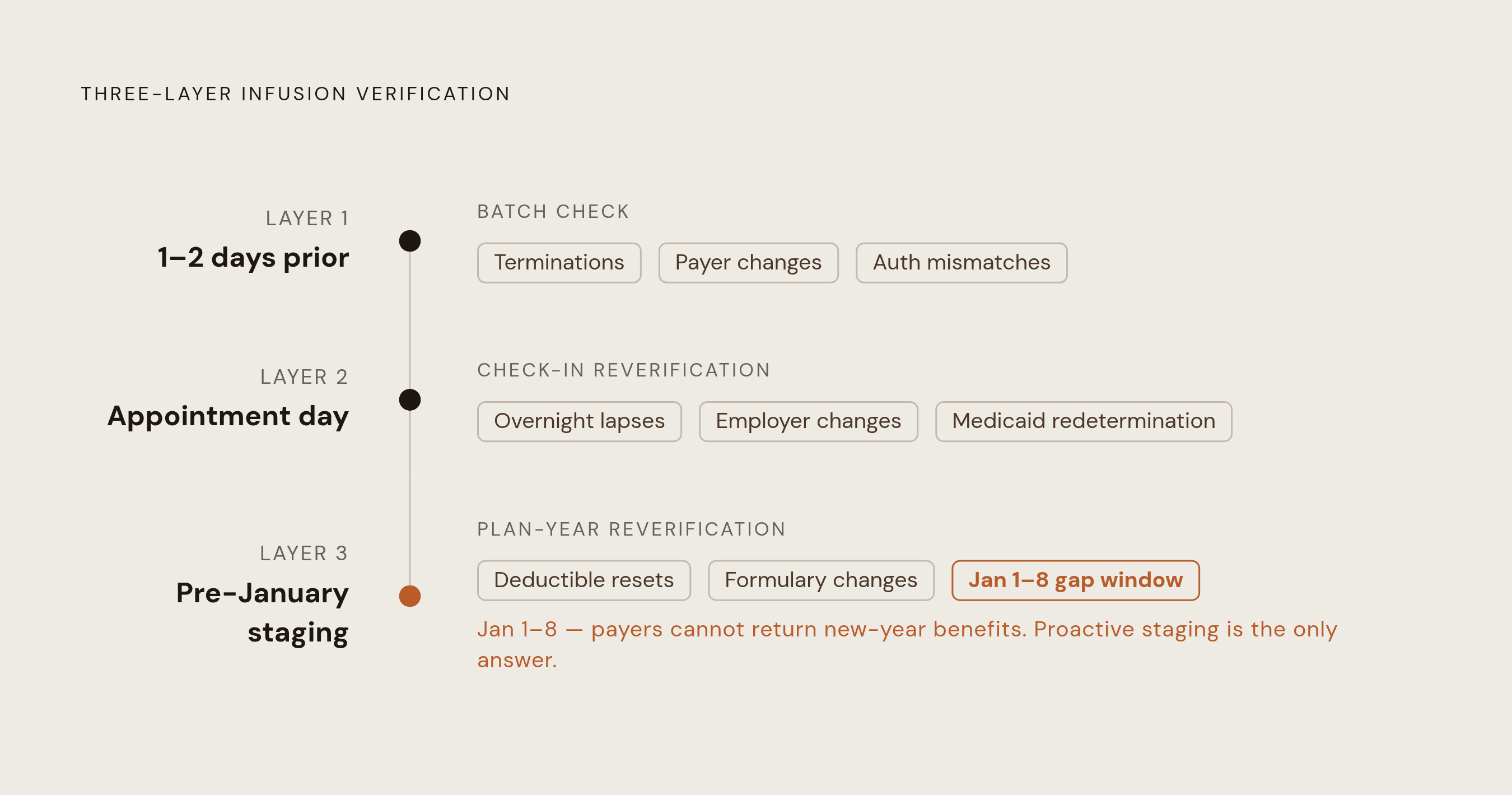
A continuously shifting coverage landscape calls for a cadence: three layers, each catching what the others can't.
The standard recommendation for recurring services runs on three layers, not one. A batch check runs ahead of the schedule. A real-time check runs at or near the appointment date. A dedicated re-check runs at plan-year boundaries. Each layer exists because the risk it catches has its own timing, and no single check can cover all three.
For infusion, each of these layers has to do more than confirm active or inactive status. The check needs to confirm specific service coverage for infusion administration itself, not just that the patient has a policy. It needs to confirm prior authorization requirements and the current status of any authorization already on file. It needs to confirm facility or site-of-care restrictions, since some plans only cover infusion in specific settings. And it needs to confirm the remaining deductible and out-of-pocket figures, which reset every year and shift with every claim that processes.
Authorization status and eligibility status are not the same thing, and one does not stand in for the other. A valid, unexpired authorization can be attached to a policy that has already lapsed. The two workflows have to run in parallel, continuously, rather than one being treated as proof that the other is fine.
The batch check window
Running a batch eligibility check a day or two ahead of scheduled appointments buys the practice time to act before the drug is ordered, before chair time is committed, and before the patient walks in the door. That lead time is the entire point: a coverage problem caught two days out is a phone call and a rescheduled visit. A coverage problem caught at check-in is a canceled infusion and an uncomfortable conversation.
At this stage, the check should flag a termination or lapse in coverage since the last appointment. It should flag plan or payer changes that affect billing, things like a new payer ID, a new plan type, or a coordination-of-benefits situation that changes who pays first. And it should flag authorization status relative to the upcoming visit, checking whether the visit count or expiration date on file still covers what's scheduled.
For recurring infusion patients specifically, the batch check is also where the practice can confirm the anticipated infusion date actually falls inside the authorization's approved window. Catching that mismatch two days before the appointment means rescheduling a visit. Catching it after the infusion has been given means fighting a denial on a claim that's already been submitted, for a drug that's already been administered.
The appointment-day check: why a clean batch result is not enough
A clean result from the batch check two days ago doesn't guarantee a clean result today. Coverage terminations tied to employer changes, premium lapses, or Medicaid redetermination can take effect overnight or over a weekend, and a check that ran 48 hours earlier cannot register those changes.
An eligibility check at scheduling confirms the policy is active for the date of service. A separate benefits verification step confirms what the plan actually pays. Both of those need to be current on the day of service itself, not just current as of the last batch run.
At check-in, the team should confirm the patient's subscriber ID, plan name, and payer routing haven't changed since the batch check ran. They should confirm no coordination-of-benefits flag has appeared that would shift which payer is primary. And they should confirm the day's infusion still falls within the authorization's approved visit count and date range. Appointment-day checks are built to catch last-minute lapses like these, but they weren't built to catch a different kind of disruption entirely: the one that happens when the plan year turns over.
Plan-year resets and the January verification gap that disrupts infusion schedules
The plan-year boundary is a different kind of problem than a mid-treatment lapse. Deductibles reset. Formularies change. Authorization requirements can change. In some cases, plan membership itself changes through open enrollment. All of it happens at once, for the entire patient panel, on the same calendar date.
Payers typically cannot provide benefits for the new calendar year until after the first week of January. That creates a gap window during which verification teams cannot reliably confirm coverage for infusions scheduled in early January, no matter how diligently they try to check. Practices administering recurring infusion treatments have to plan around that window directly: staging verifications for Q1 appointments to begin as soon as payers open their systems for the year, rather than running checks continuously straight through the holiday period and expecting results that simply aren't available yet.
The J&J withMe Annual Reverification process for REMICADE® and SIMPONI ARIA® shows what a structured version of this looks like at scale. The program's own documentation states that it will not be able to verify benefits for patients with infusions scheduled between January 1 and January 8, 2026, because payers typically cannot provide benefits for the new calendar year until after the first week of January. Eligible infusion dates for the 2026 Annual Reverification cycle run from January 9 through March 30, 2026, a window set specifically to begin after that payer gap closes.
The program also builds in a mechanism for payers known to be slow. Patients with payers historically slow to return benefits get a flag next to their name in the Annual Reverification tab before the process even starts. Once reverification begins, patients whose payers turn out to be hard to reach show a BI Case Status of "At Risk-Payer Issue," giving the practice a concrete signal to plan alternate action rather than finding out only when a claim comes back denied.
Plan-year reverification isn't a single blanket process that covers every drug a patient takes. STELARA® (ustekinumab) and Infliximab were both excluded from the 2026 Annual Reverification process and had to be reverified through the standard process instead. A practice managing patients across multiple infusion products can't assume one reverification mechanism covers all of them. Each product's reverification pathway has to be tracked on its own terms.
How prior authorization status interacts with eligibility re-verification
Eligibility and authorization are two separate records that have to stay in sync, and tracking one without the other leaves a real gap. For recurring infusion patients, authorization runs on its own expiration and reauthorization cycle, one that doesn't line up neatly with the plan year.
Authorizations expire on three possible triggers: a date, a visit count, or an approved unit volume, whichever limit gets hit first. A lapse in authorization is a different failure than a lapse in coverage, and a verification workflow has to track both, not assume that confirming one accounts for the other.
The regulatory timeline adds another layer of complexity here. The CMS Interoperability and Prior Authorization Final Rule (CMS-0057-F) requires impacted payers to implement certain provisions by January 1, 2026, including decision timeframes of seven calendar days for standard prior authorization requests and 72 hours for expedited ones. Those timeframes explicitly do not apply to drug prior authorization, and many infusion biologics fall under that category. Authorization for infusion biologics can follow separate, slower, payer-specific rules. The re-check window for infusion authorization tends to run longer and less predictably than it does for a facility or procedure authorization covered by the new CMS timelines.
Where eligibility lapses hide in the manual verification process
A practice can understand the three-layer cadence completely and still fail to execute it, if the underlying process depends on manual work. Manual eligibility verification takes real time per transaction, invites transcription error, and creates a bottleneck that discourages the kind of frequent re-checking recurring infusion patients actually require.
Manual verification means navigating payer portals, waiting on hold, and writing down benefit details by hand, a process that produces real bottlenecks and wears down staff over time through burnout and turnover. Two error modes recur in recurring infusion settings. A team that checks eligibility once at intake has no mechanism to flag a mid-treatment coverage change, because no re-check was ever scheduled. And a team running checks by hand cannot efficiently batch-verify an entire week's infusion schedule far enough in advance to act on what it finds.
Payer behavior makes the manual verification process harder. Some payers won't disclose benefits to third parties over recorded lines. Some have call volumes high enough to delay results for days. Some have a track record of simply not returning benefits information on time. None of this is a training problem, and no amount of staff diligence fixes it, because the constraint sits in the payer relationship itself. Practices have to flag and manage those accounts proactively, treating known slow payers as a distinct risk category, rather than discovering the problem only when a claim comes back denied.
Designing an eligibility verification workflow that keeps pace with recurring infusion schedules
A verification workflow built for recurring infusion has to run on a schedule, not wait for a trigger. It runs on a calendar driven by appointment dates and plan-year events, not by whoever happens to walk in and check in that day.
A few design elements make that cadence work in practice. A standing batch check runs a day or two before each scheduled infusion appointment, covering eligibility status, benefits detail, and authorization currency all at once, in a single pass. A same-day confirmation runs at check-in, catching last-minute lapses and payer changes that the advance batch couldn't see. A dedicated plan-year reverification workflow begins before payers open their new-year systems, stages patients by infusion date priority, and flags known slow-payer accounts ahead of time, before they are discovered mid-process. And a mid-authorization tracking process triggers reauthorization requests at least two weeks before expiration, running independently of the plan-year cycle.
An automated insurance eligibility verification platform built for this work pulls comprehensive benefit details, not just an active or inactive flag, and routes exceptions like coverage termination or coordination-of-benefits changes to staff for manual review. That division of labor concentrates human judgment on the cases that actually need it, instead of burning staff hours re-confirming routine cases that didn't change.
Infusion-specialized revenue cycle management is built around this exact operating requirement. Infusion billing begins at scheduling, meaning verification, authorization tracking, and benefits investigation have to function as front-end workflow disciplines. Structured this way, coverage problems are caught before the drug is ordered and before chair time is committed, rather than after a denial has already landed in accounts receivable.
A general-purpose RCM platform puts a practice at a real disadvantage here. Generic tools aren't built around the authorization and reimbursement demands specific to infusion, and the cadence described above requires product-specific benefits investigation, J-code-aware authorization tracking, and payer-level flagging that standard eligibility tools simply don't provide. Revenue cycle control in infusion starts at scheduling. By the time a claim reaches submission, every eligibility problem that could have been caught has already been decided, one way or the other.