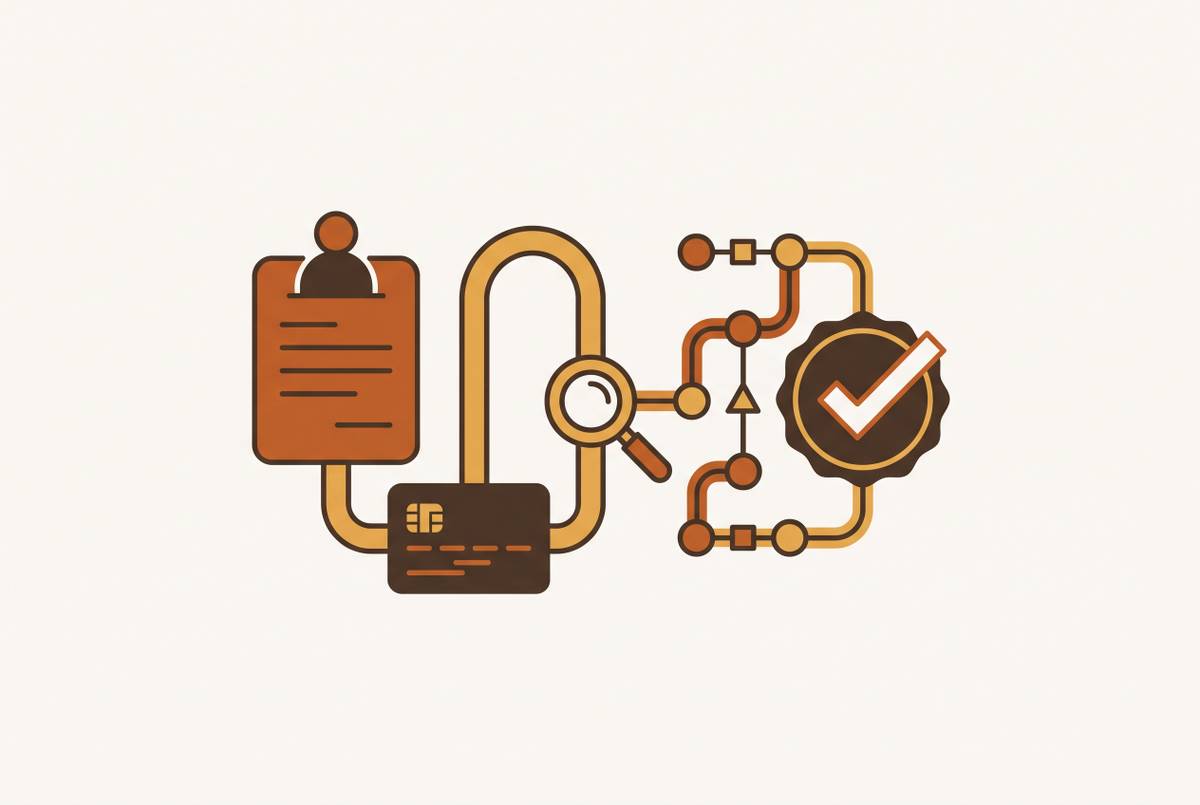
Specialty Pharmacy Versus Buy-and-Bill Determination at Intake
Getting the acquisition model wrong at intake locks in a drug-cost write-off.
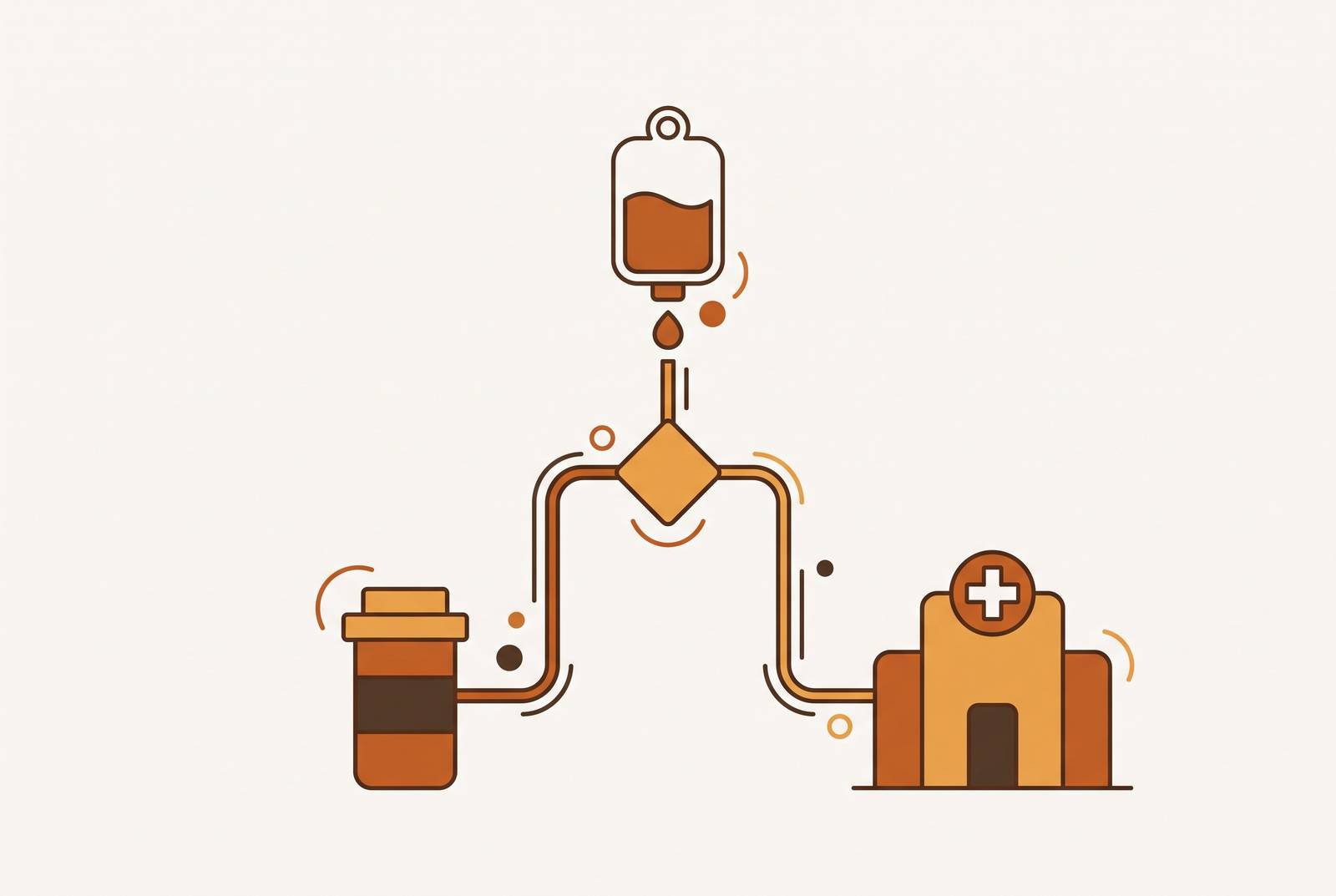
Buy-and-bill is not a billing preference. It is a structural fact set at intake, and the determination of whether a drug flows through buy-and-bill or a specialty pharmacy decides drug margin, prior authorization routing, and downstream claim accuracy. Get it wrong and the practice absorbs the full acquisition cost of a drug it cannot re-route. This article maps that determination, step by step, so infusion practices can build it correctly from the first patient contact.
What buy-and-bill actually is and what it requires operationally
Buy-and-bill is a drug acquisition and reimbursement model in which a practice purchases a specialty medication directly from a distributor, administers it to the patient, and submits a claim to the payer for both the drug and its administration. The payer reimburses the drug and the administration separately. This is the only pathway under which the practice captures drug margin.
The two alternatives sit in clear contrast. With white bagging, the drug goes through a specialty pharmacy, and that pharmacy bills drug reimbursement directly. Brown bagging, where the patient takes possession of the drug and brings it to the site of care, raises chain-of-custody and product integrity questions the administering practice cannot resolve.
Payer policy already treats these models as distinct. When a sourcing requirement exists, the drug must come from one of UnitedHealthcare's indicated specialty pharmacies, selected by the prescribing physician. When white bagging occurs for Medicare patients, it must be billed through Part D, not Part B, because pharmacies may not bill Part B for drugs furnished to a physician this way.
Why the benefit channel — medical versus pharmacy — is the first thing intake must establish
The benefit channel a drug flows through is not a billing choice. It is a structural fact set by the patient's plan design, and getting it wrong at intake sets a course toward the wrong authorization pathway, the wrong acquisition model, and a claim that cannot be corrected after the drug is administered. The same biologic can sometimes be covered under either the medical benefit, meaning buy-and-bill with a J-code, or the pharmacy benefit, meaning a specialty pharmacy with an NDC claim. Which one applies depends entirely on the patient's health plan.
You must resolve the benefit channel before a drug is ordered. Once a drug is purchased under buy-and-bill and administered, rerouting the claim to the pharmacy benefit is not possible. Ruby RCM embeds benefits verification into the intake workflow specifically to catch these channel determinations upfront, flagging sourcing requirements and preferred product policies before authorization is requested.
The stakes become concrete in payer policy. Intake must catch this step therapy trigger before authorization is requested. Active verification with the payer is required.
How payer sourcing requirements and preferred product policies override the practice's preferred acquisition model
Payers have built systematic mechanisms to redirect volume away from buy-and-bill and toward specialty pharmacy channels. Sourcing requirements, preferred product mandates, site-of-care reviews, and therapeutic equivalent exclusion lists all serve this purpose. Intake must identify which of these apply before a drug is ordered.
UnitedHealthcare's Specialty Guidance Program routes prior authorization for certain medical-benefit injectable medications through Optum. The PA pathway, the documentation requirements, and the turnaround rules are all determined by which program applies, and intake must identify this upfront. A related preferred product policy may require providers to prescribe clinically appropriate, lower-cost, self-administered medications available through the pharmacy benefit before covering infused medications through the medical benefit. This step therapy sequence must be satisfied or documented as contraindicated before a buy-and-bill PA will be approved.
The Medical Benefit Therapeutic Equivalent Medications (Excluded Drugs) policy excludes certain injectable medications outright when lower-cost alternatives exist. Site-of-care reviews add another filter. Even when a drug is eligible for buy-and-bill, the payer may require medical necessity documentation supporting the chosen site before authorizing infusion in an office or independent infusion center rather than at home.
These are not fringe payer behaviors. Intake teams need a systematic way to surface these payer-specific rules during patient scheduling, before the authorization request is even drafted. The revenue cycle control principle applies here: most recoverable intake failures have already seeded the billing problem by the time claims are submitted, and Ruby RCM structures its intake workflow around catching them before they propagate.
What buy-and-bill actually costs the practice if the intake determination is wrong
Because the practice buys the drug before it is reimbursed, a wrong intake determination turns a billing error into a drug-cost write-off. The practice absorbs the acquisition cost before it discovers the claim will be denied or underpaid. If you buy-and-bill, you purchase expensive specialty drugs upfront, often weeks before reimbursement arrives, and your cash exposure begins at the moment of acquisition, not at claim submission. If a claim is denied after the drug has been administered, because the wrong benefit channel was assumed, a sourcing requirement was missed, or PA was not obtained on the correct pathway, the practice absorbs the full acquisition cost with no reimbursement pathway remaining. If a payer pays less than acquisition cost, the practice loses money on every unit administered, and that risk compounds across a recurring infusion schedule.
Independent practices face this risk more acutely than hospital systems. 340B-eligible covered entities, including large health systems and safety-net hospitals, can buy below ASP and earn on both Medicare and commercial patients. Medicare Part B reimburses at ASP plus a statutory markup, which after sequestration lands meaningfully below the nominal rate. Commercial payer markups are higher but distributed very unevenly, and the practice cannot assume favorable spread without verifying the contracted rate for the specific drug and plan.
The financial asymmetry is directional. The risk is not symmetric, and it is not recoverable after administration. A single miscategorized patient or misrouted acquisition can eliminate that margin entirely and disrupt the prior authorization pathway, turning what should be straightforward reimbursement into a cash-flow problem that is nearly impossible to reverse.
Why the prior authorization pathway branches at intake based on the acquisition model
The prior authorization pathway for a buy-and-bill drug and the pathway for a white-bagged drug are structurally different. They involve different benefit channels, different clinical criteria, different turnaround timelines, and different consequences when they lapse. A wrong intake determination puts the practice on the wrong track before a single auth request is submitted.
Under buy-and-bill on the medical benefit, the practice submits the PA using J-codes and clinical documentation tied to the drug's medical benefit coverage policy. Under white bagging through the pharmacy benefit, the PA is submitted by or through the specialty pharmacy against the pharmacy benefit. The practice is not the billing entity for the drug, and its PA submission rights and obligations are different.
The divergence is not theoretical. UnitedHealthcare's Specialty Guidance Program routes certain injectable drug PAs through Optum with its own clinical criteria and intake process. If intake did not flag this requirement, the authorization request arrives incomplete and is denied or returned.
PA approvals for recurring infusion therapies have defined authorization windows. When the wrong acquisition model is assumed at intake, the authorization may be approved for a drug or source the practice cannot actually use, requiring re-authorization under the correct model and adding weeks of delay to treatment start. The intake determination is the prerequisite step that makes pre-treatment PA possible.
The intake determination checklist: what must be resolved before a drug is ordered
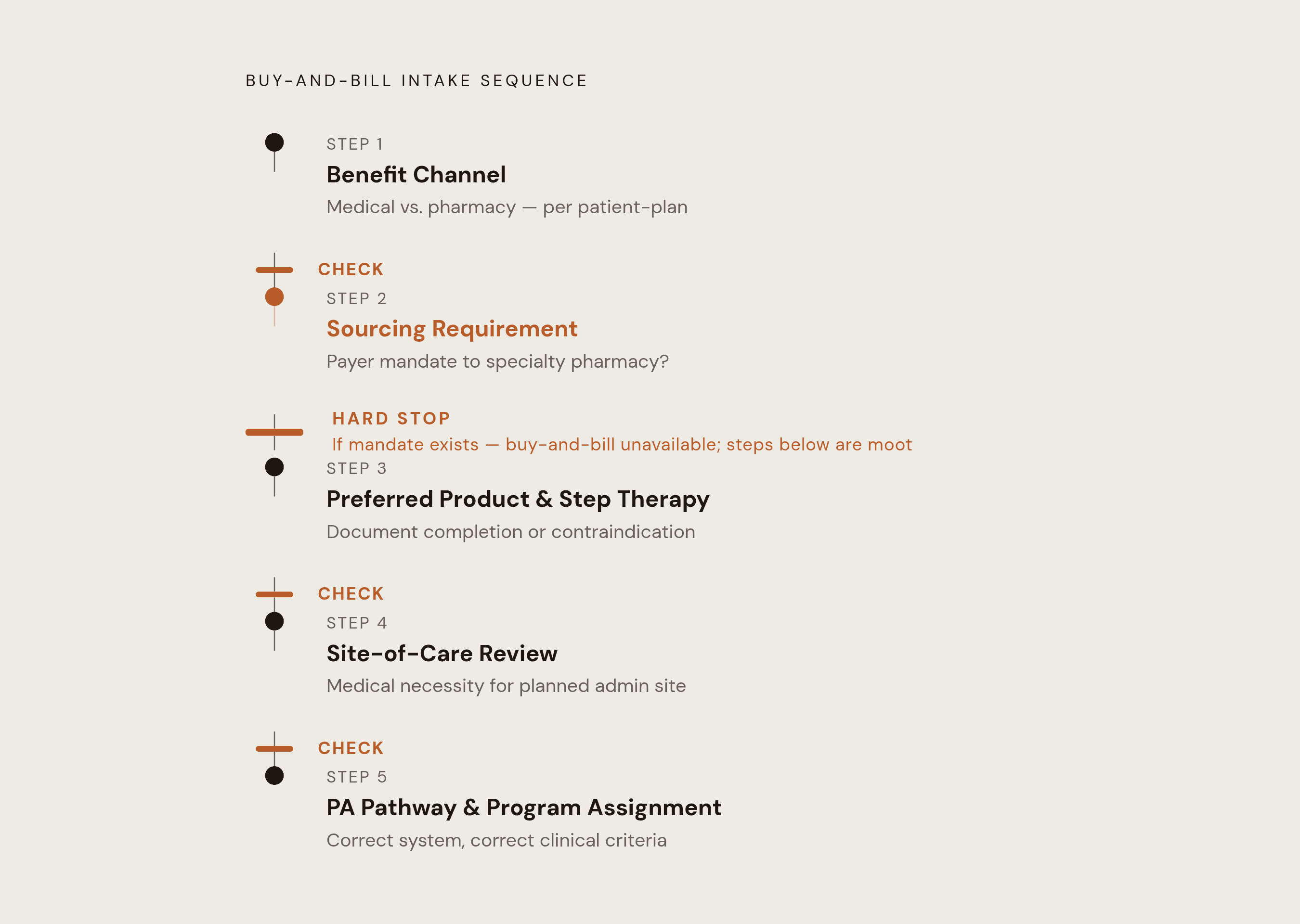
A reliable intake determination requires five sequential checks, and each one must be resolved before the next is meaningful. Skipping or reordering them is how practices end up on the wrong acquisition model with an authorization they cannot use. Check one is the benefit channel. Intake must verify whether the prescribed drug is covered under the patient's medical benefit, pharmacy benefit, or both, and confirm which channel the patient's specific plan routes infused biologics through. Active benefits verification, not reliance on plan documents alone, is required to confirm channel assignment for the specific patient and plan.
Check two is the sourcing requirement. Intake must determine whether the payer has a sourcing or medication sourcing requirement that mandates the drug come from a designated specialty pharmacy. If yes, buy-and-bill is not available for this patient-drug-plan combination. UnitedHealthcare's sourcing requirement policy is a concrete example of how payers publish these lists, and intake staff must know where to find the equivalent list for each payer they work with.
Check three is the preferred product and step therapy requirement. Intake must identify whether the payer requires a lower-cost preferred product, including a self-administered pharmacy-benefit alternative, before it will authorize the prescribed drug. Failure to document step therapy completion is one of the most common reasons a PA for a buy-and-bill biologic is denied on first submission.
Check four is site-of-care review. Intake must determine whether the payer requires site-of-care medical necessity documentation for the planned administration site, whether that is an office, an independent infusion center, or home. If yes, that documentation must be gathered and attached before submitting the PA.
Check five is the PA pathway and program assignment. Intake must confirm which prior authorization pathway applies for this drug-payer combination, whether that is a standard medical benefit PA, a specialty guidance program, a specialty pharmacy PA, or an exemption, and submit through the correct system with the correct clinical criteria package. For a recurring infusion patient, that delay is a care disruption, not just an administrative inconvenience.
How the determination at intake connects to J-code billing accuracy downstream
Once buy-and-bill is confirmed as the correct acquisition model, the intake record must capture the specific drug, dose, and NDC that will be billed. J-code billing arithmetic is unforgiving, and the inputs that drive it must be locked at intake, not reconstructed at claim submission. Most infusion drugs billed under buy-and-bill use a HCPCS J-code. NDC reporting in the standardized 11-digit format is required by Medicaid and many commercial payers but is generally not required on Medicare Part B claims unless the patient is dually eligible. Incorrect NDC conversion creates an electronic rejection before pricing validation occurs.
The arithmetic compounds the risk. Drug units must be calculated as the administered dose divided by the J-code unit size. If no linkage exists, pricing validation fails and reimbursement may be denied, though the local MAC may still process the claim by determining the payment limit independently.
The buy-and-bill claim covers both the drug, through the J-code with NDC, and administration, through CPT codes. If the drug identity, dose, and benefit channel are captured correctly at intake, billing has the inputs it needs. If they are not, billing staff are reconstructing facts after the fact under time pressure, which is where systematic errors originate.
Where the intake determination breaks down in practice and what to build instead
Most intake determination failures are not random errors. They follow predictable patterns tied to how intake is staffed, sequenced, and handed off, and the practices that get this right have deliberately designed intake as a revenue cycle function, not a scheduling function. The most common failure is treating the benefit channel and sourcing determination as a task for front-desk scheduling staff rather than a structured benefits investigation performed by staff who understand medical versus pharmacy benefit distinctions and payer-specific sourcing policies. A second failure mode is submitting the PA before the sourcing and step therapy checks are complete. This puts the practice on a PA pathway that will be denied or require resubmission, adding weeks to treatment start and sometimes losing the patient to another site of care.
A third failure mode is treating each patient visit independently rather than tracking the authorization status across a recurring infusion cycle. Independent infusion practices are most exposed to these failures because they often lack the specialized staffing that hospital outpatient departments deploy for the same function. They need a process that compensates for smaller teams.
The fix is structural. Intake must be sequenced so that benefit channel confirmation, sourcing check, and step therapy documentation are completed before the PA is submitted, and the PA submission is completed before the drug is ordered. By the time a claim is submitted, a wrong intake determination has already become a loss that billing cannot recover.
Ruby RCM is built for this operating model. As an infusion-specialized revenue cycle management platform, it structures the intake determination as a formal pre-authorization workflow that sequences benefits verification, sourcing and step therapy checks, and PA submission before drug acquisition. That distinction matters because the determination at intake, made correctly, is the difference between captured drug margin and an unrecoverable write-off.