Breaking the Recurring Denial Cycle With Payer-Specific Infusion Claim Pattern Libraries
Payer-specific claim pattern libraries stop recurring denials by fixing upstream process defects.
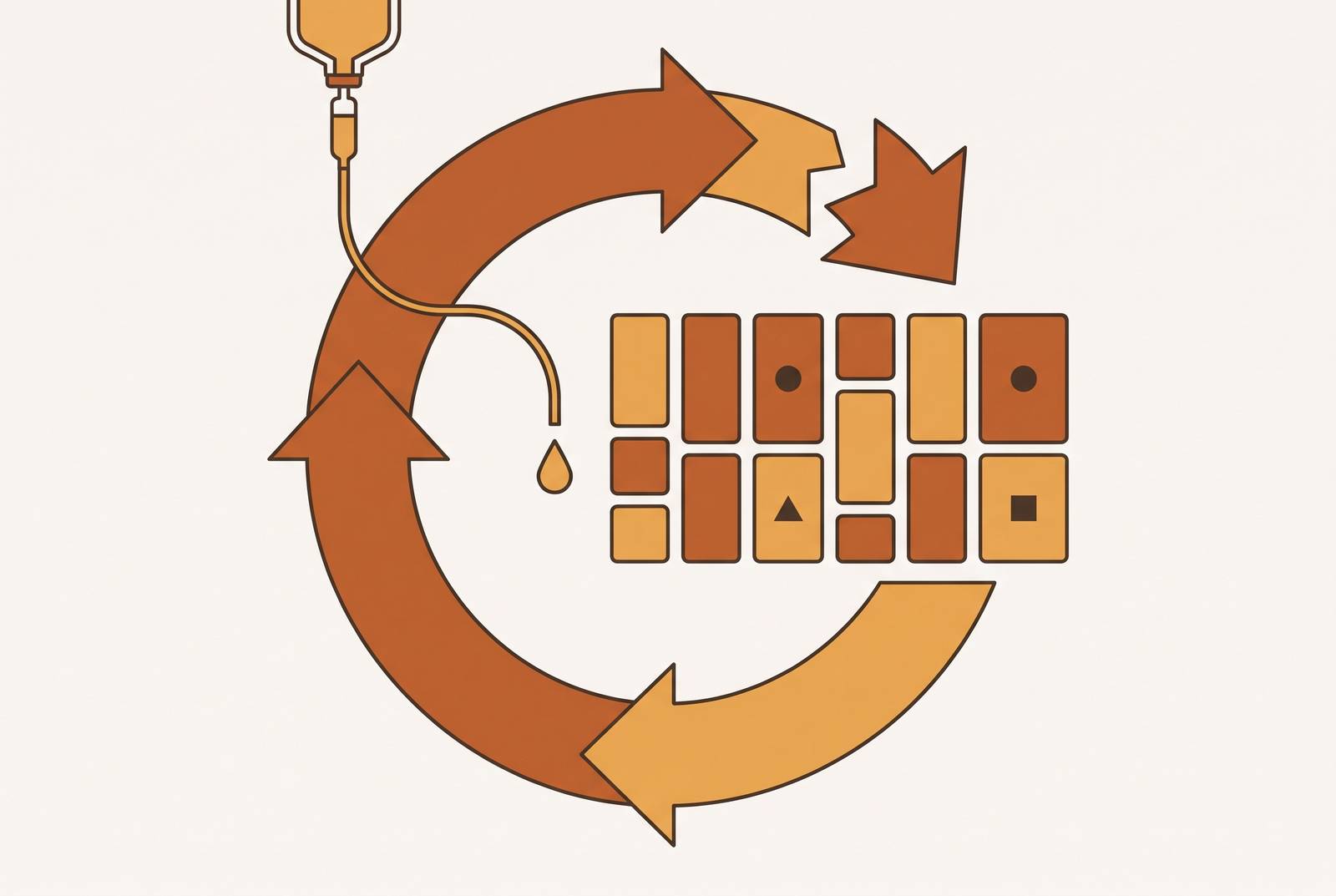
Infusion denial management and underpayment recovery work best when teams look beyond a broad denial category to the payer rule and the failure in the process behind each claim. Payer-specific claim pattern libraries use those findings to set up checks at authorization, charge capture, and submission. To break the recurring denial cycle, teams need to fix defects upstream so they stop appealing claims built with the same defects.
Why infusion denial patterns in 2026 are structural, not random
Payer rules move faster than most billing operations can track them. Claim constructions that paid last year can now fail systematically as utilization management requirements, medical necessity criteria, and payer rules change. Most billing operations still scrub claims against rule sets that are updated quarterly or less often. The mismatch is structural.
Infusion billing gives that mismatch several places to surface. A single encounter may involve four or five CPT codes, hierarchy sequencing, a J-code unit calculation, an NDC, and modifier selections. Each of these can trigger a different payment rule. Denial rates for high-value categories, including specialty drugs, are 18 to 20% higher than those for routine E/M claims. In the 2026 environment, a billing team needs a way to turn changing payer behavior into working claim checks, rather than waiting for each change to appear in the appeal queue.
The specific claim-level failure points that generate recurring infusion denials
Hierarchy failures often happen when the right code is used but its relationship to another service is wrong. Payers assess documented start and stop times, initial-versus-subsequent selection, and sequential-versus-concurrent services. Missing times undermine time-based billing and can lead to downcoding or denial. Mislabeling concurrent and sequential services can collapse billable units. Hydration billed as the primary service when a drug infusion occurred in the same visit violates CPT hierarchy rules and typically results in denial or bundling, although separately documented sequential hydration with independent medical necessity may be billable as a secondary service.
J-code failures begin with the dose-to-unit calculation. Drug units must equal the administered dose divided by the J-code unit size, so errors can creep in with dose adjustments, vial splits, and point-of-care rounding. The error can repeat with every encounter. Iron infusion codes alone include J1756, J1439, J2916, J1750, and J1437, with unit sizes ranging from 1 mg to 50 mg. Undercoding creates systematic underpayment, while overcoding creates overpayment liability and audit exposure.
NDC and modifier failures break a different set of checks. A missing or mismatched NDC, quantity, or unit of measure can make the drug line fail payer validation. A missing JW modifier when waste exists can cause underbilling or audit disputes, while some payers reject claims missing JZ when nothing was discarded. Modifier 59 overuse or underuse can cause bundling denials and audit exposure, and some payers require the more specific alternatives XE, XS, XP, or XU.
Authorization mismatches arise when billed CPT/HCPCS codes, units, or service dates do not match the approval. Medical necessity failures happen when the clinical record does not show that the submitted service meets that payer’s criteria. Payers now use NLP to compare clinical notes with codes before human review, making vague necessity language or a missing comorbidity a denial trigger for high-value infusion categories. The library should therefore record the exact mismatch or missing evidence along with the denial label.
How authorization lifecycle failures seed denials before a claim is ever submitted
For recurring infusion treatments, authorization is not finished at intake. Renewals tied to dosing cycles or clinical response updates make it an ongoing responsibility. Even a short re-authorization delay can disrupt scheduling and prevent clean submission. The process can also stall while teams wait for data from the referring physician.
The CMS Interoperability and Prior Authorization Final Rule, CMS-0057-F, generally requires impacted payers to implement its operational provisions beginning in 2026, including defined decision timeframes for standard and expedited requests and specific reasons for denied authorizations. Those reasons provide useful evidence for correction or appeal. The rule also requires annual aggregated authorization metrics, including approval rates, denial rates, turnaround times, and appeal outcomes. The first report covers calendar year 2025 and is due by March 31, 2026. It does not establish a data-field-level authorization-to-claim matching mechanism or an automatic denial for place-of-service mismatches.
Track authorization through the treatment course. Best practice requires verifying that billed CPT/HCPCS codes, units, and service dates match the authorization exactly, and submitting a new authorization when treatment changes. Renewal timing belongs in the same workflow. Because payers deny re-authorizations at different cycle points and for different stated reasons, the library needs entries by payer, drug class, and authorization stage. A library that begins at claim submission misses the upstream process failure that made the claim unpayable.
What a payer-specific claim pattern library actually contains and why payer-level granularity is the key design choice
A claim pattern library is a knowledge base organized to link failures that keep happening to payer-specific triggers, claim signatures, and prevention rules. It is not a denial report. Each entry records the denial category and CARC/RARC combination, the payer and line of business, and the precise condition that triggered the denial. That condition might be a CPT pair, modifier, J-code calculation, or a piece of documentation that is missing. The entry also records authorization context, including whether approval existed, expired, or no longer matched the treatment.
The resolution path belongs in the same entry. It identifies the documentation, modifier change, or unit correction that reversed the denial and distinguishes an appeal remedy from an upstream change. The prevention rule then names the check that should intercept the pattern before another submission. For authorization patterns, the entry also needs to show the stage in the cycle, including initial authorization, re-authorization, and mid-cycle modification. These fields make the entry usable at the point where staff can still prevent the failure.
A CO-97 bundling denial from UHC’s ClaimCheck can have a different cause and resolution path from CO-97 issued by a regional commercial plan. Grouping both under “bundling” conceals the distinction needed to choose the correction. The library also differs from a claims scrubber, which applies known edits at submission. The library records what those edits missed and feeds the findings back into the rules, making it a working billing standard.
Building the library — how to extract patterns from historical denial data
For billing leaders building this capability, the starting point is segmentation by payer and line of business. Medicare Advantage, commercial, and Medicaid claims can produce different denial distributions for the same drug and CPT. Mixing them obscures the signal before analysis begins. Within each segment, CARC/RARC combinations provide the next grouping, rather than broad categories such as medical necessity or bundling. The code combination starts the investigation but does not establish the cause.
The next step is to cross-reference each cluster against the claim lines. They look for the recurring CPT pair, J-code, modifier, and authorization status. Repetition is the test for a pattern. When the same claim signature produces the same denial across multiple encounters with the same payer, the team can map it to a process origin. That origin may be hierarchy sequencing, a documentation gap, a drug-unit calculation, or an authorization mismatch, and it determines where the prevention check belongs.
For each overturned pattern, the entry should capture the documentation or modifier correction that led to reversal. That evidence serves two purposes. It supplies a template for future appeals and supports the proposed prevention rule. Centralized appeals tracking, with common-code templates, specialty-drug documentation checklists, and a single place to record outcomes, helps distinguish patterns that are winnable on appeal from those requiring upstream prevention.
Drug-category segmentation sets the financial priority for this work. Separating high-dollar biologics from routine infusions in accounts receivable and denial data puts the highest-revenue patterns first. A biologics J-code denial warrants different financial weighting from a hydration bundling edit. The process repeats as each new denial either adds frequency and resolution evidence to an existing entry or prompts investigation of a new claim signature and its cause.
How do infusion billing teams reduce denials before submission rather than at appeal?
Repeated appeals are a tax on a broken process. A library reduces that burden only when its entries become checks in the workflows that create claims. Those checks run through authorization, charge capture, and pre-submission scrubbing in that order. That sequence also explains why a scrubber alone cannot do the whole job. By submission, many preventable failures have already been seeded in scheduling, treatment approval, or documentation.
At authorization, payer-specific patterns become a checklist before a treatment cycle begins. The checks confirm coverage for the correct CPT, modifier, units, and place of service under that payer’s requirements, while flagging re-authorization windows before they lapse. This is an operational control outside the scope of CMS-mandated matching mechanisms. Payer-published authorization metrics provide further context about denial rates and turnaround times. They help teams decide where to spend more time on authorization review, while the library’s own entries show which failure to prevent.
At charge capture, hierarchy, modifier, and documentation patterns become prompts tied to the encounter. Missing stop times or required waste modifiers can then be caught before claim construction. Pre-submission scrubbing provides the final check in this sequence. Payer-specific bundling logic, such as the UHC ClaimCheck pairs added mid-2026, becomes a custom edit applied before the claim reaches adjudication. The logic works whether the library sits in a spreadsheet, a purpose-built tool, or a specialized RCM platform.
For denied-claim recovery, the same entry directs staff to the payer-specific correction and supporting evidence. For underpayment recovery, an identified J-code unit error points to the calculation that needs correction rather than treating the shortfall as an unexplained payment problem. Appeal rates, overturn rates, and first-pass acceptance show whether the checks based on that record are working. If the appeal queue is not shrinking, the prevention rules may not be reaching the workflow stage where the failures begin.
What it takes operationally to maintain a pattern library across a changing payer landscape
A library needs an owner who tracks payer changes and updates the entries they affect. NCCI tables change mid-year, ClaimCheck pairs update without public notice, and medical policies for specific biologics revise quarterly. A static library will become obsolete too. Monitoring is therefore part of the prevention mechanism. Published changes can inform updates before claims fail, while new denial patterns reveal logic not yet captured in the library.
Automation handles known rules at scale, but operators must interpret unfamiliar payer behavior. An uncodified logic change requires an analyst to recognize the recurring signature and translate it into a prevention rule. Payer-specific expertise is essential to that judgment. Infusion-specialized support is needed to distinguish the resolution paths of two claims that received CO-97.
For decision-makers choosing an internal team or specialized partner, the operating criteria are concrete. The capability needs data infrastructure for pattern tracking, pre-submission scrubbing, and experienced operators who understand infusion payer rules. Software alone cannot supply the missing judgment. Teams should review denials by payer and drug class at set intervals and look into new patterns within a set time. Before deployment, prevention rules should be tested against a sample of recent clean claims so that a fix for one pattern does not obstruct valid billing.
A well-maintained library measures prevention by the share of historically recurring denial patterns that now produce clean first-pass claims, tracked by payer and drug class. Good infusion billing operations make this a standing responsibility, with ownership, review, and rule testing built into the revenue cycle.