Pre-Submission Claim Edits That Prevent Infusion Denials
Catching infusion coding errors before submission prevents denials.
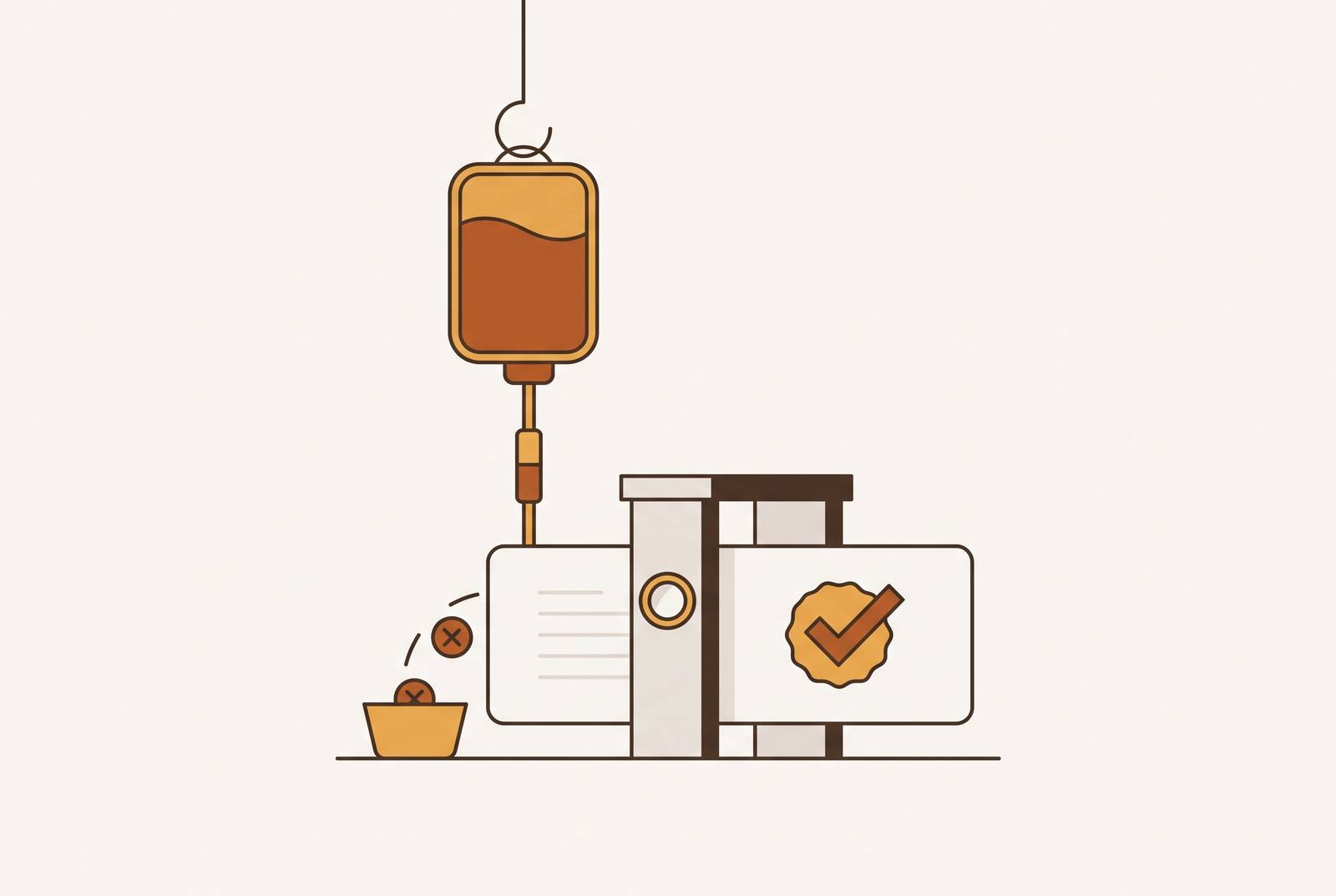
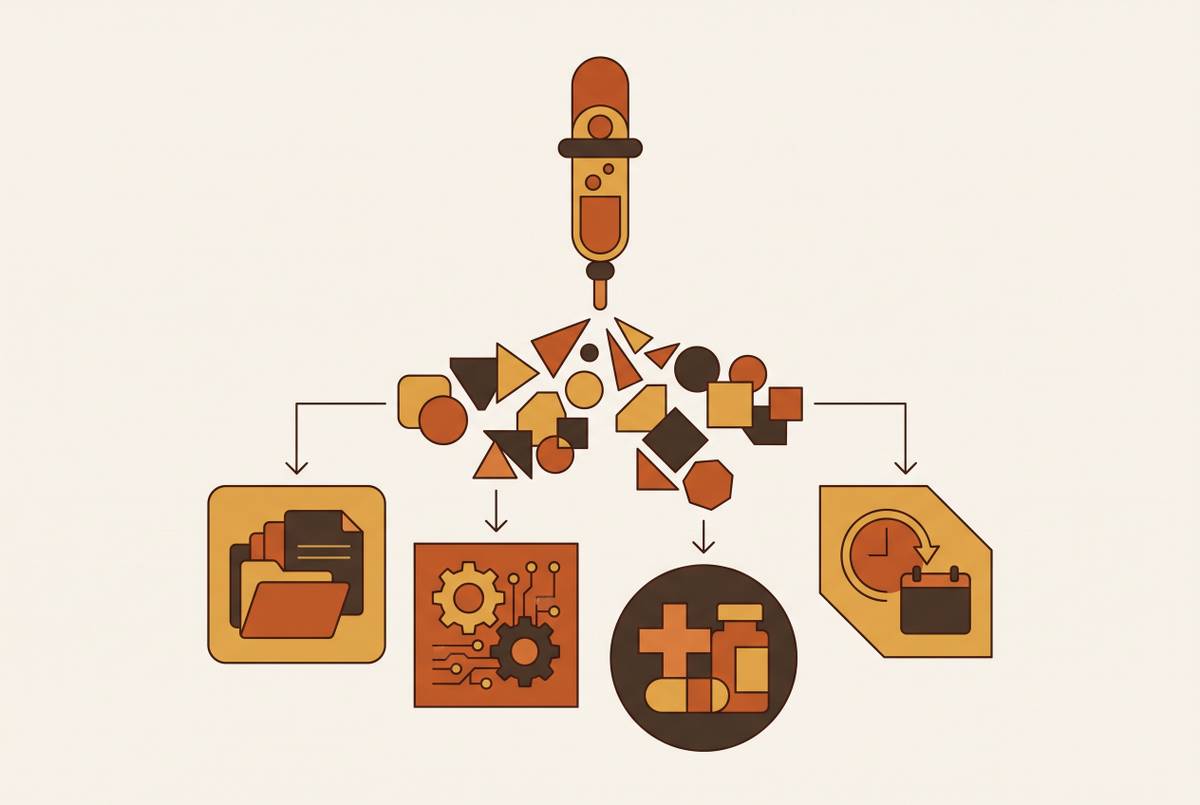
Preventing infusion denials takes a category of pre-submission claim edits that most general billing teams never build, covering CPT hierarchy sequencing, modifier integrity, drug unit accuracy, authorization alignment, and documentation completeness. Infusion coding errors are structural, and that distinction changes how a practice has to approach the whole billing workflow.
A standard outpatient claim rarely asks this much of a coder. Infusion billing does. A single encounter can require four or five CPT codes, a J-code drug line with unit-level precision, modifier assignments, and authorization alignment, and all of it has to cohere before the claim ever leaves the building. Missing one piece exposes the whole claim.
Most billing teams still treat infusion claims like every other outpatient claim moving through the queue. That's the root problem. The errors that follow aren't random noise, they follow predictable patterns tied to hierarchy, units, modifiers, and documentation, which means they're preventable if someone builds the edit logic to catch them. Denial rates remain high nationwide, and most of those denials are avoidable, yet practices keep discovering the mistakes after submission, when a correction is slow and expensive to chase down. Pre-Submission Claim Edits That Prevent Infusion Denials.
The pressure is not letting up either. Prior authorization denials rose to around 31% in 2026, and much of that growth traces back to high-complexity specialty infusion and biologics, exactly the claims with the most moving parts Your 2026 Medical Coding Made Easy Guide for Denial Prevention and Au…. Payer scrutiny at the claim level is intensifying, so the practices still relying on after-the-fact correction are fighting a current that's getting stronger every quarter Your 2026 Medical Coding Made Easy Guide for Denial Prevention and Au….
Pre-submission edit logic built specifically for infusion claims is the only stage in the workflow where these structural errors are still fully recoverable. Once a claim reaches the payer, the practice is negotiating from a weaker position, appealing instead of preventing.
CPT hierarchy sequencing determines payment and bundling of services
CMS and most commercial payers require infusion services to be sequenced in a specific priority order, and the primary service in that sequence determines how every other code on the claim gets adjudicated. Chemotherapy infusion sits at the top of that hierarchy and takes priority over everything else on the claim, with non-chemotherapy therapeutic drug infusion below it, and hydration at the bottom. Get that order wrong, and the claim doesn't just lose a line item, it triggers a bundling denial even when every service listed was legitimately provided.
The core IV infusion codes carry specific structural roles that only make sense in relation to each other. Code 96365 covers the initial hour of an IV infusion and functions as the primary code for a therapeutic drug, while 96366 is an add-on for each additional hour, with its maximum unit count set entirely by documented time. Code 96367 applies to an additional sequential infusion of a different drug, administered after the primary infusion has ended, while 96368 covers a concurrent infusion of a different drug running at the same time, capped at once per day. Hydration has its own pair of codes, 96360 for the initial 31 minutes to one hour and 96361 as the add-on for each additional hour, but 96360 cannot be billed as a concurrent infusion alongside a therapeutic drug, and it only becomes separately billable when it runs at a clinically distinct time or through a separate IV access point 2026 Proven CMS Infusion Billing Guidelines to Prevent Loss.
Chemotherapy carries its own separate set of codes built around the same logic. Codes 96413 and 96415 cover the initial hour and each additional hour of a chemo infusion, 96417 covers each additional sequential chemo infusion, 96409 and 96411 cover a chemo IV push (single or additional substance), and 96401 covers a chemo injection given subcutaneously or intramuscularly.
The sequencing error a pre-submission edit has to catch above all others is hydration coded as the primary service when a drug infusion happened in the same visit, because payers will deny that hydration line automatically. A second, related error occurs whenever chemotherapy is administered: the chemo code has to be primary regardless of which bag actually went up first in the treatment room, since the clinical order of events doesn't override the billing hierarchy. Every claim carrying multiple infusion service lines needs a check confirming that the highest-priority service is coded as initial, with everything below it coded as an add-on, sequential, or concurrent service rather than as an independent primary code. Getting that hierarchy check right is what stands between a clean claim and a CO-97 bundling denial, the kind that shows up specifically when hydration following a chemotherapy infusion gets billed separately under current NCCI edits.
Time documentation as a billing control: start/stop times and the thresholds that determine which add-on codes are billable
The billing clock on an infusion starts the moment the infusion actually begins, not when the nurse hangs the bag, and documentation has to capture start and stop times for every drug or fluid given during the encounter. That distinction sounds small. It isn't, because every add-on code downstream depends on it.
The threshold rules are exact, and they leave no room for rounding in the practice's favor. The initial code, 96365, covers the first hour of infusion, and each 96366 add-on unit requires at least 30 additional minutes beyond the hour that precedes it. A 90-minute infusion supports 96365 plus one unit of 96366, but a 70-minute infusion only supports the initial code, because the 30-minute threshold for the add-on hasn't been met. Anything under 15 minutes doesn't bill as an infusion at all, it bills as a push under 96374 or 96375.
One missing stop time is enough to flip a high-value encounter into edits, denials, and weeks of appeals; the record fails to prove the billable structure behind the claim, and that failure, not any lapse in care, is what triggers the denial. The payer isn't disputing that the patient got treated, it's disputing that the paperwork proves what was billed. Current CMS guidance mandates accurate documentation of infusion start and stop times on every claim, which makes this an explicit compliance requirement now, not a best practice a practice can choose to skip.
The pre-submission edit has to confirm start and stop times exist for every drug or fluid line on the encounter, then calculate total infusion minutes and check that number against the add-on units actually coded. Any claim where the documented time is in that 15 to 30 minute range at the edge of a threshold deserves a flag, since that boundary zone produces the most common miscodes. The edit also needs to confirm that anything short enough to qualify as a push gets coded as one, not force-fit into an infusion code it doesn't meet. rcmaxis.com presents the threshold rules that drive add-on code eligibility as time documentation serving as a billing control through start/stop times.
Modifier integrity: the assignments that distinguish legitimate multi-service claims from NCCI edit targets
Infusion billing has been called a modifier battlefield, and that's not an exaggeration: missing or misusing a modifier can trigger an NCCI edit, push a claim into manual review, or produce a CO-4 denial for a missing or incorrect modifier. A handful of modifiers do most of the damage when they're wrong.
Modifier 59 overrides an NCCI bundling edit when two codes are legitimately separate services performed the same day, and modifier 25 covers a significant, separately identifiable E/M service delivered alongside a procedure on that same day, though misuse of 25 is one of the most frequent audit triggers in the entire claim. Then there's the drug wastage pair: modifier JW marks a discarded, unadministered amount from a single-dose vial, and modifier JZ certifies that nothing was wasted at all, with some payers requiring one or the other on every single drug claim.
The wastage modifiers carry real financial weight. Without JW, a practice simply can't capture reimbursement for drug that was drawn up but never administered from a single-dose vial. On expensive biologics, discarded drug can represent hundreds or even thousands of dollars per encounter, so getting this modifier right or wrong moves real money. Applying JW when it doesn't belong invites an audit; applying neither modifier when the payer requires one gets the claim denied outright. CMS has made JW mandatory since 2017 and JZ mandatory since July 1, 2023, for discarded drugs from single-dose containers that are separately payable under Medicare Part B, and both denials and overpayment risk are explicit, named consequences of skipping them. Modifier misuse, alongside unbundling and diagnosis-procedure mismatches, ranks among the most common coding errors driving claim denials industry-wide.
The edit logic that catches this before submission is straightforward to describe, even if it takes discipline to run consistently. Every drug line needs a wastage modifier, JW or JZ, and any line missing both gets flagged. Modifier 59 needs to be present whenever two codes sharing an NCCI edit pair are billed together for services that are genuinely distinct. Modifier 25 needs a second look on any claim where the clinical notes don't clearly separate the E/M service from the infusion encounter itself.
J-code unit accuracy and NDC validation: the origin and cost of drug claim errors
More than 14% of outpatient claim denials that used J-codes in early 2025 traced back to erroneous billing units.
Undercoding units, often from rounding or a mid-treatment dose adjustment, produces a quiet, systematic underpayment that compounds across every high-volume drug line in the practice. Overcoding units flips that risk entirely, creating overpayment liability and exposure to an OIG audit.
Unit redundancy occurs when CPT administration units are multiplied based on the drug milligrams billed under the J-code, when CPT codes are meant to track time or access points, not drug volume at all. Biologic therapies like infliximab, billed under J1745, and other monoclonal antibodies carry a high per-unit cost, so improper unit reporting on these drugs can trigger both a payment recovery action and OIG audit activity at once.
NDC numbers add another layer most billing teams underweight. Most payers require an NDC on every drug line, and missing NDCs alone cause thousands of dollars in denied drug claims every month, which makes a simple presence check, pulling recent infusion claims and verifying that every drug line carries a J-code with units, an NDC, and the correct modifier, one of the highest-value edits a practice can run.
The code set itself keeps shifting underneath practices that aren't watching closely. The 2026 HCPCS update added 160 new codes and deleted 101 from the Level II list, and any practice that hasn't updated its billing system against that list is exposed to systemic underpayment or, worse, a compliance audit tied to overpayment recoupment Your 2026 Medical Coding Made Easy Guide for Denial Prevention and Au…. For most Part B drugs, Medicare pays based on average sales price plus 6%, updated quarterly, and CMS continues to refine how that ASP data gets collected and audited, so any discrepancy in billing these medications can mean a delayed claim or a retrospective adjustment months later.
The edit logic here has four distinct checks, and none of them are optional. Verify that the J-code unit count matches the actual administered dose converted into the code's billing unit, not the dose that was ordered and not the vial size. Confirm the CPT administration code matches the route of administration the J-code implies. Confirm an NDC is present on every drug line. Validate every J-code against the current HCPCS file and flag any deleted code still sitting active in the billing system. Every injectable or infusible drug has one or more J-codes assigned by CMS, the J-code identifies the drug, the number of units identifies the dose, and most J-codes are defined per a specific measurement unit (per mg, per 10mg, per 100mg, or per vial), the research brief states. CPT + J-code pairing failures create a separate category of error, the research brief states.
Authorization alignment at the claim level: catching mismatches before the claim reaches adjudication
Nearly every infusion drug requires prior authorization, and that authorization is drug-specific, not service-specific: an approval on file for rituximab does not cover infliximab, even if both drugs are being infused in the same chair on the same protocol. That specificity is where a lot of claims quietly go wrong.
The common failure looks like this: a physician switches a patient to a different biologic mid-treatment cycle without securing a new authorization for it. The claim goes out with the administration code and J-code for the new drug, but the authorization number sitting on file still belongs to the prior one. CO-15, a missing or invalid prior authorization, ranks among the top denial codes in the industry, and the same failure pattern occurs when a chemotherapy infusion is completed after a previously approved authorization has already expired. The administrative burden that produces this is well documented, with 91% of infusion providers reporting negative effects on patient care from the authorization process itself, but the billing consequence is the sharper point: an administered drug without a valid authorization on file is a claim that will not pay, no matter how correct the coding is everywhere else Infusion Therapy Billing 2026: CPT Codes, Hierarchies & Denial Preven….
The alignment checks that belong in a pre-submission edit are specific and narrow by design. Confirm an active authorization exists for the exact J-code being billed. Confirm that authorization covers the actual date of service, and confirm the authorized number of units or visits hasn't already been exhausted by prior claims in the same treatment cycle. Flag any claim where the J-code being billed doesn't match the drug named on the authorization, and flag any claim where the authorization number is simply absent from the file. None of these checks are complicated on their own. Run together, before the claim ever reaches the payer, they close off the exact gap where a clinically sound infusion turns into an unpaid one.
Sources
- Your 2026 Medical Coding Made Easy Guide for Denial Prevention and Audit Protection
- Infusion Therapy Billing 2026: CPT Codes, Hierarchies & Denial Prevention
- 2026 Proven CMS Infusion Billing Guidelines to Prevent Loss
- Drug & Infusion Billing Errors in 2026: J-Codes, Modifiers & ASP-NDC Mismatches - 24/7 Medical Billing Services