RCM Platform Integration Requirements for Infusion EMR and Specialty Pharmacy Workflows
Infusion billing requires three data streams converging before claims are submitted.

An infusion-only RCM platform for buy-and-bill practices must connect clinical documentation, pharmacy dispensing, authorization, and payment data. This article maps those integration requirements and explains why a generic billing connection is not enough. The deciding test is whether the platform receives the right data before treatment, translates it correctly into claims, and checks payment against what the practice is owed.
Why infusion billing integration is not a generic data-pipe problem
General ambulatory billing usually centers on the medical benefit and a claim largely contained within the EHR encounter. Infusion billing crosses more boundaries. A single encounter can involve medical coverage, the Part B drug benefit, buy-and-bill acquisition, and specialty pharmacy supply. Billing that encounter depends on events originating in systems the RCM platform does not control. Moving a patient record between systems is therefore not the same as transferring everything needed to collect payment.
In buy-and-bill, the practice purchases the drug before submitting the claim, so a missing pharmacy record can put that purchase at risk. A denied or underpaid claim is not simply delayed payment for staff time and services. It can leave the practice unable to get back what it paid for the drug. The RCM platform gets records after treatment and dispensing, so missing data in those records can put the drug’s cost at risk in a way that ordinary primary care billing does not.
How clinical events in the infusion EMR seed billing outcomes before a claim is ever submitted
Infusion time documentation shapes selection of the primary infusion code, sequential add-on codes, and push codes. Concurrent infusion coding is different. Noridian Medicare states that concurrent infusion services are not time-based and are reported once per encounter regardless of duration. When the nurse’s administration log and the data transmitted by the EMR disagree, the resulting claim can under-bill or trigger an NCCI edit.
Dose documentation creates a separate calculation risk. The RCM system must distinguish the administered dose from the ordered dose and divide the administered dose by the J-code unit size. Mid-treatment adjustments, doses split across vials, and rounding at the chair make that distinction important. Diagnosis coding also links the clinical record to payment because the encounter diagnosis determines J-code eligibility and whether authorization criteria are met. A mismatch between that diagnosis and the authorization can produce a medical necessity denial before billing staff have made any independent error.
InfuseFlow, an ambulatory infusion-specific EMR, illustrates how billing-critical information can sit within the clinical workflow. It surfaces live eligibility and prior-auth status, together with real-time allergy and interaction monitoring. When authorization status, dose, and protocol are in the clinician’s view, discrepancies are less likely to be left for billing staff to reconcile later. That example describes a handoff design.
What the RCM platform must receive from the EMR at each stage of the infusion encounter
At scheduling, the RCM platform needs the appointment event, patient demographics, insurance, planned drug, diagnosis, and expected dose. The appointment must trigger eligibility and benefit verification rather than wait for billing staff to begin the process after treatment. Timing is part of the integration requirement. The drug and anticipated dose give the authorization workflow what it needs before the treatment date. If the diagnosis changes later, that update must also reach the RCM system so the claim does not drift away from the authorization.
Before treatment, authorization status must flow back to the clinical team as approved, pending, or denied. Visibility only in the billing system is insufficient. The clinical team needs that status before the patient occupies the infusion chair. Step-therapy evidence, clinical criteria, and documentation supporting medical necessity must also be accessible to the RCM platform. Otherwise, an appeal requires staff to reconstruct evidence that was already assembled during authorization.
At encounter close, the platform needs the administered dose, its unit of measure, discrete start and stop times for each drug, NDC, lot number, waste, and any therapy changes. Ordered dose is not an acceptable substitute. The dose must be in a form the system can use for J-code unit conversion, and separate time fields must allow administration-code sequencing without staff having to work out the times from nursing notes. Waste documentation must show how much unused drug was drawn but not administered, because leaving out waste affects unit counts and the risk of audit findings.
The record after the encounter must also have the dispense-specific 340B designation from pharmacy data so the system can apply the modifier. These fields need to arrive as structured data. When dose, time, or drug identifiers arrive as free text, are missing, or use the wrong unit, billing staff face an avoidable choice. They can correct the record manually, adding labor and error risk, or submit a claim built on bad data and risk denial or underpayment.
How specialty pharmacy systems create a parallel data dependency for buy-and-bill and specialty-dispensed infusions

The EMR cannot supply the full drug record by itself. For buy-and-bill, the RCM platform must reconcile what the pharmacy dispensed, what the clinician administered, and what the claim reports. That is a three-way match. When pharmacy and clinical systems work separately without a shared feed into RCM, the billing platform does not have the data it needs to match those records. An integrated specialty pharmacy and infusion center can still have this problem if each uses a separate system.
Acquisition cost adds another pharmacy dependency. Medicare Part B reimburses most physician-administered drugs at ASP plus a fixed percentage, with CMS recalculating rates quarterly. The practice’s margin depends on the spread between its purchase cost and the applicable reimbursement rate. Without actual acquisition cost and lot-specific NDC from the pharmacy system, the RCM platform cannot flag claims whose reimbursement has fallen below the purchase cost. That loss can remain hidden even when a claim is paid.
The pharmacy also assesses a specific dispense’s 340B eligibility. That designation belongs to the dispense event. CMS discontinued JG effective January 1, 2025, making TB the sole 340B identifier, so the claim workflow needs current modifier logic as well as the pharmacy’s designation. Limited-distribution drugs come through restricted-network supply, so dispensing and shipment must also be confirmed before treatment. The RCM platform needs the confirmed dispense event to establish that the drug described on the claim was received by the practice or patient.
Why prior authorization is the highest-stakes integration point between clinical, pharmacy, and RCM systems
Authorization is where the clinical and pharmacy handoffs converge. If a biologic is administered after authorization expires, without approval for a changed dose, or without pre-appointment verification, the resulting denial puts the full acquisition cost at risk. The authorization record in the system must cover the treatment planned for that patient. This returns the workflow to scheduling. The appointment, expected dose, drug, and diagnosis provide the starting data for financial clearance before treatment.
Recurring therapy makes authorization a continuing requirement. The RCM platform must track expiration dates against the treatment schedule and trigger renewal before a gap occurs. Step-therapy requirements may also call for interim clinical evidence during treatment, which must reach the authorization workflow from the EMR. Changes to the dose, diagnosis, therapy, and site-of-care need to reach the system as structured data so it can check whether the approval still covers the encounter. A clinical update that never reaches the authorization record creates a silent coverage gap.
Regulatory changes could reduce some renewal work. The NAIC’s December 2025 white paper includes consideration for potential future action of authorizations lasting at least one year irrespective of dose changes, and lasting for the duration of treatment for chronic conditions. Even if broadly adopted, longer validity periods would not remove the need to share current authorization data. For authorization to be part of clinical work before treatment, intake, clinical staff, authorization teams, and billing need to work from near-real-time information.
What happens downstream when these integrations fail — denial patterns that trace back to data gaps
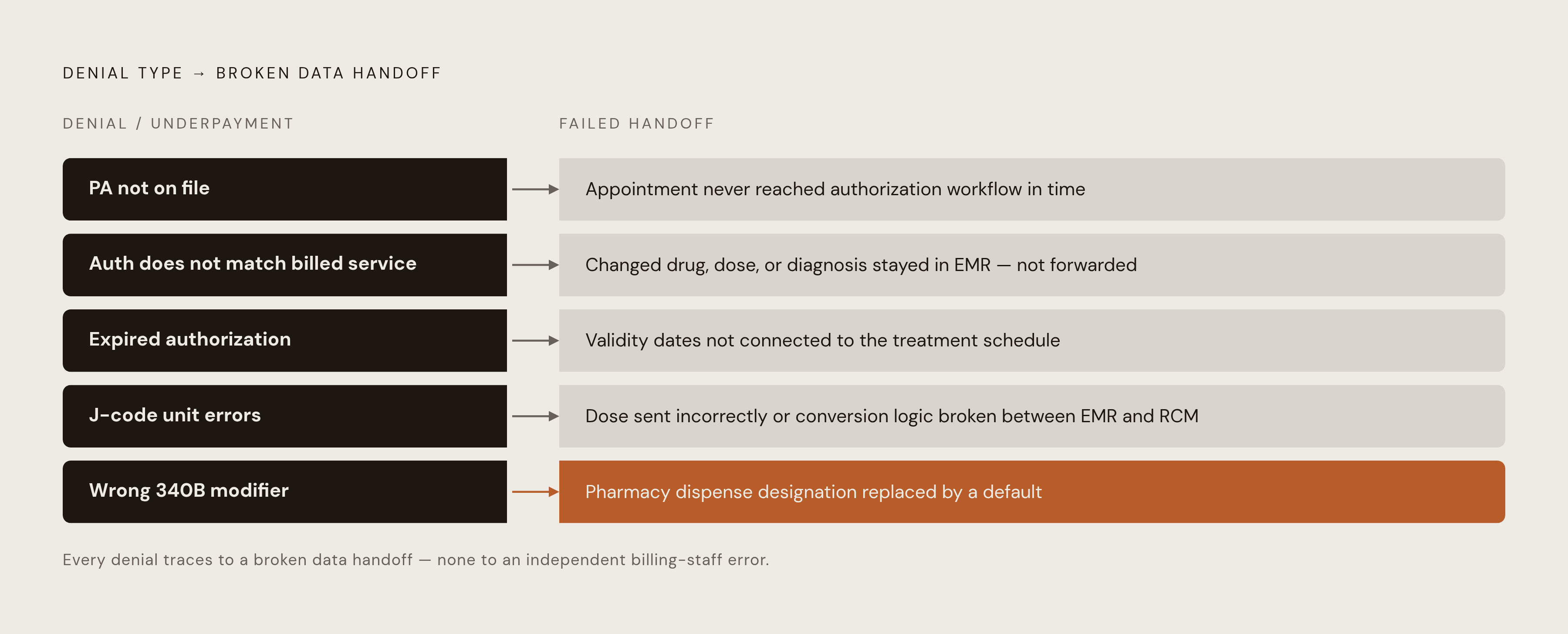
Authorization denials can identify where a handoff broke. “PA not on file” can trace back to an appointment that never reached the authorization workflow in time. An authorization that does not match the billed service can point to a changed drug, dose, or diagnosis that stayed in the EMR. An expired authorization can indicate that validity dates were not connected to the treatment schedule.
Coding and unit denials identify different boundaries. A group of J-code unit errors points to how the dose is sent or how conversion logic works between the EMR and RCM platform. Missing or wrong NDCs point to the pharmacy feed, especially when staff have to enter identifiers by hand. Wrong 340B modifiers can show that a default took the place of the pharmacy’s dispense-specific designation.
Administration-code problems require a look at time documentation. Narrative notes instead of separate start and stop fields can prevent correct sequential and concurrent code assignment, leading to NCCI edits or under-coding. Billing needs structured encounter information to apply the right hierarchy. Organizations that perform well use these patterns to check how well their systems share data. Correcting one claim may recover one payment, while leaving the failed handoff in place exposes later encounters to the same error.
How underpayments from remittance data create a third integration requirement that most platforms overlook
A paid claim can still be wrong. Underpayment occurs when the payer pays below the contracted amount, and it can remain invisible without line-level reconciliation. One infusion encounter may have a J-code drug line, administration CPT lines, and add-on codes, each with its own rate. The payer may partially pay some lines, bundle others, or apply different fee schedules to drugs and administration. Checking only the claim total cannot reliably show which line was paid wrong.
The systems need to share line-level ERA/835 remittance data. The RCM platform must check each payment line against a contracted-rate reference kept up to date for the payer and drug. That reference needs to keep up with quarterly ASP changes. A rate that supported the correct payment in Q1 may not support the correct payment in Q3. The comparison also needs the administered units from the clinical record reconciled with pharmacy drug identifiers, so staff can detect whether the payer reduced the unit count.
Most general-purpose platforms are not built for this J-code and unit-level comparison. Receiving a remittance is not enough. The system must compare what was paid with what was expected for each line, using the rate for that period and keeping the reference up to date. If an underpayment goes unnoticed until the corrected-claim or appeal deadline passes, it becomes a permanent write-off. It never has to appear in the denial queue to cost the practice revenue.
What to look for in an infusion-only RCM platform for buy-and-bill practices
Operators evaluating a platform should test actual handoffs. The first EMR checks are whether administered dose comes through as a numeric field and whether J-code conversion happens automatically. Separate start and stop times per drug are another test, as is authorization visibility for clinicians before treatment. Manual nursing-note interpretation is not equivalent to structured integration. Neither is an authorization status that only billing staff can see after the encounter.
The pharmacy test is whether NDC, lot number, acquisition cost, and 340B designation arrive at the dispense level. Evaluation should also establish whether the platform can flag reimbursement below acquisition cost after an ASP update. Authorization requires its own scrutiny. The platform must connect expiration dates to scheduled treatment, trigger renewal workflows, and propagate clinical changes without depending on staff to send a separate notification.
The remittance test should check whether ERA/835 reconciliation compares each J-code line with current contracted rates as well as checking the claim total. A maintained ASP reference is part of that test. If staff convert dose units, search another portal for authorization, or compare payments with contracts in spreadsheets, they are doing work that the integration still leaves to them. The right operating model combines structured data handling with experienced people who can judge authorization exceptions and interpret denial patterns that rules engines cannot fully automate.